Meet Dilla: Mobile Bay Estuary Program’s Sewage-Sniffing Dog Saved Fairhope $166,000, Officials Say
The Mobile Bay National Estuary Program continues to train Dilla, a wastewater detection dog whose work on Fairhope's sewage investigations saved the city about $166,000 and three years, according to the program.
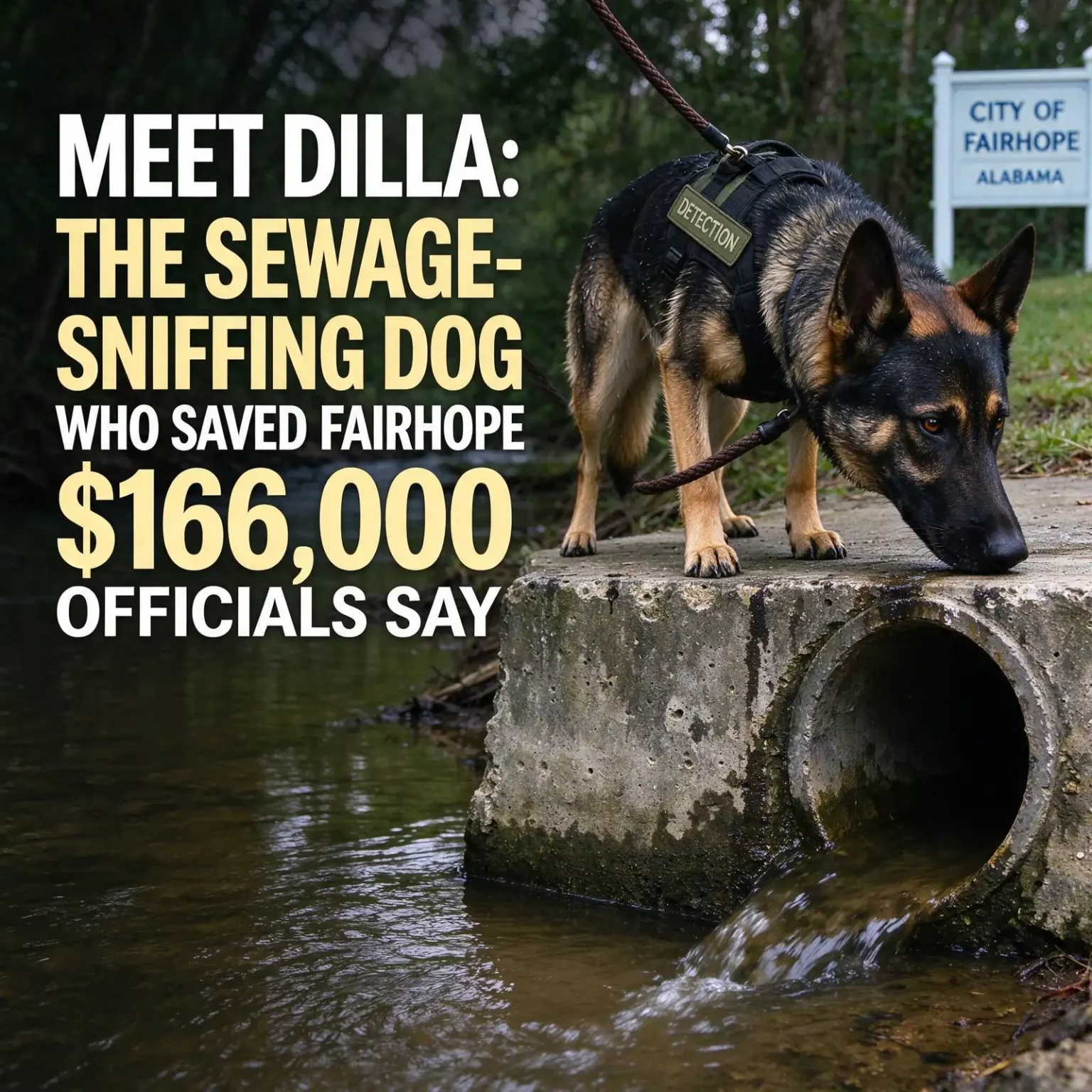
FAIRHOPE, Ala. — A dog’s nose can pick up what people and, in some cases, laboratory instruments cannot. The Mobile Bay National Estuary Program is putting that ability to work on one of the most persistent problems facing coastal waterways: figuring out whether human sewage is the reason a creek or bayou is contaminated. The program’s sewage detection dog, a canine named Dilla, is continuing her training as a wastewater detection dog, and program leaders say the approach has already paid off for Fairhope, saving the city roughly $166,000 and about three years of investigative work.
The canine detection effort is still being explored and refined, but program staff and city leaders say the early results suggest trained dogs could become a regular part of how Mobile Bay-area communities track down sources of pollution, giving investigators a faster and potentially less expensive way to pinpoint problems before they spread or cause wider environmental damage.
How a sewage detection dog works
Detection dogs are trained to recognize one specific scent and signal when they find it. For Dilla, that target is human sewage at a level that matters to regulators. Cody Aloi, a program manager for the Mobile Bay National Estuary Program, often called MBNEP, explained that the dog was imprinted on wastewater at a concentration considered to be of regulatory significance.
“A dog takes samples with its nose. He’s searching for what that regulatory threshold was. We trained the dog on the sewage that was considered a regulatory significance, and we imprinted the dog on that, and that’s what the dog is looking for,” Aloi said.
In practice, that means the dog is not simply reacting to dirty water. It is searching for the particular odor signature of human waste. That distinction is important, because high bacteria counts in a waterway can come from many places, including wildlife, pets, livestock and decaying plant material, and not every bacterial problem points to a broken sewer line or a failing septic system.
Why dogs?
Dogs’ noses are vastly more sensitive than human noses, and working dogs are already used to locate explosives, narcotics and human remains. Aloi said sewage detection was a natural extension of that kind of work, and that the program found the dog’s sensitivity remarkable.
“Dogs have the ability to detect things at such a minute level. When we were doing this project, for example, we actually found out that the dog was about nine orders of magnitude lower than what the laboratory test could pick up. So this was something dogs’ noses are incredibly sensitive to. Dogs also are really good at finding explosives, narcotics, human remains, things like that, and so it was just kind of a natural next step for this to implement sewage detection,” Aloi said.
Nine orders of magnitude is a factor of about one billion, a measure of how much fainter a trace the dog could detect compared with the laboratory method used in the project, according to Aloi.
Narrowing down the source
The value of a detection dog lies in sorting out where contamination is coming from and, just as important, where it is not. When water samples show elevated bacteria, investigators traditionally have to collect more samples, send them to a laboratory and wait for results, sometimes repeating the process along a stream or storm drain system to trace a problem upstream. That can take days for each round and much longer for a complete investigation.
A trained dog working along a creek bank or at a stormwater outfall can give an indication on the spot. If the dog alerts, investigators know to focus their attention and lab testing there. If the dog does not alert where bacteria levels are high, that suggests the source may not be human sewage, steering crews away from costly searches for sewer leaks that may not exist.
That is the kind of result Fairhope saw earlier in the program. As South AL News previously reported, MBNEP told the Fairhope City Council in August that its canine pilot, which the city helped fund in 2024, had passed its first real test in Fly Creek: the dogs reliably identified samples containing sewage in controlled testing and did not alert on the creek water, where laboratory analysis later confirmed the elevated bacteria were not related to human waste.
$166,000 and three years saved
The program now reports that incorporating canine detection into Fairhope’s wastewater investigations saved the city approximately $166,000 and three years of time.
Fairhope Mayor Sherry Sullivan said the speed of the results and the smaller number of people needed are the biggest advantages for the city.
“The biggest thing for us is that you get instantaneous results and you don’t have the time to wait on labs. You don’t have as much personnel involved, you know, in the time that it takes. So being able to use the canine source point tracking is going to be much more time-effective for us and much more cost-effective,” Sullivan said.
For a city government, those savings matter beyond the bottom line. Time spent waiting on test results is time in which a leak or overflow can continue to send contamination toward Mobile Bay. Faster answers mean repairs can be scheduled sooner and resources can be directed where they are most likely to make a difference.
A tool, not a replacement for the lab
Program leaders are clear that Dilla will not replace laboratory testing. Lab analysis remains the standard for documenting water quality and meeting regulatory requirements. Instead, the dog helps investigators narrow down potential sources of contamination and determine where further investigation and sampling are most needed.
That two-step model, with a dog narrowing the search and a laboratory confirming what the nose found, is the same approach that emerged from the Fly Creek pilot. It allows communities to spend their testing budgets more strategically, sampling the places a dog has flagged rather than blanketing an entire watershed.
About the Mobile Bay National Estuary Program
The Mobile Bay National Estuary Program is one of 28 national estuary programs created under the federal Clean Water Act to protect and restore estuaries of national significance. The program works with local governments, state and federal agencies, businesses, scientists and residents in Mobile and Baldwin counties to improve water quality, protect habitat and plan for the long-term health of the Mobile Bay watershed.
Much of that work centers on watershed management plans for individual creeks, rivers and bayous, and on helping communities identify and fix the sources of pollution that affect swimming, fishing and shellfish harvesting. Bacteria from sewage is among the most common concerns in coastal waterways, particularly after heavy rain, when aging pipes, overflows and septic systems can send contaminated water into streams that drain to the bay.
What it could mean for local waterways
The canine program is a different approach to an ongoing environmental challenge. With Fairhope’s experience as an example, program staff and local officials say canine detection could help other communities make better-informed decisions about where to invest in sewer repairs and water quality improvements.
Residents who notice signs of a possible sewage problem, such as foul odors near a ditch or creek, discolored water, or wastewater coming from a manhole, should report it to their local utility or city public works department so crews can investigate. Information about water quality efforts across the Mobile Bay watershed is available from the Mobile Bay National Estuary Program.
For now, Dilla’s training continues, and so does the work of keeping the region’s creeks and bayous clean, one sniff at a time.