

{
“title”: “Fairhope’s Sewage-Sniffing Dogs Pass Their First Real Test in Fly Creek”,
“status”: “publish”,
“content”: “
Two years after Fairhope agreed to fund an unusual experiment, the question the city asked has an answer: dogs really can smell human sewage in a creek. The Mobile Bay National Estuary Program told the Fairhope City Council during its Monday, Aug. 10 work session that a wastewater detection canine program the city backed with roughly $35,000 in 2024 has proven the concept, correctly identifying trace levels of raw sewage in controlled testing and ruling out human waste in the waters of Fly Creek, where elevated bacteria turned out to have a different source.
\n\n
The results, confirmed in part through laboratory analysis by the Environmental Protection Agency, mark the end of the program’s pilot phase and the beginning of a broader conversation about whether trained detection dogs should become a standing tool for water quality work across Coastal Alabama.
\n\n
How the idea got its start
\n\n
The project began in 2024, when Fairhope leaders agreed to spend about $35,000 on a proposal that sounded, to many ears, more like a novelty than a science program: train bomb-sniffing style dogs to detect evidence of sewage overflows in local waterways. Fly Creek, which winds through some of the most visible parts of Fairhope before reaching Mobile Bay, had long been a waterway of concern for the city, and city officials wanted a faster way to figure out whether human waste was reaching the creek.
\n\n
During the Aug. 10 work session, representatives of the Mobile Bay National Estuary Program, the regional organization that carried out the work, walked the council through what two years of training and field testing had produced. \”I want to thank Fairhope for being ground zero on this,\” MBNEP Project Manager Cody Aloi told council members.
\n\n
How a dog learns to smell sewage
\n\n
The training followed a discipline familiar to anyone who has watched a working dog earn a certification. Handlers collected wastewater samples from a treatment plant and prepared them as \”blind samples,\” meaning the trainers themselves did not know which samples contained what. The dogs were taught to alert on bacteria such as E. coli, which is commonly associated with human waste, without handlers accidentally cueing them through body language or expectation.
\n\n
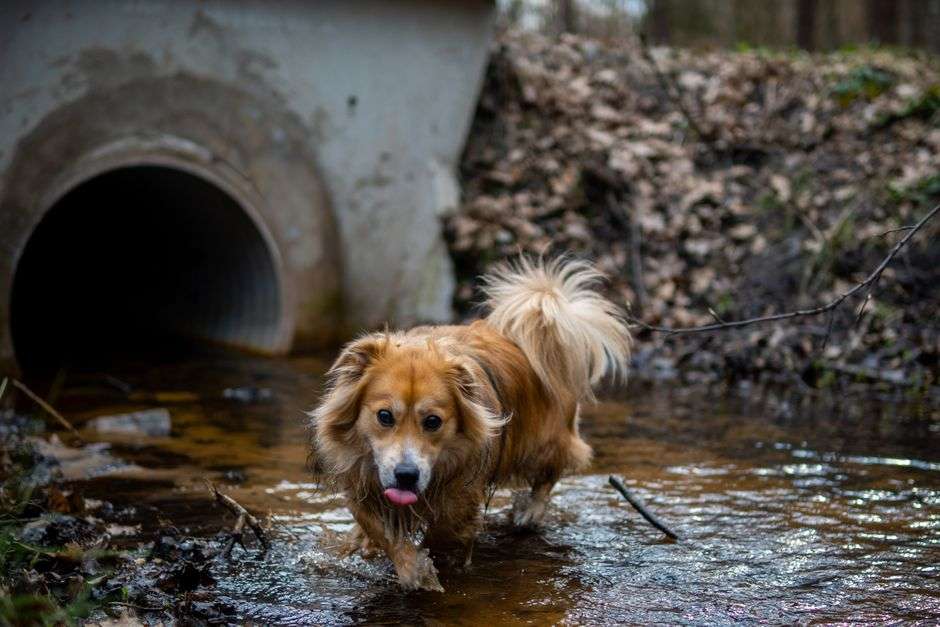
Once the dogs were thoroughly trained, Aloi and a partner took them out onto Fly Creek for field testing. The results were instructive in more ways than one. Bacteria levels in the creek water were high, but the dogs did not indicate on the water, and laboratory testing later confirmed why: the contamination present was not related to human waste. When the dogs were then given spiked samples with waste deliberately planted inside, they signaled correctly every time.
\n\n
That combination, a clean miss on non-human contamination and a reliable hit on the real thing, is what program backers consider the proof of concept. The dogs are not simply reacting to dirty water. They are distinguishing the specific signature of human sewage, the thing a city actually needs to find when it is hunting a broken sewer line or an overflowing system.
\n\n
Why speed matters
\n\n
Aloi said the program had two aims beyond the novelty of the idea. The first was to determine whether dogs could find evidence of sewage overflows the way a lab test can. The second was to see whether contamination in Fly Creek was a persistent issue, and whether the dogs could improve the speed and efficiency of testing local waters.
\n\n
That second goal gets at a practical problem every water utility and environmental agency faces. Traditional bacteria testing requires collecting a sample, transporting it to a laboratory, and waiting for cultures to develop, a process that can take a day or more. In that window, a sewage overflow can keep flowing, and the trace that led investigators to it can dissipate. A dog can stand on a creek bank and give an indication in minutes, letting investigators chase the contamination upstream while the trail is still warm.
\n\n
Fairhope Councilman Jack Burrell framed it in dollars and hours during the work session. \”If there’s a suspected sewage overflow, you could get a dog there real quick. You don’t have to wait for lab results,\” he said. \”You know, it’s a cost and a time factor in that for me. The accuracy seems to be there.\”
\n\n
What comes next for the program
\n\n
MBNEP Executive Director Jason Kudulis told the council the organization is \”really pleased with the initial results, just seeing the value of the dog and the accuracy,\” and is exploring opportunities to continue implementation as needed in Coastal Alabama. He credited the city for funding a project that doubled as an innovation bet. \”We’re really grateful to the city of Fairhope because they wanted to investigate the issues of Fly Creek while also fostering an opportunity for this innovative technology,\” he said.
\n\n
Paul Orcutt, a dog trainer with decades of experience across the country who participated in the program, said the next step is expansion. \”There are cities I know within Baldwin County and Mobile County that are looking for some services and are trying to figure out the funding and the timing, and that’s a lot of moving pieces that the MBNEP has to put together, so there’s those opportunities,\” Orcutt said. Kudulis said the organization is already reaching out to potentially interested parties about continuing the testing method elsewhere.
\n\n
The council weighs a refunding decision
\n\n
The pilot as originally scoped is finished, but several council members signaled interest in new funding. Burrell asked whether further city money to keep building a dataset could extend the work to other areas, including waters near the Fairhope Yacht Club. Kudulis said he would like to keep building the Fly Creek dataset but that other areas of concern should be considered too.
\n\n
\”We want to be strategic. I think we still want to look at those sites that we examined already and get some more data, so that we can give them some confidence in interpreting those results to make better decisions as elected officials for infrastructure and water quality improvements,\” Kudulis said. \”I think everything’s on the table.\”
\n\n
Councilman Joshua Gammon was the most emphatic supporter of continuing the program in Fairhope, framing it as a monitoring tool whose speed advantage is decisive. \”I definitely support continuing the program,\” Gammon said. \”I like the idea of it being a monitoring program, and us being able to really better identify these different sections. There’s so many differences in potential access points in our watershed that need to be monitored, and this is just from a concept perspective and a speed perspective so much more efficient than us just filing some water, milling off to a lab somewhere, waiting for results.\”
\n\n
Council President Jimmy Conyers and Councilwoman Andrea Faust Booth declined to comment on the presentation until they had studied it further. Mayor Sherry Sullivan said she found the program helpful to Fairhope but was unsure whether it will be refunded for more testing. Councilman Jay Robinson did not respond to a request for comment before press time.
\n\n
What the dogs cannot do
\n\n
For all the enthusiasm, the program’s own results sketch the limits of the method. In the Fly Creek field work, high bacteria counts alone told investigators nothing about the source, and the dogs’ inability to indicate on the creek was itself the finding: the contamination was not human in origin. A dog identifies a scent; it does not produce the lab documentation regulators typically need to cite a violator or order a repair. In practice, the model that emerged from the pilot is a two-step one, with a dog narrowing the search and a laboratory confirming what the nose found.
\n\n
For Fairhope, which funded the pilot to get answers about a creek that runs through the heart of the city, the two-year experiment delivered something more valuable than a single test result: a faster, cheaper way to ask the next question.
“,
“status”: “publish”
}