Downed Transmission Lines Knock Out Power to Eastern Shore Customers
A transmission failure near Belforest knocked out five Riviera Utilities substations, cutting power to thousands of Eastern Shore customers in Baldwin County.
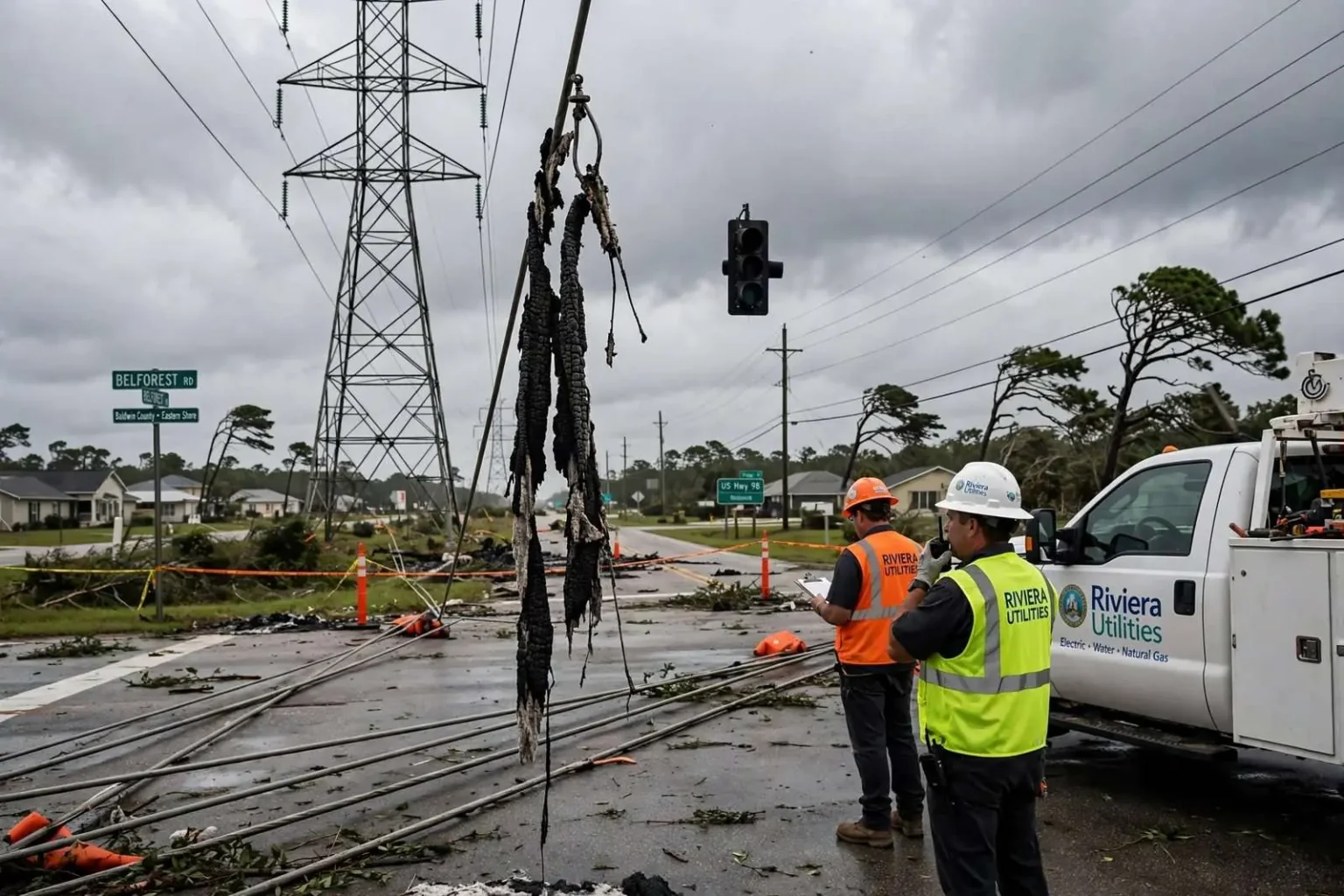
Thousands of Riviera Utilities customers along Alabama’s Eastern Shore lost electricity for several hours after equipment failures on an Alabama Power transmission system knocked out five substations at once, utility officials said.
The outage began mid-morning when a connector piece on the transmission system, sometimes called a “jumper,” burned apart near the Belforest community, according to Riviera Utilities. Additional lines in the area also went down around the same time.
Because the affected substations draw power from that shared transmission system, the failure cascaded quickly, cutting service to a large share of the utility’s customer base.
Riviera Utilities serves roughly 44,000 customers across Baldwin County, and utility officials said about 18,000 of them were without power at the height of the outage.
Crews worked to reroute electricity from unaffected substations so that customers could be brought back online in stages rather than waiting for the original transmission problem to be fully resolved.
“We’re going to do some switching and pick the customers up from some other substations,” a Riviera Utilities spokesperson said at the time, adding that crews hoped to have the bulk of customers restored quickly.
Within a few hours, power had been returned to essentially all affected homes and businesses.
Traffic Trouble on the Eastern Shore
The outage also disrupted some traffic signals in Daphne and Spanish Fort, creating brief headaches for drivers navigating busy Eastern Shore corridors during the disruption. Local officials urged motorists to treat dark intersections as four-way stops until signals came back online.
Those corridors — U.S. Highway 98, Alabama Highway 181 and the approaches to the Interstate 10 interchange — carry some of the heaviest commuter and retail traffic in Baldwin County, and signal outages there slow trips even when drivers follow the four-way-stop rule. Police in both cities monitor signal outages during storms and major disruptions, directing traffic at the busiest intersections when conditions warrant.
Belforest, where the burned jumper was located, sits in the fast-growing corridor between Daphne and Fairhope, an area that has seen substantial residential and commercial development in recent decades. Growth along that corridor has increased demand on the electrical grid, and the Belforest area’s substations feed neighborhoods and schools that barely existed a generation ago.
Who Owns What on the Grid
Alabama Power, which owns the transmission infrastructure that failed, said the exact cause of the downed lines was still under review. Blustery conditions were moving through coastal Alabama that day, with forecasters calling for wind gusts topping 30 mph, and a company spokesperson said wind could not be ruled out as a contributing factor.
“We experienced a problem on our transmission system,” the spokesperson said, describing the failure in terms that underscored the division of responsibility on the grid: Alabama Power owns and maintains the high-voltage transmission lines and towers that move electricity across the region, while Riviera Utilities operates the local distribution system that delivers power from substations to homes and businesses.
That division matters in outages like this one. When a transmission failure knocks out substations, the local utility can restore service only by rerouting around the problem — switching customers to substations fed by intact lines — or waiting for the transmission owner to make repairs. Riviera crews did the former, bringing customers back in stages as unaffected substations picked up the load.
The five substations lost in the cascade represented a substantial share of Riviera’s Baldwin County network. The municipal utility, owned by the cities it serves, is one of the largest locally operated utilities in Alabama, with electric, water and gas service across the Eastern Shore. Its customer base has grown with Baldwin County’s population, which has made the county one of the fastest-growing in the state.
A Reminder About Grid Reliability
Outages of this kind — measured in hours, not days — are the expected outcome when redundancy works. Transmission systems are designed with alternate paths so that a single failure does not black out an entire region indefinitely, and the mid-morning timing of this failure meant crews could work in daylight and restore most customers before the day was out.
Still, the episode illustrated how quickly a small hardware failure can cascade. A burned jumper — a short connector between lines or equipment — is a modest component, but when it fails on a transmission line feeding five substations at once, the loss ripples through every customer those substations serve.
Wind was not the only possible factor; Alabama Power’s review of the failed equipment was ongoing, and utilities typically inspect burned connectors, insulators and conductors for signs of corrosion, wear or wildlife contact before assigning a cause. Coastal Alabama’s salt air and storm exposure are hard on electrical hardware, and transmission owners in the region maintain ongoing inspection and replacement programs.
For residents, the practical lessons were familiar ones: treat dark signals as four-way stops, keep refrigerators closed, and check on neighbors who depend on powered medical equipment. The Eastern Shore’s hospitals, schools and businesses have backup plans for brief outages, and the few hours without power tested them without consequence.
By evening, the switching operations were complete, the five substations were back in service, and the transmission repair remained Alabama Power’s responsibility to finish and review.
Baldwin County’s Utility Landscape
Riviera Utilities traces its history to the early 20th century, when it began as a water and electric provider for the growing communities of the Eastern Shore. Today the utility is jointly owned by the cities of Daphne and Fairhope, and its service territory spans much of central Baldwin County, including Spanish Fort, Daphne, Fairhope and surrounding communities. In addition to electricity, Riviera provides water, wastewater and natural gas service, making it an unusual multi-service municipal utility for a county of Baldwin’s size.
The utility’s roughly 44,000 electric customers make it a significant but secondary player next to Alabama Power, which serves most of the rest of the county. Riviera buys power delivered over Alabama Power’s transmission network and distributes it through its own substations and lines — an arrangement common among municipal utilities across the state. The transmission system that failed near Belforest is the link between the regional grid and the local distribution network, which is why a failure on Alabama Power’s side of the fence emptied Riviera’s substations.
Growth pressures have shaped the system’s recent history. Baldwin County has added tens of thousands of residents over the past two decades, and the Belforest corridor between Daphne and Fairhope has been among the fastest-growing parts of the county. New subdivisions, schools and commercial centers raise peak demand, and utilities respond by adding substations and lines — but each addition also creates another asset whose failure must be planned for.
How Restoration Actually Works
The restoration sequence Riviera crews followed is standard practice for distribution utilities. First, crews identify which substations are dead and whether the cause is on the transmission side or within the local system. Then dispatchers begin switching — opening and closing breakers to transfer load from lost sources to live ones, a little at a time so the remaining substations are not overloaded. Customers come back neighborhood by neighborhood as the switching proceeds.
The spokesperson’s description — “we’re going to do some switching and pick the customers up from some other substations” — was exactly that process. It explains why some customers saw power return within the first hour while others waited longer: restoration order follows the topology of the grid, not a simple queue.
Utilities also prioritize critical loads where they can. Hospitals, water pumping stations and wastewater treatment plants typically sit on feeders that can be restored first, and Riviera’s water system depends on electric pumps — so a widespread power outage on the Eastern Shore is also, briefly, a water-system event until pumping stations are back online.
Communication is the other half of the work. Utilities use outage maps, social media and local media to keep customers informed, and the scale of this event — 18,000 customers dark at once — put it at the top of Riviera’s public reporting for the day. Outages of that size are rare for the utility; most interruptions are small, localized line events measured in dozens or hundreds of customers.
The weather context was typical for the Gulf Coast, where strong gusts accompany frontal passages and thunderstorms much of the year. Thirty-mile-per-hour gusts are routine by coastal standards, but they stress aging connectors and hardware, and investigators were left to determine whether the wind simply exposed a component already weakened by corrosion or wear.
Alabama Power’s review was expected to examine the failed jumper and the additional lines that went down around the same time, both to assign a cause and to prevent a repeat. For the Eastern Shore, the afternoon’s restoration closed the episode; the underlying question of hardware condition on the transmission system remained with the utility that owns it.