Rare Two-Democrat Runoff Set for House District 96, Which Spans Baldwin and Mobile Counties
Two Democrats, Maurice Horsey and Web Whiting, face off in a June 5 runoff for House District 96, which spans Baldwin and Mobile counties, ahead of a fall matchup with Republican Matt Simpson.
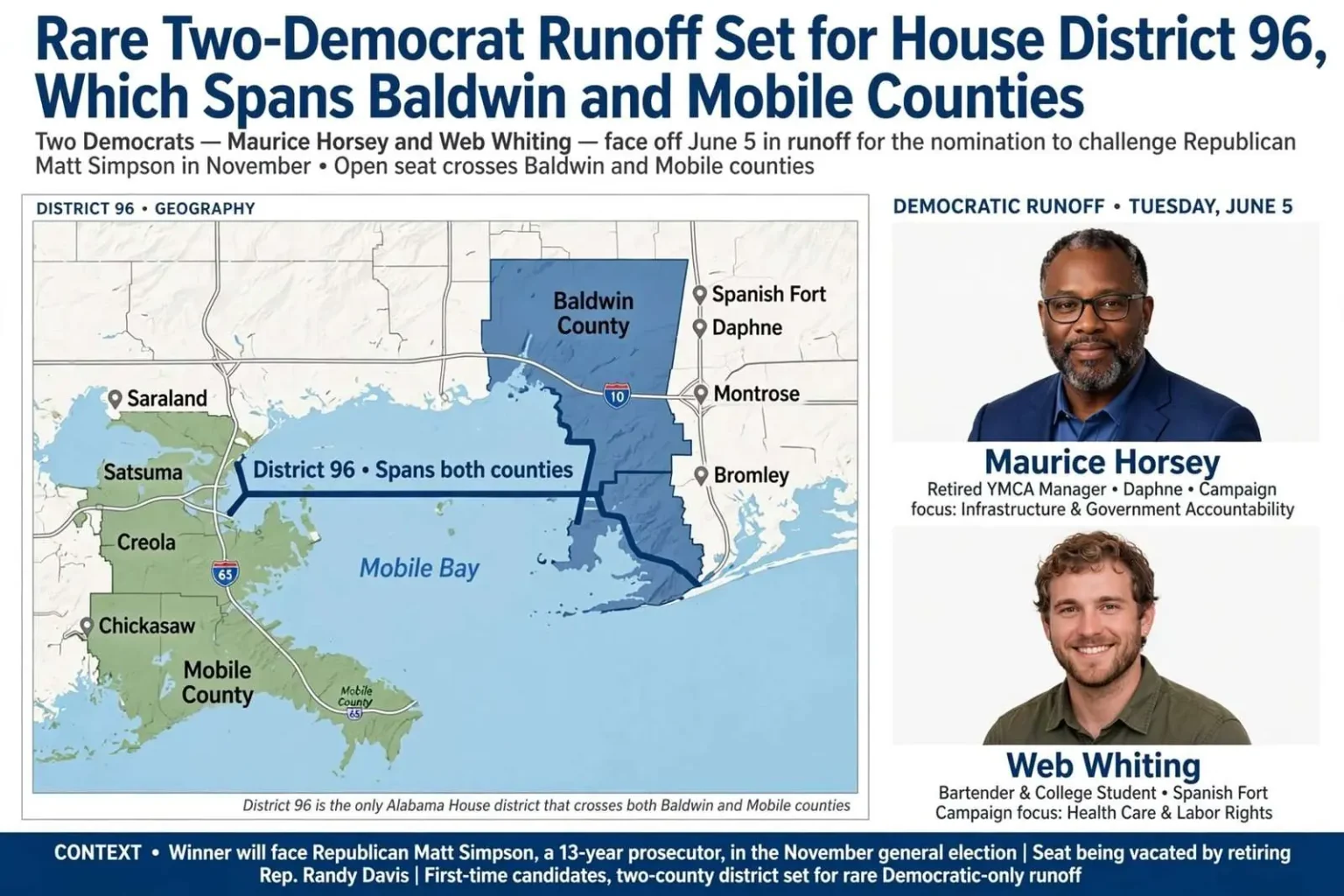
House District 96 is producing an unusual matchup in Alabama politics this year: two Democrats are facing off in a June 5 runoff for the right to challenge a single Republican candidate in November, an anomaly in a state where GOP-only or single-candidate races are far more common.
District 96 is the only Baldwin County race on this year’s ballot featuring two Democratic candidates. Republican Matt Simpson is unopposed in his own primary and will face the winner of the Democratic runoff, either Maurice Horsey or Web Whiting, in the November general election. All three candidates are running for public office for the first time. They are seeking to succeed Randy Davis, who previously held the seat and is not running for re-election.
District 96 is the only Alabama House district that crosses into both Baldwin and Mobile counties. On the Baldwin County side, it includes Bromley, Spanish Fort, Daphne and Montrose; in Mobile County, it covers portions of Creola, Satsuma, Saraland and Chickasaw.
That geography makes the seat unique in the Legislature. Alabama’s House districts are redrawn every ten years after the census, and most stay neatly inside a single county. District 96 stretches across Mobile Bay, tying the fast-growing Eastern Shore suburbs of Baldwin County to the industrial and residential communities of north Mobile County along the Interstate 65 corridor. A legislator who represents it answers to Spanish Fort’s new subdivisions and Chickasaw’s older streets in the same term, and to both counties’ delegations in Montgomery.
An open seat with two Democrats in it
Open-seat contests attract crowded fields when a district looks competitive; they attract any field at all when a long-serving incumbent departs. Davis’s decision not to seek re-election opened the door, and the fact that two Democrats rather than one walked through it makes District 96 a curiosity in modern Alabama, where the Democratic Party’s fortunes have receded to the point that many legislative districts feature no Democratic candidate whatsoever.
The state’s runoff requirement — a candidate must win a majority, not merely a plurality, of the primary vote — is what forces the June 5 second round. When more than two candidates seek the same nomination and none clears 50 percent, the top two advance. For the parties, runoffs are expensive extensions of the primary season; for voters in a district like this one, they are the only moment when a Democratic nominee is actually being chosen, since November’s result in most Alabama legislative races is a foregone conclusion the moment the nominees are set.
A runoff between two first-time candidates also means the seat’s next representative will be new to office regardless of the outcome — a rare full reset for a district that has had the same representation for years. Whoever emerges will inherit the district’s transportation file, its delegation seat and the challenge of learning two counties’ worth of municipal politics at once.
Maurice Horsey: a manager’s case against Montgomery
Horsey, who retired from management positions with the YMCA, has lived in Daphne since 2015 and argues that special interests hold too much sway in Montgomery.
“Plainly, we haven’t gotten what we need from our leadership in Montgomery,” Horsey said. “Too much time has been spent on special interests and too little or no time on our interests.”
His pitch draws on a management career — the YMCA’s branch and association leadership is fundamentally an operational job, balancing budgets, staffing programs and answering to communities — reframed as a critique of state government. The argument is a familiar one in legislative campaigns, but it lands differently in a district undergoing Baldwin County’s pace of growth, where residents watch roads, schools and infrastructure strain to keep up and wonder whether anyone in the State House is attending to the details.
Horsey’s Baldwin County base matters in a district where the Eastern Shore holds the larger share of the population. Daphne and Spanish Fort have been among the fastest-growing cities on the Gulf Coast, adding neighborhoods, retail and traffic far faster than the highways serving them, and the local demand for state road money along the I-10 corridor is the district’s most consistent political issue.
Web Whiting: health care and unions on the ballot
Whiting, a Spanish Fort bartender working toward a degree in secondary education, said health care access and worker protections are his top priorities.
“I think my two largest priorities when elected will be to guarantee health justice and the rights of our workers, the single greatest strides we can take to begin creating a gentler, fairer and more compassionate society,” he said. “I want to bring back unions stronger and better than ever to fight economic inequality here in Alabama.”
Whiting’s platform is a deliberately populist one, and in a Democratic primary it is aimed squarely at his party’s base. Expanding health care access has been a live issue in the State House for years — Alabama remains among the states that have not expanded Medicaid coverage to low-income adults under the Affordable Care Act, a decision with outsized consequences for rural hospitals and working families — and pro-labor candidates across the South have spent a decade arguing that the region’s low unionization rates and low wages are two sides of the same coin.
A bartender running for office is also, by design, a statement about who the seat is for. Whiting’s campaign invites voters to see a working-class candidate in a district that includes shipyard suppliers, plant workers, service employees and commuters — constituencies that traditional Democratic messaging in Alabama has struggled to reach. His candidacy asks primary voters to send the kind of legislature the state’s labor movement has long wanted rather than the one it has.
Matt Simpson waits in November
Simpson, a 13-year veteran prosecutor, said his focus would be on maintaining law and order if elected. His unopposed primary meant he could conserve resources and define himself while the two Democrats spent June attacking each other — a structural advantage in any general election, and an unusually clean one for a first-time candidate.
A prosecutor’s résumé is a conventional foundation for a legislative run in Baldwin County, where courthouse and law-enforcement experience polls well and where the district’s suburban base tends to favor candidates with public-safety credentials. Simpson’s task in the fall is the standard one for a Republican in modern Alabama: hold the party’s historical margin in a district that has elected Republicans to the House for years, and convert a new district’s growth — which has leaned heavily Republican on the Eastern Shore — into votes.
The open seat also carries a delegation dimension. Baldwin County’s legislative delegation has been entirely Republican for some time, and Davis’s exit created the only realistic Democratic opening in the county’s delegation this cycle. County parties, legislators and interest groups typically invest accordingly: the minority party defends its rare opportunities, and the majority defends its map.
Why this runoff matters beyond the district
Legislative districts that straddle Mobile Bay are rare enough that whoever wins will be a bridge figure by necessity. The Mobile County communities in the district — Creola, Satsuma, Saraland and Chickasaw — share an industrial corridor along U.S. 43 and I-65 that includes some of the region’s largest employers, while the Baldwin side brings the Eastern Shore’s growth-driven agenda. Statewide issues such as the I-10 Mobile River bridge and bayway project touch both sides of the district, as do the funding formulas that divide school money between the two county systems.
For Alabama Democrats, the June 5 runoff is a small test of whether the party can still compete anywhere in South Alabama. Party organizations have spent recent cycles recruiting candidates in suburban districts that Democrats stopped contesting a generation ago, on the theory that ballot presence builds future strength. Two Democrats in a Baldwin County race — and two more votes in a runoff — is modest evidence of life in places the party’s maps no longer favor.
For voters in District 96, the unusual calendar is an opportunity. They get two rounds of candidate forums, two rounds of mail and door-knocking, and a longer look at three first-time candidates competing to represent a district that is, by any measure, one of the most interesting seats in the Alabama House.
The shape of the new district
The district’s odd shape is a product of the redistricting process itself. When legislative maps are drawn, population equality within a few percentage points is the legal requirement, and meeting it sometimes means reaching across county lines to capture enough people. District 96’s dual-county footprint reflects Baldwin County’s explosive growth: as the Eastern Shore’s population swelled, mapmakers had to shift district boundaries, and the result is a seat that dips across the bay into north Mobile County.
For the communities involved, representation has practical consequences. Creola, Satsuma, Saraland and Chickasaw are compact municipalities along the industrial corridor north of Mobile, each with its own schools or school agreements, police forces and utility systems, and each historically represented alongside the rest of north Mobile County. Being attached to a Baldwin-based district means their senator-equivalent in the House divides his time between two county delegations and two sets of local priorities — road projects on one side of the bay, subdivision growth on the other.
Runoff elections in June also test organization more than money. With turnout typically in the single digits, a candidate who can identify a few thousand reliable primary voters and get them to the polls — through churches, civic clubs, unions, retirement communities and the neighborhood networks that dominate Eastern Shore politics — can beat a better-funded rival. Both Democrats have spent the weeks between the primary and the runoff doing exactly that work, precinct by precinct, in two counties at once.
Whoever wins the June 5 runoff will carry a Democratic label into a general election where the district’s registration and voting history favor the Republican nominee. But the seat’s future may be less settled than its past: District 96’s new boundaries, its open-seat status and the candidate quality on both sides make it one of the few Alabama House races this year where both parties have a genuine reason to compete.