Gulf Coast bikers ‘Kruise’ to raise money for St. Jude Children’s Research Hospital
Motorcyclists rode from Spanish Fort to the Flora-Bama for the annual Kruise for St. Jude, raising money for St. Jude Children's Research Hospital.
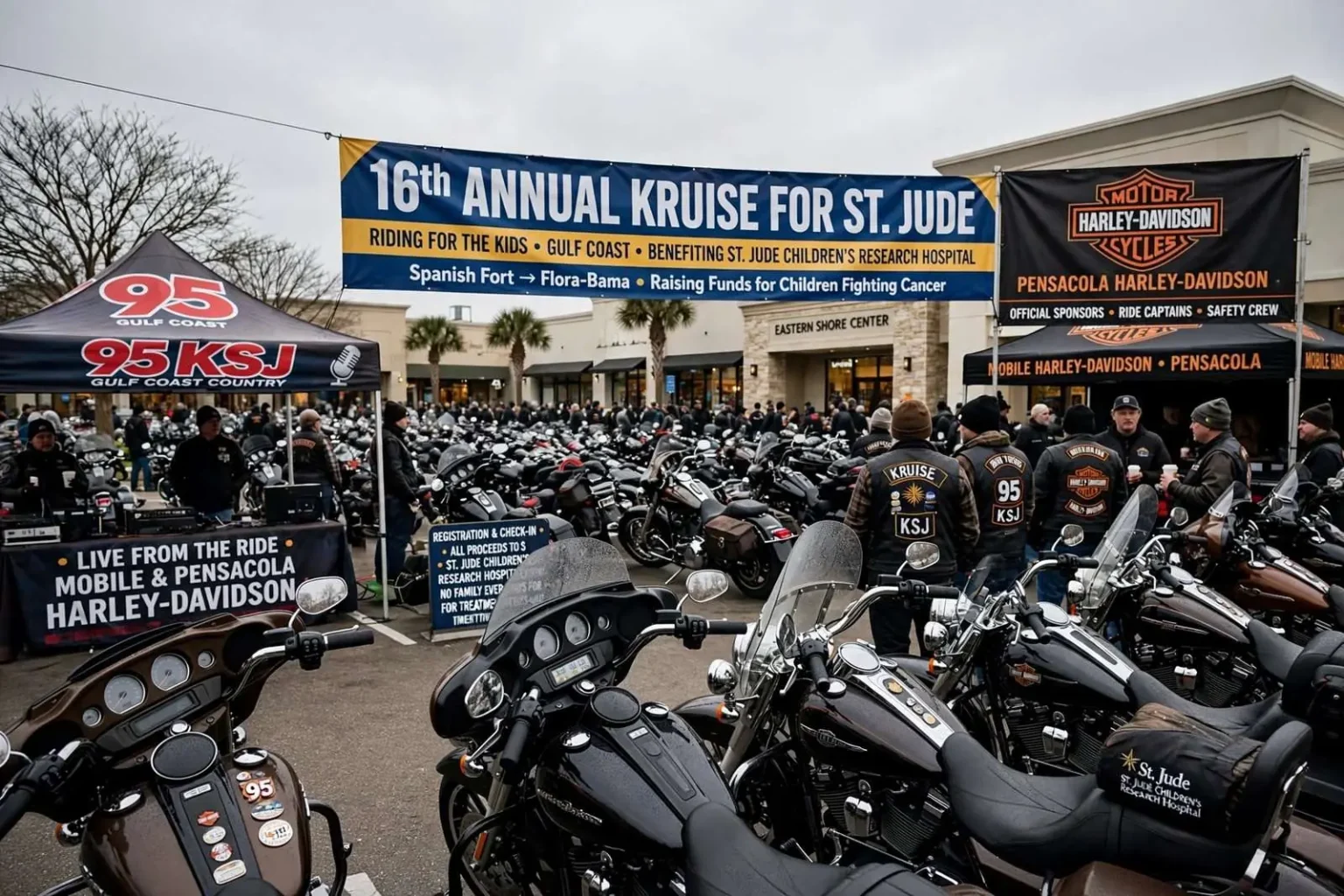
Chilly weather didn’t stop a group of motorcyclists from riding for a good cause Saturday, as they left the Eastern Shore Center in Spanish Fort bound for the Flora-Bama for the annual Kruise for St. Jude. The ride is one of the Gulf Coast’s most familiar charity traditions, drawing riders from both sides of Mobile Bay for a run down the coast that ends at the famous beach bar on the Florida line — all in the name of raising money for children fighting cancer.
The ride, sponsored by radio station 95 KSJ and the Mobile and Pensacola Harley-Davidson dealerships, raises money for St. Jude Children’s Research Hospital in Memphis. Organizers note the ride helps children in the Mobile and Baldwin County area specifically, since St. Jude treats young patients from across the region who travel to Memphis for care. For the local families, the money raised on a Saturday morning ride along the Baldwin County coast translates directly into treatment, travel support and hope.
“We have way too many kids in the Mobile and Baldwin County area who suffer from cancer and that’s what St. Jude’s all about, saving lives and healing sick children. We have almost 50 families right here in our area who depend on St. Jude every day,” said Bill Black of 95 KSJ. The station’s morning voice has long been tied to the ride, and Black’s numbers put a local face on a national institution: nearly fifty families from the two counties alone rely on the Memphis hospital at any given time.
The Route and the Destination
Starting at the Eastern Shore Center — the open-air shopping destination in Spanish Fort just off Interstate 10 — the ride carries participants south through Baldwin County toward the coast. The run’s destination, the Flora-Bama, sits straddling the Florida state line on Perdido Key, a landmark that has anchored Gulf Coast beach culture for decades. The combination of a staging area with room for hundreds of bikes, a scenic ride through the Eastern Shore and an iconic finish makes the Kruise a natural fit for the region’s riding calendar.
Motorcycle charity runs work on a simple formula: riders pay registration fees, businesses donate goods and services, and the procession itself becomes a rolling public awareness campaign. Motorists along the route see the scale of the effort, and the sheer sound and spectacle of a charity ride publicizes the cause in a way no billboard can. By the time the pack reaches Perdido Key, the day has raised both money and visibility for the hospital it supports.
St. Jude Children’s Research Hospital, founded in Memphis by entertainer Danny Thomas, operates on a promise that no family ever pays for treatment, travel, housing or food while their child is in care. That policy is why events like the Kruise matter: the hospital’s operating budget depends on donations, and the families who arrive from Mobile and Baldwin counties — like the nearly fifty Black described — arrive without the crushing financial burden that pediatric cancer care would otherwise impose.
A Sixteen-Year Tradition
This was the 16th year for the ride, an anniversary of sorts for a Gulf Coast tradition that has outlasted economic downturns, hurricanes and the ordinary churn of charity events. Rides that survive sixteen years do so because the institutions behind them commit annually — the dealerships that organize the route and the station that promotes it — and because the cause touches nearly every family in the region in some way.
The Mobile and Pensacola Harley-Davidson dealerships bring more than sponsorship. Harley-Davidson riders form a nationwide community with a deep tradition of charity work, and the dealerships function as the connective tissue for that community between rides — hosting events, posting route maps and encouraging riders to sign up. Their involvement guarantees a professional operation: road captains, safety planning, fuel stops and the logistics of moving a long column of motorcycles safely along public roads.
95 KSJ, the Gulf Coast country station, supplies the promotional engine. Radio partners like the station turn a motorcycle ride into a regional event, reminding listeners for weeks that the Kruise is coming, broadcasting from the staging area and giving the cause a familiar voice. Black’s on-air advocacy — and his emphasis on the local families who depend on St. Jude — frames the ride as neighbors helping neighbors rather than a generic fundraiser.
For the families in Mobile and Baldwin counties whose children receive treatment in Memphis, the ride’s significance is practical. St. Jude covers the medical bills, but a family facing months of treatment far from home still bears the costs and strains of travel, missed work and split households. Donations to the hospital fund the housing, food and support services that keep families whole during treatment, which is why Black’s “depend on St. Jude every day” is not rhetorical flourish — it is a description of how the system works.
Why St. Jude Resonates on the Gulf Coast
The Kruise’s endurance reflects St. Jude’s unique place in American charity. The hospital’s founding mission — that no child should die in the dawn of life, in Danny Thomas’s formulation — and its no-cost promise have made it one of the most trusted names in fundraising. Gulf Coast families have sent children to Memphis for decades, and the connection is personal in ways that out-of-town charities rarely achieve: riders know the families, or know someone who does.
St. Jude’s research mission also means that donations fund more than treatment of the children in its own wards. The hospital shares its research findings with doctors worldwide, and survival rates for childhood cancers have climbed dramatically since its founding — progress that hospitals across the region, including those serving south Alabama, draw on. A rider’s registration fee thus supports both the child from Mobile County in a Memphis ward and the state of knowledge that future patients will inherit.
What the Ride Looks Like on the Day
A charity Kruise of this scale unfolds with the rhythm of a well-drilled operation. Riders gather at the Eastern Shore Center early, registering or checking in, grabbing coffee against the chill and staging their bikes in rows as the parking lot fills. The station’s crew broadcasts from the site, sponsors’ banners line the staging area, and at the appointed hour the pack rolls out of Spanish Fort under escort, a river of engines rolling south through Baldwin County that turns heads in every town it passes.
The chilly weather that greeted this year’s riders is a familiar companion for the late-year run, and it rarely dents turnout. Gulf Coast riders are a hardy lot — winter rides along the coast are a staple of the calendar — and a cold morning matters less when the destination includes the warmth of the Flora-Bama and the company of a few hundred like-minded riders. The bar’s sprawling decks have hosted the ride’s finish for years, and the arrival turns into an afternoon of music, food and drawings as the last bikes roll in.
The Flora-Bama finish line is more than a party venue; it completes the ride’s geography from the Mobile Bay’s eastern shore to the Gulf itself, tracing the Baldwin County communities the donations serve. Riders from Mobile, Fairhope, Daphne, Gulf Shores and Pensacola all converge on the same ribbon of road, a one-day map of the region’s riding community united around a Memphis hospital that treats their children free of charge.
If You Missed the Ride
Those who missed it can still donate to St. Jude. The hospital’s fundraising runs year-round, and gifts large and small support the same mission the Kruise serves — treatment that no family pays for, research shared freely with the world, and the care that keeps the almost fifty local families Black mentioned, and thousands more like them across the country, focused on their children rather than their bills.
For the Gulf Coast’s riding community, the 16th annual Kruise for St. Jude marked another year of a tradition that has become part of the region’s identity: the dealerships, the radio station, the Eastern Shore start, the Flora-Bama finish and the children in Memphis whose lives the whole rolling convoy supports. Next year, the pack will form again in Spanish Fort — and the families who depend on St. Jude every day will still be counting on the riders who show up.
The Families Behind the Ride
Behind the nearly fifty local families Black cited are individual stories familiar to anyone who has lived through a child’s cancer diagnosis. A Mobile County toddler begins weeks of treatment in Memphis while a parent takes leave from a job on the Gulf Coast. A Baldwin County teenager continues schoolwork between appointments at the hospital, siblings shuttled between grandparents’ homes. St. Jude’s model anticipates all of it — on-campus housing for families, school services, meals — because the hospital’s founders understood that healing a child means sustaining a family.
That model is only possible because of the donation stream that events like the Kruise feed. The hospital’s daily operating costs run to millions of dollars, and the sixtieth-anniversary-era expansions of its research and clinical programs have only increased the need. Community fundraisers across the country supply the majority of that budget, which means a Saturday ride through Baldwin County is not a symbolic gesture — it is a functioning piece of a national funding network, with the Gulf Coast’s share measured in the families it keeps afloat.
Local riders often join because of personal connection. Many have a relative, church member or coworker whose child was treated in Memphis, and the ride gives that community a way to act on gratitude. The Kruise’s longevity — sixteen years and counting — suggests those connections renew with each generation, as new families encounter St. Jude’s care and new riders take up the cause.
Charity Rides and the Gulf Coast Calendar
The Kruise sits within a wider Gulf Coast tradition of charity rides that spans the riding year. From spring runs supporting veterans to fall rides for local food banks, the region’s motorcycle community has made philanthropy a core part of its identity, and the St. Jude Kruise is among the most established entries. Riders plan their calendars around these events, and businesses along the routes — from gas stations to restaurants — plan for the surge of leather-clad customers each ride brings.
Spanish Fort’s Eastern Shore Center has served as the staging ground for precisely these reasons: ample parking, easy Interstate 10 access from both Mobile and Baldwin County, and restaurants that open early for arriving riders. The venue’s role in the Kruise has made it a familiar landmark to the riding community, and the sight of the lot filling with bikes on ride morning has become part of the Eastern Shore’s seasonal rhythm.
The partnership between the Mobile and Pensacola Harley-Davidson dealerships is itself a study in regional cooperation. Competing businesses in ordinary weeks, the two stores join forces for the ride, dividing organizational duties and drawing from their respective customer bases — one rooted in the Mobile Bay area, the other in the Pensacola region. The route between their territories, ending at the Flora-Bama on the state line, physically ties the two communities together.
Looking Toward Next Year
Every ride ends the same way the last one did, with organizers thanking riders and reminding everyone that the hospital’s need never pauses. Children are diagnosed with cancer in Mobile and Baldwin counties every month, and each new family arrives at St. Jude with the same promise waiting: treatment that costs them nothing, supported by strangers on motorcycles and radio listeners and donors across the country who keep the hospital’s doors open.
The 16th annual Kruise for St. Jude thus closes another chapter in a Gulf Coast tradition that has quietly become one of the region’s most dependable acts of generosity. Chilly weather came and went; the riders rode anyway; the money went to Memphis; and the families of the two counties who depend on St. Jude every day felt the difference. For those who missed the run this year, the invitation stands — next year’s staging is already a certainty, and the hospital’s doors, as always, are open to any child.