Investigators Say Shots Fired Not Ruled Out in Elberta Elementary Lockdown
Baldwin County officials say they haven't ruled out gunshots during a lockdown at Elberta Elementary and detailed a multi-agency debriefing on the response.
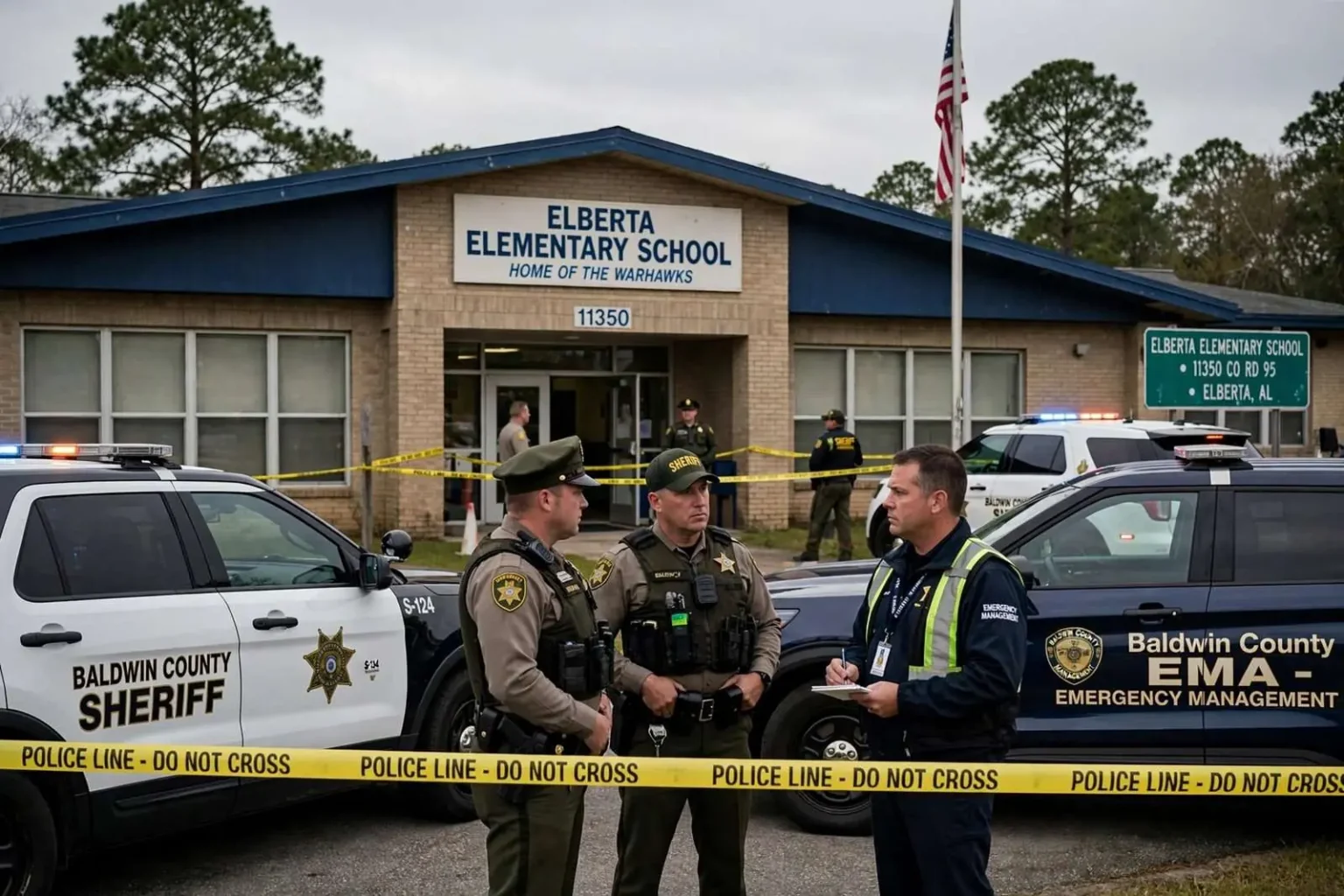
Baldwin County investigators say they still have not ruled out the possibility that shots were fired inside Elberta Elementary School during a lockdown earlier in the week, as first responders from across the county gathered to review their response to the incident. The uncertainty surrounding the central question, whether a shot actually rang out inside the school, has kept the case open even as the emergency response that followed is being studied for lessons.
Emergency personnel met at the Baldwin County Emergency Management Agency office in Robertsdale for the first joint debriefing since the school went into lockdown just after 1:30 p.m. the previous Wednesday. The session brought together every agency that touched the incident, from deputies and municipal police to fire and medical responders, in the kind of after-action review that emergency management professionals consider the most valuable step after any major call.
Baldwin County Sheriff Huey “Hoss” Mack said it marked the first time every agency that responded that day had been in the same room together, and that while communication between agencies could be improved, the overall response to the rural community’s lone elementary school was handled well and by the book. The county’s emergency management framework, coordinated through the EMA office in Robertsdale, exists for exactly this purpose: getting disparate agencies onto the same page during an incident and then comparing notes afterward while memories are fresh.
Elberta sits in the southern stretch of Baldwin County, a small farming community whose elementary school serves as one of the town’s few public buildings. A lockdown at the school empties onto a community with limited resources of its own, which is why the response drew agencies from across the county rather than relying on the closest municipal departments alone.
How the Incident Unfolded
According to Mack, a woman came to the back service door of the school’s cafeteria asking to speak with a relative who worked there, and entered the building once a cafeteria employee went to retrieve that staff member. Investigators believe a handgun was produced shortly after she entered. The sequence, a familiar face at a service entrance, a moment of unsecured access, and a weapon appearing inside a school building, compressed a full-scale emergency into seconds.
Forensic specialists had already collected evidence from the scene, including fractured glass and a bent metal window frame consistent with possible gunfire, though accounts from witnesses in close proximity to the incident were mixed on whether a shot was actually heard. The physical evidence and the human recollections point in slightly different directions, and investigators have resisted settling the question until both can be reconciled.
Mack said investigators believe it’s possible shots were fired from outside the school as well, and that the entire episode unfolded in a matter of seconds. That possibility, a shot originating beyond the building, adds another layer to the reconstruction, since it would mean the sound some witnesses may have heard did not come from inside the cafeteria at all.
Reconstructing an incident that lasted seconds takes weeks. Investigators work from the physical evidence, the trajectories and marks that tell them where a round may have traveled, the entrance logs and camera angles that establish who was where, and the often conflicting accounts of people who experienced the most frightening moments of their lives and reported them in fragments. The joint debriefing at the EMA office addressed the response, but the criminal investigation continues alongside it.
The Response, Reviewed
The lockdown procedure itself worked as designed. Schools across Baldwin County drill for these scenarios, training staff to secure students behind locked doors, account for every child and wait for law enforcement to clear the building. When the call went out Wednesday afternoon, the school executed the plan while deputies converged on the campus, and the woman was taken into custody without harm to students or staff.
Mack’s assessment that communication between agencies could be improved is a standard finding of after-action reviews, and a valuable one. Multi-agency responses run on radio interoperability, clear command structures and pre-established protocols, and the gaps that appear under stress are precisely what debriefings exist to find. The sheriff’s praise for the overall effort, handled well and by the book, signals that the gaps identified were procedural rather than fundamental.
The Aftermath and the Court’s Response
The woman involved was later ordered held on $1 million bail, required to undergo a mental evaluation, and barred from coming within a mile of a school. The conditions imposed by the court reflect the seriousness with which the justice system treats weapons on school grounds, even when no one is physically harmed, and the mile exclusion zone keeps her away from every school campus in the area, not just Elberta.
Alabama law imposes heightened penalties for possessing a firearm on school property, and courts routinely pair such charges with mental health evaluations when the circumstances suggest the defendant was in crisis. The $1 million bail figure, high for an incident with no reported injuries, communicates the court’s assessment of the danger posed, and it also functions to keep the individual in custody long enough for evaluation and for the investigation to run its course.
For the children and staff who were inside the building, the aftermath is its own process. Schools that experience lockdown incidents typically bring in counselors, and teachers spend the following days answering questions and restoring the sense that school is a safe place. In a small community like Elberta, where the elementary school is a civic center as much as a campus, the incident touched nearly every family in town.
An Armed Parent at the Perimeter
Officials also disclosed that a separate, armed parent had to be stopped from entering the school perimeter that law enforcement set up in the aftermath of the initial incident. That parent was not arrested, but Mack called the situation extremely dangerous, stressing that in scenarios like this, only law enforcement should be armed inside the perimeter.
The moment illustrates a modern reality of school incidents: parents racing to the campus within minutes of the first alert, and officers tasked with holding a cordon against people acting out of fear and love rather than malice. Police agencies nationwide have grappled with how to manage that convergence, using reunification sites away from the scene, staggered release procedures and clear communication, because a perimeter filled with armed, frightened civilians multiplies the risks for everyone.
Sheriff’s officials emphasized that a parent carrying a weapon toward an active incident, however understandable the impulse, creates the worst possible conditions for responding officers: a second armed person whose identity and intent cannot be verified at a distance, in the middle of a scene already being searched for exactly such a figure. The instruction that only law enforcement should be armed inside a perimeter is not a bureaucratic rule but a survival protocol for everyone, including the parent.
What the Debriefing Means for Baldwin County Schools
The joint debriefing will feed into broader planning for how Baldwin County handles school emergencies, a subject the county has invested in heavily as its student population has grown. The sheriff’s office and the school system maintain coordinated emergency plans, and each real incident, however troubling, supplies the data that drills cannot: how long notifications actually took, where radio coverage failed, how the service entrances that are supposed to stay secured performed under real conditions.
The question of the service door, where the woman entered while an employee went to retrieve her relative, will draw particular scrutiny. School security reviews across the country have focused on exactly these access points, back doors, kitchen deliveries and service corridors, which staff open daily for practical reasons and which represent the most common breach point in school incidents. Balancing the operational needs of a working school kitchen against the security requirement that every exterior door remain closed and monitored is a challenge every district manages, and Elberta’s experience will inform how Baldwin County draws that line.
The unresolved question of the gunfire will also shape the case going forward. If forensic analysis confirms that shots were fired, whether inside the cafeteria or from outside the building, the charges the woman faces could change, and the physical evidence will matter more than any single witness account. Investigators have kept the possibility open deliberately, refusing to close a question that the evidence has not yet answered.
For the Elberta community, the county’s public willingness to review its own performance, and to name the places where communication fell short, offers a measure of reassurance. The debriefing was the first time every responding agency sat in the same room, but officials indicated it will not be the last; after-action reviews are most valuable when they become routine, and a rural school that draws a county-wide response deserves nothing less than a county-wide accounting of how the response went.