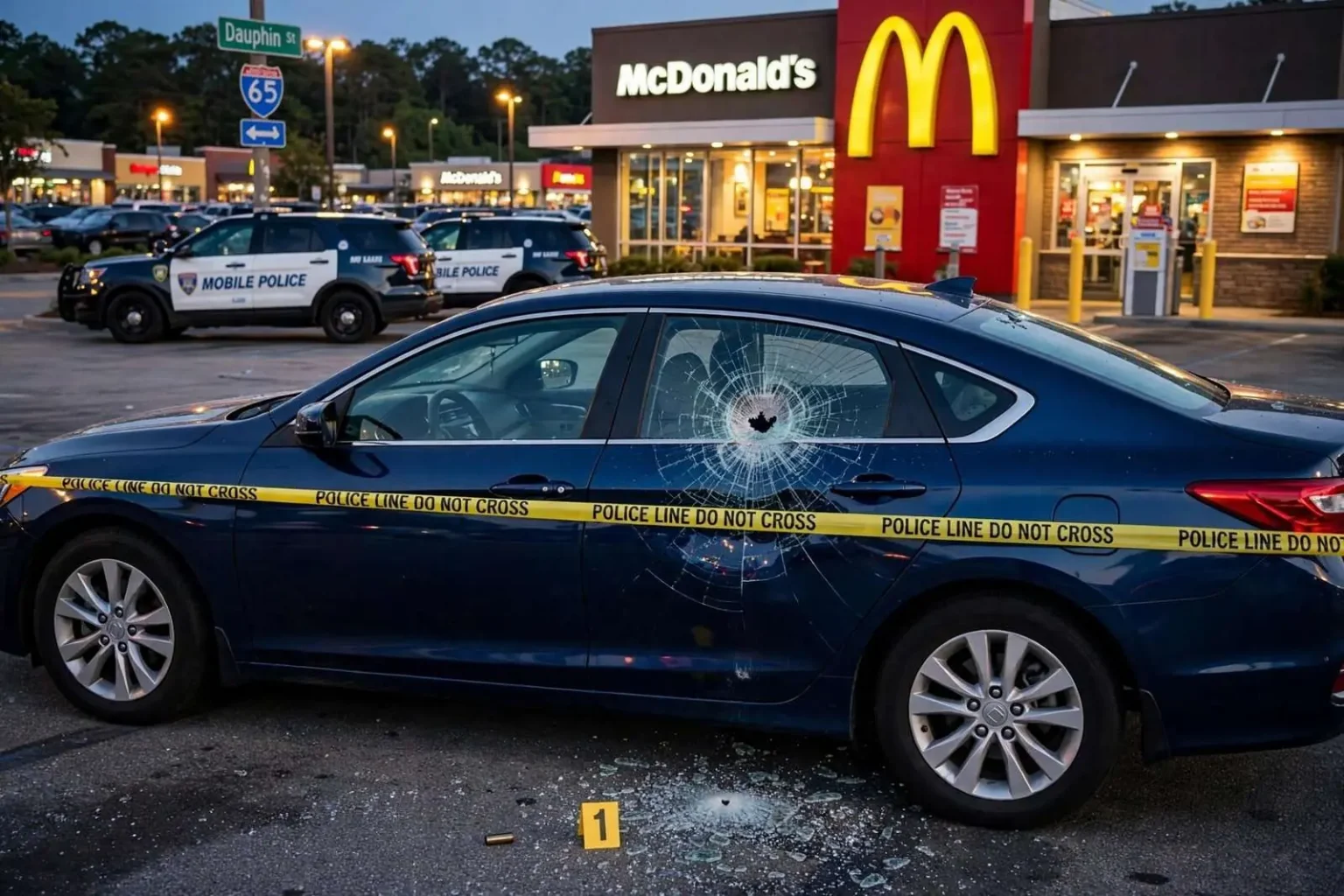
A trip for fast food turned frightening for one Mobile customer after his vehicle was struck by gunfire during an argument between two other men in a restaurant parking lot, according to the Mobile Police Department. Officers responded around 7 p.m. one Wednesday night to a report of gunshots at the McDonald’s located near Dauphin Street and Interstate 65, said police spokesman Terence Perkins.
Investigators determined that two men had gotten into an argument next to a customer’s parked car. During the dispute, one of the men fired a handgun, and the shot struck the vehicle the customer was sitting inside. The customer was not injured despite the gunfire striking his car, a close call that police said could easily have ended differently had the round traveled a few feet in another direction.
Investigators did not immediately identify either of the men involved in the argument or announce any arrests. The lack of names reflected the early stage of the inquiry: with both participants apparently gone by the time officers arrived and the wounded vehicle the only physical evidence on the scene, detectives were left to work backward from shell casings, witness statements and whatever the surrounding cameras recorded.
The McDonald’s sits along one of Mobile’s busiest retail and dining corridors near the interstate interchange, an area that draws heavy traffic throughout the day and evening from commuters, shoppers and travelers passing through the city. The stretch of Dauphin Street near the interstate links midtown neighborhoods with the shopping districts to the west, and its fast-food lots stay busy through the dinner hour, when the shooting occurred.
An Argument and a Single Shot
Mobile police did not release details about what sparked the argument between the two men or whether the dispute was linked to any prior conflict. The department’s ongoing investigation is treating the shooting as an isolated incident between the two men rather than a random act targeting the restaurant or its customers, a distinction that matters for residents deciding whether the area remains a routine stop.
Parking lot disputes escalating into gunfire, while relatively rare, put uninvolved bystanders at risk in exactly the kind of everyday setting where people expect to feel safe. A customer sitting in his own car waiting on an order has no role in someone else’s quarrel, yet a single errant round in a crowded lot can injure or kill a bystander as easily as a combatant. Police departments across the Gulf Coast have made the same point in recent years while investigating arguments that turned deadly in retail parking areas.
Officers canvassed the area for surveillance footage from nearby businesses that might help identify the shooter, a standard step in commercial-area shootings where multiple cameras often cover overlapping fields of view. The restaurant itself, along with several neighboring businesses, typically maintains exterior security cameras that could assist investigators in piecing together the sequence of events, from the moment the two men began arguing to the instant the shot was fired and both left the lot.
How These Investigations Work
Commercial-area shooting investigations follow a well-worn path once the initial response ends. Detectives collect casings and examine the struck vehicle for entry points, then compare what the physical evidence shows against the accounts of anyone who saw or heard the argument. Parking lots like the one at this McDonald’s present both an advantage and a challenge: multiple cameras overlook the property, but dinner-hour traffic means any capture of the shooter’s face or the vehicle he left in must be pulled from frames full of other cars and customers.
The Mobile Police Department is continuing to investigate, and detectives have not said whether the two men knew each other before the argument began. Charging decisions in cases like this one typically wait until investigators can identify the shooter and locate him, since an arrest on assault or shooting-into-an-occupied-vehicle charges requires enough evidence to survive review by the district attorney’s office. Under Alabama law, discharging a firearm into an occupied vehicle is a felony on its own, even when no one inside is hurt.
The timing of the call, around 7 p.m. on a weeknight, put officers into one of the corridor’s busiest windows. Patrol response to shots-fired calls in commercial areas usually brings several units at once, both to secure the scene and to check whether anyone else was hurt. In this case, the only known damage was to the customer’s vehicle, and medics were not needed for the man police said was sitting inside it when the round arrived.
The identity of the customer whose car was struck has also not been released, and police said only that he declined injury in the exchange. His account of the argument, assuming he witnessed enough of it to describe, would be among the most valuable statements detectives collect, since he sat at the center of the scene while the two men quarreled beside his vehicle. Bystanders inside the restaurant or in neighboring lots who saw the same minutes would fill in the rest.
Gun Arguments in Public Lots
Prosecutors in Mobile County have handled a steady run of cases involving disputes that reached for a gun in public settings, and the outcomes tend to turn on the same factors detectives are assembling here: who escalated, whether the shooter could reasonably claim fear, and how close bystanders came to harm. Alabama law gives wide latitude to self-defense claims but does not protect someone who introduces a firearm into a shouting match and fires in a crowded lot, particularly when the round strikes a person or vehicle with no role in the dispute.
The department’s Public Information Office, which Perkins staffs, serves as the channel between the investigation and the neighborhood, balancing what can be released against what could compromise the case. Residents along the corridor who heard the shot that evening but saw nothing have little to add; the people detectives want are those who watched the argument build, because motive and sequence are what turn a struck car into a conviction.
What It Means for the Corridor
Businesses along the Dauphin Street corridor operate in one of the city’s most heavily trafficked retail zones, where the interchange brings together drivers from Interstate 65, the Bankhead Tunnel approach to the south, and the residential streets of Spring Hill and midtown. Incidents in these lots draw attention precisely because thousands of residents pass through them weekly, and a single shooting can linger in customers’ minds long after the investigation ends.
Police routinely note that commercial lots are neither more dangerous nor safer than other settings; they simply concentrate strangers near each other at close range, which raises the stakes when tempers flare. Restaurant and retail managers in Mobile have responded to isolated incidents in recent years by adding or upgrading exterior cameras, improving lot lighting, and coordinating with the department’s precinct commanders on patterns they observe in the evening hours.
For customers, the practical lessons from incidents like this one are the ones officers repeat after every parking lot shooting: leave the area if a nearby argument turns physical, call 911 rather than intervening, and pay attention to details that help investigators, such as descriptions of the people involved and the direction they drove away. Witnesses who left the lot before officers arrived are encouraged to come forward, since even partial accounts of the argument can establish the sequence detectives need.
The case also illustrates how the department’s public updates work in the hours after a shooting. Initial releases, like the one carrying Perkins’ name, confirm the location, the time and the basic facts while withholding identities and theories of the case. Follow-up details, if any, typically emerge only after an arrest, and many commercial-area shootings are never publicly updated again unless charges are filed, leaving residents to rely on the initial account.
Gunfire striking an occupied car with no injury is the rarest of outcomes in these disputes. National data on parking lot shootings shows that rounds fired into vehicles at close range frequently strike occupants, which is why investigators and prosecutors treat the customer’s survival as luck rather than design. It is also why the department’s decision to classify the shooting as targeted at the two men, not the restaurant or its customers, carries real weight for how the public reads the incident.
Detectives will now work the case the way commercial-area shootings are worked across Mobile: pulling camera footage before it is overwritten, interviewing anyone who called 911, and tracing the argument from its beginning to the moment a handgun came out. When an identification is made, the file will move to the district attorney for review, and the next public word will likely come in the form of an arrest rather than an update, closing out an evening when a fast-food run nearly turned fatal for a customer who had nothing to do with the fight that struck his car.