Mobile Police Officer Treated After Three-Vehicle Crash on Dauphin Street
A Mobile police officer suffered minor injuries when a driver pulled into his path near Dauphin Street and Springdale Boulevard during a call response.
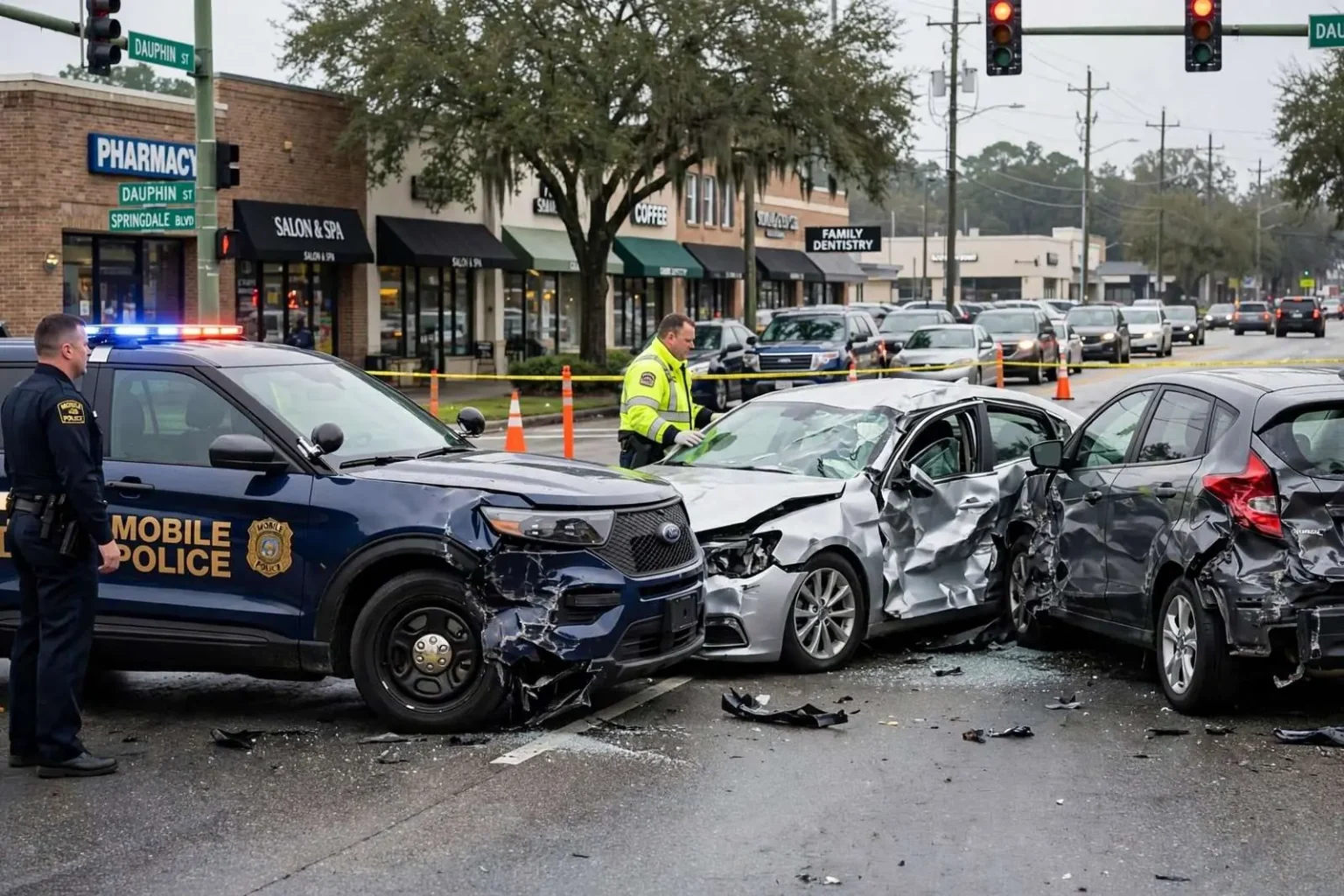
A Mobile police officer was taken to a local hospital and released after being involved in a three-vehicle collision while responding to a call, according to the Mobile Police Department. The crash, which snarled midtown traffic at one of the city’s busiest intersections, ended with no serious injuries — but it stands as a reminder of the risks that come with every emergency run, and of the split-second decisions other drivers make around patrol cars every day.
How the Crash Unfolded
The officer was driving west on Dauphin Street in a marked patrol vehicle around 9 a.m. when the crash occurred at the intersection with Springdale Boulevard, said police spokeswoman Ashley Rains. A driver in another vehicle apparently did not notice the officer’s flashing emergency lights and pulled out in front of him. The two vehicles collided and then struck a third car nearby. Morning rush was still clearing when it happened, and the intersection — where Dauphin’s four lanes meet Springdale’s commercial strip — left little room for any of the three vehicles to avoid the chain of contact.
Paramedics checked the drivers of the other two vehicles at the scene, and both were released without being transported for treatment, Rains said. The officer was taken to a hospital as a precaution and suffered only minor injuries before being released the same day. The precautionary trip is standard practice for on-duty officers involved in significant impacts, both for the officer’s own safety and because some injuries — the neck and back strains typical of intersection collisions — are not always apparent at the scene.
Police did not disclose the nature of the call the officer was responding to at the time of the crash. Officials said afterward that no criminal charges were expected to result from the collision, characterizing it as an accident rather than a case of reckless driving. That characterization matters in how such cases resolve: a crash found to be accidental typically ends with insurance claims and traffic citations at most, while findings of recklessness can lead to criminal exposure. Here, officials drew the line clearly — the driver misjudged, the officer could not stop in time, and the result was property damage and minor injuries rather than a prosecution.
A Busy Corridor, A Familiar Risk
The intersection of Dauphin Street and Springdale Boulevard sits in a busy commercial corridor of midtown Mobile, near a cluster of restaurants and retail centers not far from Interstate 65. The stretch sees a steady flow of traffic throughout the day, and emergency vehicles moving through the area with lights and sirens are a regular occurrence given the number of first responders who use Dauphin Street as a primary route across the city. Dauphin functions as one of the city’s east-west spines — carrying commuters from west Mobile toward downtown and threading past the hospitals, schools and shopping centers of Midtown — which makes its intersections natural pinch points for both traffic and emergency response.
Collisions involving responding patrol cars, while not common, do happen periodically in Mobile as officers navigate intersections against oncoming traffic that may not immediately clear the way. Responding to a call changes the calculus of every intersection for an officer: authorized to exceed speed limits and proceed against signals — with lights and siren active and due regard for safety — the officer depends on other drivers seeing, hearing and yielding. Each crossing is a negotiation conducted in seconds, and the crashes that occur tend to happen precisely where this one did: at intersections, in the gap between what a patrol car’s lights announce and what a driver actually notices.
The Law on Yielding to Emergency Vehicles
Local law enforcement officials have periodically reminded drivers of the legal obligation to yield to any vehicle displaying active emergency lights, regardless of whether a siren is also audible. Alabama law requires motorists to pull to the right and stop when they see flashing lights approaching from either direction, a rule aimed at preventing exactly the kind of last-second lane change that led to this crash. The statute applies everywhere a driver might be — mid-intersection, at a red light, in a parking lot exit — and it obliges drivers to clear the path first and sort out their own positions afterward.
Safety officials pair the legal reminder with practical advice that addresses the common ways drivers fail the test: check mirrors before changing lanes when you hear a siren, never brake abruptly in a travel lane, stop well back from intersections so emergency vehicles can pass, and remember that lights alone — silent lights, as in some non-siren responses — carry the same legal weight as a full siren run. Modern vehicles, with their insulated cabins and sound systems, make it easier than ever to miss an approaching siren, which is why officers are trained to treat every intersection as if drivers have not yet seen them.
What Follows an On-Duty Crash
No further details were released about the identities of the other drivers involved or the extent of any damage to the vehicles. The Mobile Police Department did not indicate whether an internal review of the incident was planned, which is standard practice for crashes involving on-duty officers regardless of fault. Departments across Alabama review every on-duty collision for the same reasons insurance adjusters review any crash: to establish the facts, to identify training or equipment issues, and to protect both the officer and the public record.
The mechanics of the aftermath are routine but worth understanding. The responding emergency here was double: the call the officer was answering had to be reassigned to another unit, and the crash scene itself required traffic control on a corridor that cannot easily absorb a blocked intersection. Investigators documented the scene, photographs were taken, witnesses were identified, and each of the three vehicles left the scene on a different path — the officer to the hospital, the other drivers to the roadside to exchange information, and the wreckage to tow yards and claims adjusters.
For the officer, the afternoon ended with a release from the hospital and, in time, the ordinary return to duty that follows a minor injury. For the two drivers, the collision resolves as an insurance matter — an expensive, disruptive day with no lasting harm. And for the drivers who pass through Dauphin and Springdale every morning, the scene — three vehicles, a patrol car with its doors crumpled, lights still turning — is the kind of visible lesson that stays with commuters longer than any public safety announcement.
Emergency Response in a City Built Around Corridors
Mobile’s geography makes Dauphin Street and corridors like it central to how the city’s emergency system works. The city stretches east to west along Mobile Bay’s western shore, its neighborhoods divided by a web of arterial streets that funnel traffic toward the downtown, the hospitals and the interstate. Fire stations, ambulance posts and police beats are positioned along those arteries, and response times in a city of Mobile’s size depend on keeping them moving. Every blocked intersection — whether by crash, construction or a rail crossing — ripples outward to the units that would have used it.
That is also why the city’s first responders run through Midtown so often. The hospitals cluster near the center of the city, the interstate crossings funnel suburban traffic through the same corridors, and a fire station’s first-district boundaries put Midtown streets at the front of almost every response map. A resident of the Springdale Avenue corridor will hear sirens daily, and the routine nature of that sound is part of the safety problem officials keep describing: familiarity breeds inattention, and inattention at an intersection is precisely how crashes like this one happen.
The Broader Record on Emergency Vehicle Crashes
Nationally, collisions involving emergency vehicles account for a small but persistent share of the incidents that injure both responders and civilians, and intersections are overwhelmingly where they occur. Studies of emergency response driving have consistently found that the most dangerous moment of any run is not the high-speed stretch between intersections but the crossing itself — where the responding vehicle must enter against traffic and rely on other drivers to see and yield. The findings have shaped training across the country, including in Alabama, where officer and firefighter driving courses emphasize slowing at intersections, clearing lanes, and assuming that at least one driver has not seen the lights.
The “due regard” standard at the heart of that training is also the legal test. An officer responding to a call is granted exemptions from ordinary traffic law, but those exemptions are conditioned on operating with due regard for the safety of others — a phrase courts interpret on the facts of every case. When an officer strikes a vehicle that pulled out despite active lights, the law generally places the burden back on the other driver, which is the position Mobile officials took in their assessment of this crash. No charges were expected, no reckless driving was alleged, and the incident was treated as what officials concluded it to be: an accident in the ordinary sense of the word.
For the Mobile Police Department, the episode closes with the outcomes that matter most — an officer treated and released, two civilians checked and cleared, and no serious injuries on a corridor that could easily have produced them. The reminder it leaves behind is aimed at everyone else on the road: when the lights appear in your mirror or across an intersection, the law’s instruction is simple — yield to the right, stop, and let the emergency pass. The seconds a driver loses by pulling over are nothing against the cost of finding out what happens when they don’t.