University of South Alabama Mobile
City Slashes BayFest Funding, but Festival Founder Says It Will Go On
Mobiles proposed budget cuts BayFests city appropriation by 59 percent, but organizers say this years festival will proceed as scheduled.
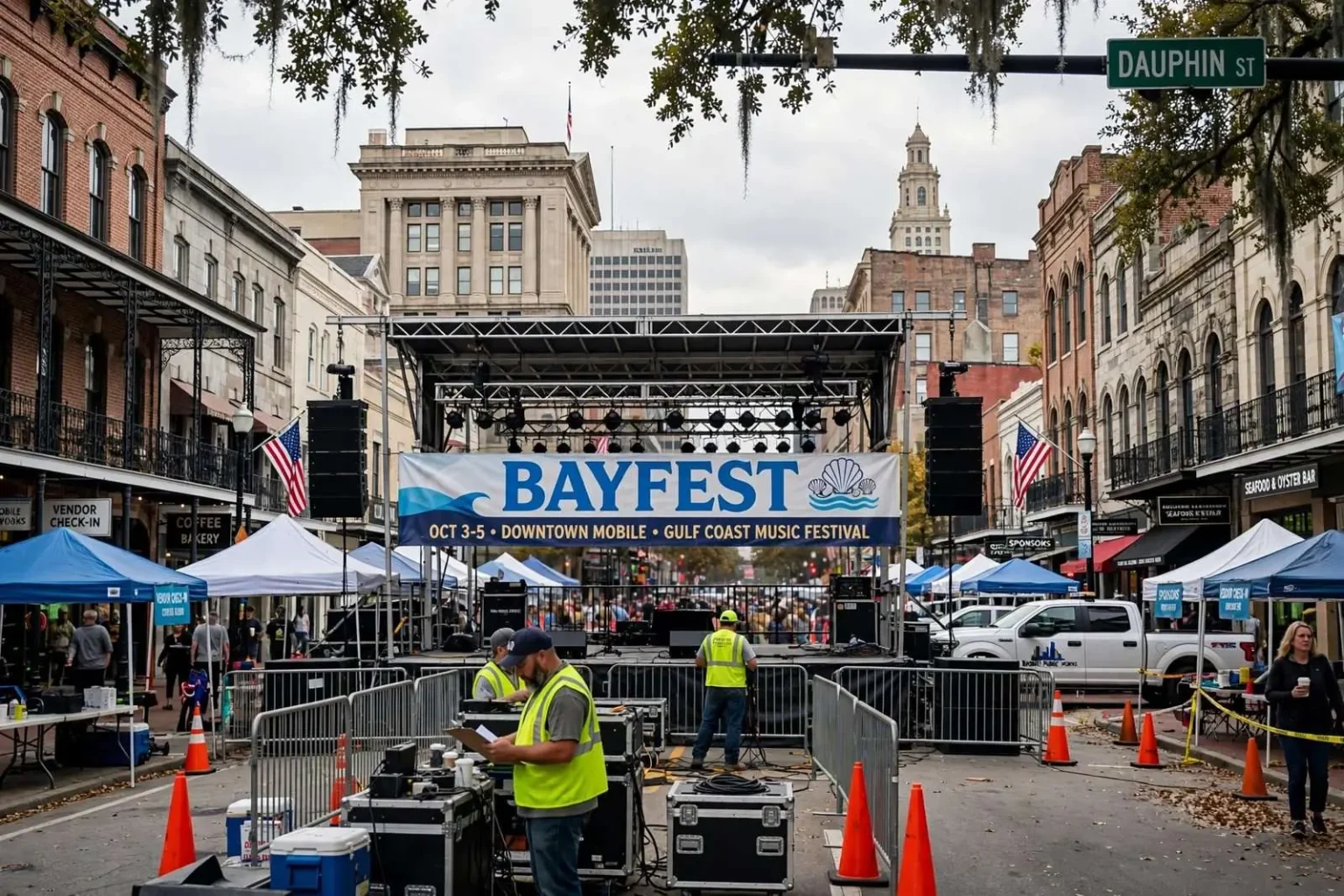
MOBILE, Ala. — The city’s proposed fiscal year 2015 budget slashes funding for the annual BayFest music festival by 59 percent, dropping the city’s contribution from $243,000 last year to just $100,000. Despite the steep reduction, festival organizers say the show will go on this fall as planned.
Bobby Bostwick, board president of the BayFest organization, downplayed concerns over the cut once the proposed budget became public, saying every city-funded group seemed to be absorbing reductions this cycle. Just a day earlier, Bostwick had warned that a total elimination of city support could put the festival’s future in jeopardy, but the smaller-than-feared cut appeared to ease those worries for this year’s event, scheduled for Oct. 3-5 in downtown Mobile.
The episode was one of the most closely watched line items in a budget season that required City Hall to reconcile the demands of dozens of outside agencies and events against the revenues available to fund them. Under Mayor Sandy Stimpson, who took office in late 2013 promising a harder-nosed look at city spending, groups that had long counted on direct appropriations found themselves justifying their subsidies with attendance figures, financial statements and economic impact data. BayFest, with one of the largest public subsidies of any annual event, sat squarely in the middle of that review.
The three-day festival has long transformed the streets of downtown Mobile into a sprawling outdoor music venue, staging dozens of acts across multiple stages over a single October weekend and drawing crowds from across the Gulf Coast. For many local businesses downtown, the first weekend of October ranks among the busiest of the year, as hotels fill, restaurants extend hours and bars around Dauphin Street absorb thousands of festivalgoers moving between stages.
The mayor’s case for a smaller check
Mayor Sandy Stimpson said the $100,000 direct appropriation is only part of the city’s overall support for the festival. He noted the city will also contribute roughly $150,000 in in-kind services, covering costs like police presence, barricades, and other logistical support needed to safely run a large downtown event. Counted together, the city’s total support still approaches a quarter of a million dollars even in a year when the cash contribution fell so sharply.
Stimpson acknowledged BayFest’s importance to the community, noting it has anchored Mobile’s fall calendar for two decades. The mayor pointed to a series of unusual financial developments in recent years as part of the reasoning behind the reduced allocation. Those included a $3.2 million settlement payment BayFest received tied to the Deepwater Horizon oil spill, along with a 2006 legislative exemption that freed the organization from paying taxes on goods it buys or sells in connection with the festival.
Those two facts cut to the heart of the city’s argument. The spill settlement, paid to compensate Gulf Coast organizations for revenue and other losses stemming from the 2010 disaster, left BayFest in a stronger financial position than most nonprofit festival operators in the region. The sales tax exemption, secured through the Legislature seven years earlier, further relieved the organization of costs other event promoters absorb on every ticket and vendor transaction. Against that backdrop, Stimpson and his budget staff concluded the festival did not need city cash at the level it had received in previous years.
What organizers asked for
Earlier this year, Bostwick had requested $350,000 in direct funding plus the in-kind services package, pointing to an economic impact study from a University of South Alabama professor that found the city received a 366 percent return on its prior year’s investment in the festival. The study’s arithmetic was simple enough: money the city put in, measured against the sales tax, lodging and related revenue the event generated, came back several times over.
That kind of return is why festivals across the country seek public support in the first place. A large outdoor music event incurs heavy upfront costs — staging, sound, lighting, security, insurance and cleanup — before the first customer walks through the gates. Ticket prices alone rarely cover the full cost of a festival that also positions itself as a community celebration rather than a purely commercial venture. Public appropriations, organizers argue, bridge that gap while returning economic activity that benefits the whole city, not just the festival’s balance sheet.
But Stimpson said learning that BayFest held roughly $2.6 million in reserves factored heavily into the city’s decision to scale back support to $100,000 this year, while leaving open the possibility that funding levels could shift again in future years. From the administration’s perspective, an organization with reserves of that size — several times its annual city appropriation — could absorb a smaller public subsidy without endangering the event, particularly in a budget year when services and other obligations were competing for the same dollars.
Threats, meetings and reassurances
Stimpson said he and Bostwick met privately before the budget was finalized to discuss the appropriation, and he emphasized that the conversation never touched on the festival potentially relocating outside Mobile. Bostwick, however, said earlier in the week that should the city move to defund BayFest entirely, he would be open to exploring other host cities for the event.
The public back-and-forth underscored how much leverage each side held. A festival of BayFest’s size is not easily duplicated by a rival city — it requires the street grid, infrastructure and civic cooperation that downtown Mobile provides — but for the city, losing an event that has defined its October for two decades would leave a visible hole in the fall calendar and the downtown economy. Both sides, in the end, had strong reasons to keep the festival where it is, and neither was eager to test what the other might do in a standoff.
For 2015, at least, the question was settled: the festival would receive its reduced appropriation, organize its usual three-day run and hope that attendance revenue and sponsorship could cover the shortfall from prior years. Organizers’ immediate challenge was logistical rather than financial — booking acts across multiple stages, coordinating with police and public works on street closures, and managing the vendors and volunteer corps the event depends on each year.
A changing standard for city support
The BayFest decision fit a broader pattern in how Mobile’s city government approached outside organizations under the new administration. Instead of treating appropriations to festivals, museums and civic groups as recurring entitlements, the budget process began asking each recipient to demonstrate need and return on the public’s investment. Organizations with healthy reserves, other revenue streams or recent windfalls found their subsidies trimmed first, while the city protected core services it was legally obligated to provide.
That shift was never purely about BayFest. The fiscal 2015 budget proposal required trade-offs across every department and every outside agency the city supports, and the mayor consistently framed his budget choices as corrections to structural problems inherited from previous years rather than judgments about the value of any single event. Still, the contrast was stark: an organization that had received $243,000 one year and requested $350,000 the next ended up with $100,000 and the continued benefit of in-kind services worth roughly $150,000 more.
What the cut means for the festival
For the BayFest organization, the reduced appropriation meant tightening a budget that already operated on thin margins typical of the festival business. The $143,000 difference between what the city gave last year and what it gives this year is real money for a nonprofit event — the equivalent of a headline act’s fee, a fleet of staging rentals or a significant share of security costs. Organizers could draw on reserves to cover the gap, but reserves, once spent, are difficult to rebuild, which is why the administration’s knowledge of those reserves shaped the debate so strongly.
The in-kind services, meanwhile, are anything but trivial for an event of this scale. Policing a downtown festival that draws tens of thousands of people across multiple stages requires overtime for officers, traffic control around closed streets and coordination with fire and emergency medical crews on standby throughout the weekend. Barricades, signage, street cleanup and utility support all represent costs that would otherwise come out of the festival’s budget or be passed along to vendors and ticketholders. When those services are tallied, the city’s contribution remains one of the largest the event receives from any single source.
For now, downtown Mobile will see BayFest return for its annual three-day run in October, even as organizers and city leaders continue to negotiate what long-term public support for the festival will look like going forward. The warning shot from both sides — Bostwick’s openness to other host cities, Stimpson’s insistence that reserves and windfalls must count in funding decisions — set the terms for future budget seasons, in which BayFest’s appropriation will likely be weighed against its balance sheet each year rather than renewed as a matter of course.
What is not in dispute is the event’s place in the city’s identity. For two decades, BayFest has been one of the largest festivals on the Gulf Coast and a fixture of downtown Mobile’s economy, and no one in the dispute argued for letting it fade. The question, for this year and the years after, is simply how much of the festival’s cost the city’s taxpayers should carry — a question the 2015 budget answered at $100,000, with an implicit invitation for organizers to prove the festival can stand on more of its own.