University of South Alabama Mobile
Kappa Sigma Breaks Ground on New Fraternity House at South Alabama
Kappa Sigma alumni and students broke ground on a new on-campus fraternity house at the University of South Alabama.
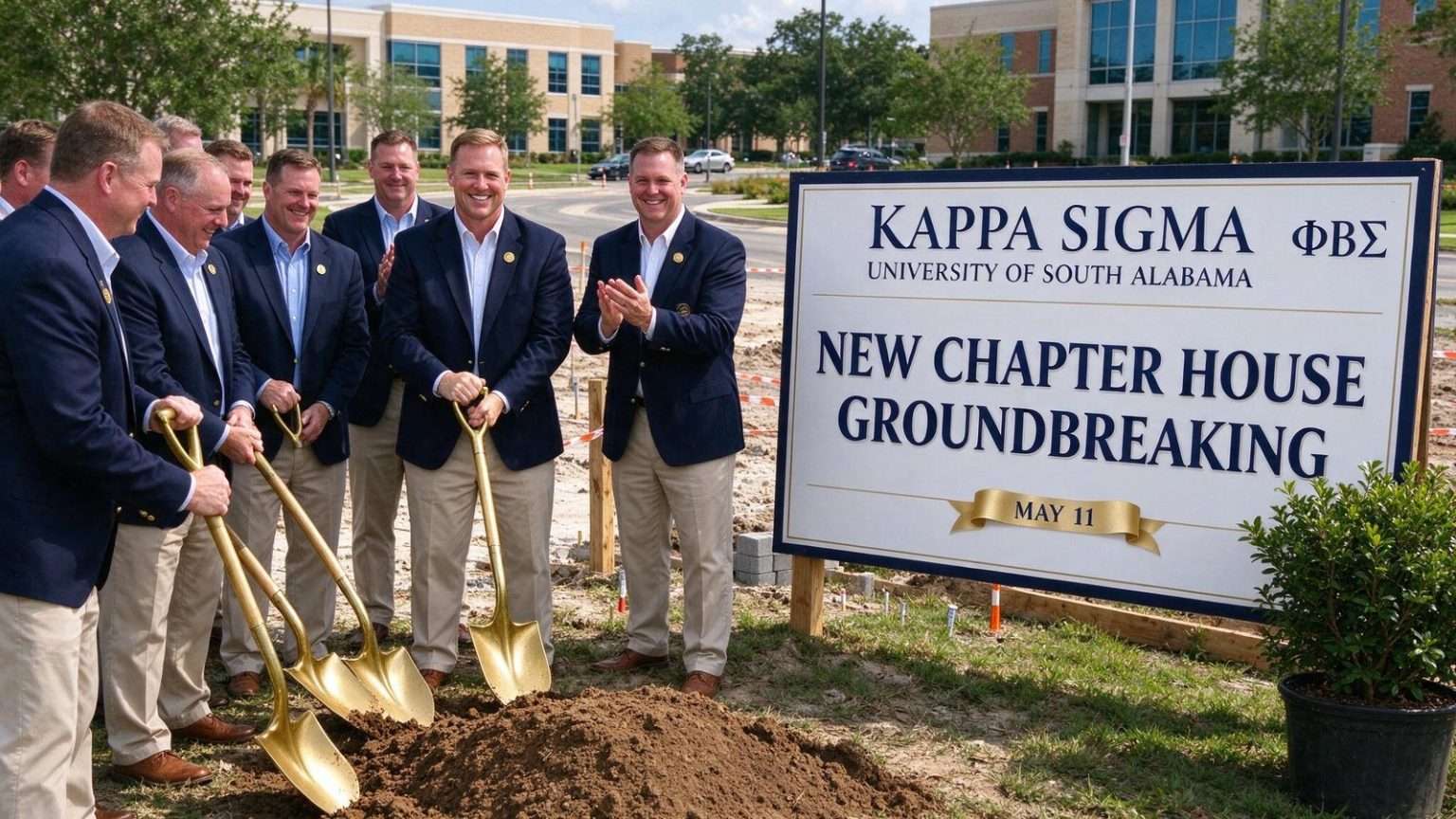
Members and alumni of the Kappa Sigma fraternity at the University of South Alabama recently celebrated a milestone nine years in the making: the start of construction on a new, on-campus fraternity house. The groundbreaking comes as the chapter marks its 46th anniversary at the university.
For years, Kappa Sigma brothers lived in a house located near, but not directly on, USA’s campus. That is set to change with a new building planned in front of Gamma 9, facing the university’s traffic circle, putting the fraternity in the heart of campus for the first time.
The location places the new house among the university’s core residential facilities, visible from one of the campus’s main circulation points. Moving onto university land changes the chapter’s relationship with the institution in practical terms as well — the building will fall under the university’s planning, safety and facilities oversight, and its residents will live within the same footprint as the rest of USA’s on-campus student population.
Construction officially got underway on May 11, timed to begin just after the spring semester wrapped up, according to chapter alumni president Robert E. McManus IV. The post-semester start lets the noisiest phases of the work proceed while most students are away for the summer, sparing the surrounding residential area the worst of the construction traffic.
A funding model built on alumni
McManus said the project relies on a funding model in which alumni cover the bulk of the cost, with the university backing the remainder. That approach, he said, keeps current students from shouldering the financial burden of a project expected to cost between $2 million and $3 million.
The structure is increasingly common in Greek housing nationwide, where undergraduate members — who live in a chapter house for only a few years — are rarely in a position to finance major construction. Alumni housing corporations, often organized as nonprofit entities, raise funds from generations of graduates, arrange financing and hold the property, while the university provides land, infrastructure connections and long-term cooperation.
At South Alabama, that means donations from Kappa Sigma alumni stretching back across the chapter’s four and a half decades are the engine of the project. Nine years of planning — through fundraising campaigns, design revisions and negotiations with the university over the site and the operating arrangement — preceded the May groundbreaking.
An adjoining dormitory
Rather than students financing the new house directly, the plan calls for an adjoining dormitory to be filled first by fraternity members as space allows, with remaining beds available to the broader student body.
“From what I understand, it’s a concept USA feels other off-campus fraternities may be able to do to get on campus,” McManus said, suggesting the arrangement could serve as a model for other Greek organizations looking to relocate onto university property.
The hybrid arrangement solves several problems at once. It gives the fraternity a guaranteed core of residents to sustain the chapter, fills remaining beds with the general student population so the university’s housing inventory grows, and spreads the cost of the new construction across a building that serves more than one purpose. University residence halls across the country have adopted similar shared models as institutions seek to bring Greek housing under their residential-life systems.
The campus housing trend
Moving fraternity housing onto campus has been a broader trend at many universities seeking to keep student life, and the oversight that comes with it, closer to the core campus footprint. Administrators cite student safety, property maintenance standards and academic accountability among the benefits: houses on university land are subject to university fire inspections, guest policies and conduct systems, while off-campus houses often operate beyond the institution’s direct authority.
For universities like South Alabama, whose residential campus has expanded steadily since its founding in 1963, absorbing Greek housing into that footprint also strengthens the residential character of the campus. Commuter-heavy institutions have found that on-campus student life — of which fraternities and sororities are a visible part — is a measurable factor in retention, since students who live and socialize on campus are more likely to stay enrolled through graduation.
South Alabama’s Greek system has been part of campus life since the university’s early decades, with fraternities and sororities organized under the university’s office of student involvement. Chapters have historically relied on a mix of off-campus houses and university spaces, and the Kappa Sigma project is the most prominent recent move to change that geography.
A chapter with deep roots
For Kappa Sigma, the shift represents both a practical upgrade and a symbolic step toward deeper integration with the university’s campus culture after decades operating from an off-campus location. The chapter’s 46th anniversary at South Alabama spans nearly the full history of the university itself, which admitted its first students in 1964 and has grown into the second-largest university in the state system on the Gulf Coast.
Alumni of the chapter include generations of Mobile-area professionals, and the fundraising effort drew on that network. Chapter alumni associations typically organize around reunions and homecoming, but a construction project of this scale required sustained organizing — committee work, pledge campaigns and coordination with the national fraternity’s housing programs, which offer guidance and financing tools for chapter house projects.
The new house replaces living quarters that, like many off-campus fraternity houses, had aged beyond what renovation could economically address. Purpose-built chapter housing constructed to modern codes offers something the old house never could: fire suppression systems, contemporary accessibility, and space designed around both chapter functions and residential life.
A small celebration and a long build
Chapter alumni and current members marked the groundbreaking with a small on-site celebration, with plans for a larger dedication once construction is complete. Groundbreaking ceremonies for Greek housing projects traditionally draw back alumni who remember the chapter in earlier eras, and organizers used the occasion to thank the donors whose gifts over nine years made the project possible.
Construction of a building of this size typically runs twelve to eighteen months, meaning current students will watch the structure rise along the traffic circle during the coming academic year. The chapter expects to occupy the completed facility once fit-out and furnishing finish, with the adjoining dormitory wing opening to residents at the same time.
University officials have pointed to the project as evidence that the campus’s residential growth continues even as construction elsewhere reshapes the institution. For the fraternity’s members, the first morning they wake up on campus will end a nine-year effort and begin a new chapter — literally and figuratively — in the organization’s history at South Alabama.
What the move means for the neighborhood around campus
The relocation also affects the area near the chapter’s old off-campus house. University neighborhoods — the streets just beyond campus where fraternities and student rentals have long clustered — often see both benefits and friction from student housing, and a chapter moving onto university land removes one of the larger party venues from the residential streets. For the permanent residents of those neighborhoods, that shift can mean quieter weekends; for the university, it means the chapter’s activities now fall under campus policies rather than city noise ordinances.
Mobile has watched its university districts mature over the past two decades, with apartment complexes and retail along Old Shell Road and University Boulevard catering to students. The chapter house’s move into the campus core continues the pattern of consolidating student life inside the university’s boundaries, a direction administrators have favored for both economic development and student safety reasons.
Kappa Sigma nationally
Kappa Sigma is among the largest fraternities in North America, with hundreds of active chapters and colonies across the United States and Canada. Its chapters operate under a national structure that includes housing corporations, risk-management standards and scholarship programs, and the national organization has encouraged chapters to relocate onto university-owned land where institutions are willing partners.
The South Alabama chapter’s project fits that national pattern. Fraternity headquarters in recent years have pushed chapters away from aging off-campus houses — which carry liability and reputational risks — toward facilities that meet modern standards, often pairing with universities willing to dedicate land in exchange for shared oversight. The model McManus described, with an adjoining dormitory wing serving the broader student body, is the kind of hybrid arrangement national organizations have cited when encouraging similar projects elsewhere.
For now, the chapter continues operating from its existing house while construction proceeds. Members expect the transition to the new building to coincide with a recruiting season that will let them show prospective members a brand-new facility in the middle of campus — a selling point no off-campus house could match, and one the chapter hopes will carry it through its next 46 years.