Airbus and United Way Expand School Funding Push With Second Round of Mobile Grants
Airbus Americas Engineering and the United Way of Southwest Alabama are funding a second round of grants worth nearly $10,000 for Mobile County school programs focused on attendance, literacy and robotics.
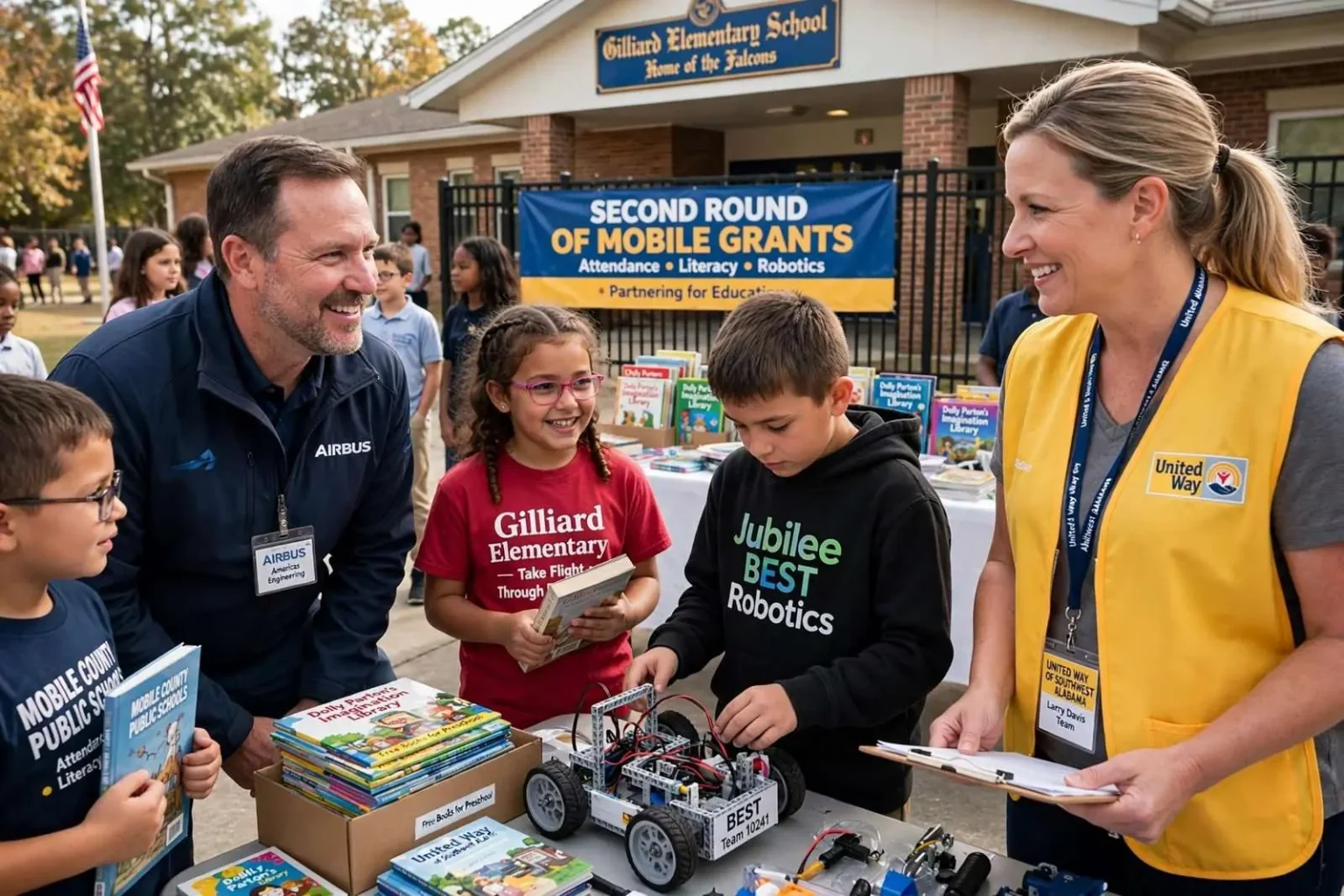
Airbus Americas Engineering and the United Way of Southwest Alabama are moving into the second year of an education partnership that has already funneled thousands of dollars into Mobile County school programs, with new grants totaling nearly $10,000 set to support attendance, literacy and robotics initiatives across the district. The partnership, launched in 2014, was designed to funnel corporate and community resources into programs that improve educational outcomes in the greater Mobile area. The second round of grants signals that the arrangement is not a one-time gesture but a standing commitment, the kind multi-year funding that school programs can plan around.
Organizers say the latest round of funding builds on lessons learned during the first year and targets programs that reach students at several different stages of their education, from preschool through high school. That spread is deliberate. Early literacy efforts lay the groundwork before children can fall behind; attendance initiatives catch trouble as it develops; and robotics programs give older students a destination that keeps engineering skills sharpened through high school.
Among the recipients is the September Attendance Challenge, an incentive-based initiative aimed at boosting attendance across every elementary school in the Mobile County Public School System. The challenge taps one of the most stubborn problems in early education: children who miss school in the earliest grades fall behind in reading, and the deficits compound year after year. Rewarding classrooms and schools for showing up, educators say, costs far less than remediation later. Attendance also serves as an early-warning system for whole families — when a child’s absences spike, schools know to reach out before academic trouble follows — and the September timing is deliberate, setting attendance habits in the year’s opening weeks while the school year is still young.
Also receiving funds is Dolly Parton’s Imagination Library, which mails free books each month to preschool-age children living along the Dauphin Island Parkway corridor, an area organizers have identified as a priority for early literacy support. The Imagination Library, founded by the country music legend and now active in communities across the United States, sends an age-appropriate book to enrolled children every month from birth until age five, building home libraries in places where they may not otherwise exist.
Reading and robots
Gilliard Elementary School will again see funding flow to its “Take Flight Through Reading” program, an accelerated reading initiative that rewards students for meeting individual reading goals. Gilliard, which serves a neighborhood in the southern part of Mobile, made the accelerated reader approach a centerpiece of its literacy instruction, and the grants underwrite both the reading materials and the rewards that keep children turning pages.
Jubilee BEST Robotics, a robotics program based at B.C. Rain High School, rounds out the list of programs sharing in this year’s grants. BEST — which stands for Boosting Engineering, Science and Technology — challenges student teams to design and build a functioning robot over a compressed six-week season, culminating in competitions that draw schools from across the region. B.C. Rain, located in the Oakdale area of Mobile, has made the program a signature offering for students drawn to engineering and technical careers.
For an aircraft manufacturer, the robotics connection is hardly accidental. Airbus has an obvious stake in the supply of future engineers, welders, and technicians, and programs like Jubilee BEST give students their first taste of the problem-solving, teamwork, and deadlines that define work in the industry. A grant that puts tools in the hands of a high school robotics team is, in a sense, seed capital for the company’s own future hiring pipeline.
A company beyond the factory floor
Airbus Americas President Barry Eccleston said the company views its role in the community as extending well beyond its manufacturing operations. “Being a good corporate partner and a good corporate citizen is important to us,” Eccleston said. “We are excited to team up with United Way across the country to address the educational goals in the communities where we have a physical footprint. Our investment, coupled with the funds that the Airbus Corporate Foundation has invested throughout the world, will help thousands of students excel in school.”
The remarks place the Mobile grants inside a larger corporate architecture. The Airbus Corporate Foundation operates globally, supporting humanitarian and educational causes in the communities where the company builds and employs, while the Americas engineering arm handles the local partnerships that put dollars and volunteers into specific schools. For Mobile, the arrangement means the city’s grants come with the weight of a global company behind them.
Larry Davis, chief executive of the United Way of Southwest Alabama, said the renewed funding reflects a broader, ongoing relationship between Airbus and the local community that includes volunteer efforts by company employees in area schools. “We are very thankful to have the opportunity to continue working with Airbus to support programs and services to help our community reach education goals in school readiness, reading and math scores, and, most importantly, increasing the graduation rate in Mobile County schools,” Davis said.
Davis framed the priorities in the terms educators use when they talk about the long game: readiness before kindergarten, proficiency in the middle years, and a diploma at the end. United Way chapters across the country have reorganized their education funding around those stages, and the Mobile chapter’s partnership with Airbus follows the same map — money aimed at the points in a student’s career where intervention makes the greatest difference.
At Gilliard, the proof shows up in parties
At Gilliard Elementary, Principal Debbie Bolden said the first year of funding for the accelerated reader program translated directly into motivation for her students. Prizes tied to reading goals, along with quarterly celebrations for students who met their targets, helped keep children engaged with books throughout the school year. “The students were ecstatic when they saw the prizes they could earn, and at the end of each quarter, all students who met their goal were rewarded with a party,” Bolden said. “The celebrations were possible because of the funds we received. Our students strive to make their reading goal and love the recognition and celebrations.”
It may sound small — a prize, a party, a certificate handed out in front of classmates — but elementary educators say recognition is among the most reliable levers they have. A reading program that exists only as a requirement produces reluctant readers; one that produces quarterly celebrations produces students who talk about books in the hallway and ask to take the next one home.
Why corporate-education partnerships hold
The Airbus-United Way model illustrates how school funding increasingly works in Alabama. Public money covers teachers and core instruction, but the extras that motivate students — robotics kits, reading prizes, mailed books, attendance incentives — depend on a patchwork of grants, donors, and volunteer networks. A company with a large payroll and a long hiring horizon, paired with a nonprofit that knows which programs work, can fill gaps that neither the district’s budget nor individual school fundraising reliably reaches.
The partnership also carries lessons for other employers along the Gulf Coast. As more large manufacturers have established operations in the Mobile area, schools have gained corporate neighbors with both resources and reasons to invest: educated graduates become employees, and strong schools become a selling point when companies recruit workers to relocate. Educational giving, in that light, is both philanthropy and economic development.
United Way’s role deserves its own note. The organization vets programs, administers funds, and measures results, sparing the corporate partner the work of evaluating dozens of small requests and sparing schools the work of courting individual donors. The local chapter’s reach across southwest Alabama also means the model can extend beyond a single city as needs are identified.
Looking ahead
School and community leaders say they expect the Airbus-United Way partnership to continue evolving in future years, with additional programs potentially added as new needs are identified across Mobile County classrooms. Each year’s grant cycle, organizers suggest, will reflect what the previous year taught: which attendance incentives moved numbers, which reading programs held students’ attention, and where the next gap appears.
For the programs already funded, the second year of support provides something more valuable than novelty: continuity. Attendance challenges, book-mailing programs, and robotics teams all work best when students and parents can count on them being there next year, and multi-year commitments from partners like Airbus and United Way are what make that reliability possible.
The nearly $10,000 in this round will not transform a school system, and no one involved pretends it will. What it does — in preschool homes along Dauphin Island Parkway, in Gilliard’s quarterly celebrations, and on a robotics workbench at B.C. Rain — is reach individual students at the moments when a book, a prize, or a robot can change the direction of a school career. Repeated year after year, that is how corporate citizenship becomes measurable in graduation rates.