United Way of Baldwin County Sets $1 Million Fundraising Goal for 2014
The United Way of Baldwin County kicked off its 2014 campaign in Daphne with a $1 million fundraising goal, its most ambitious target to date.
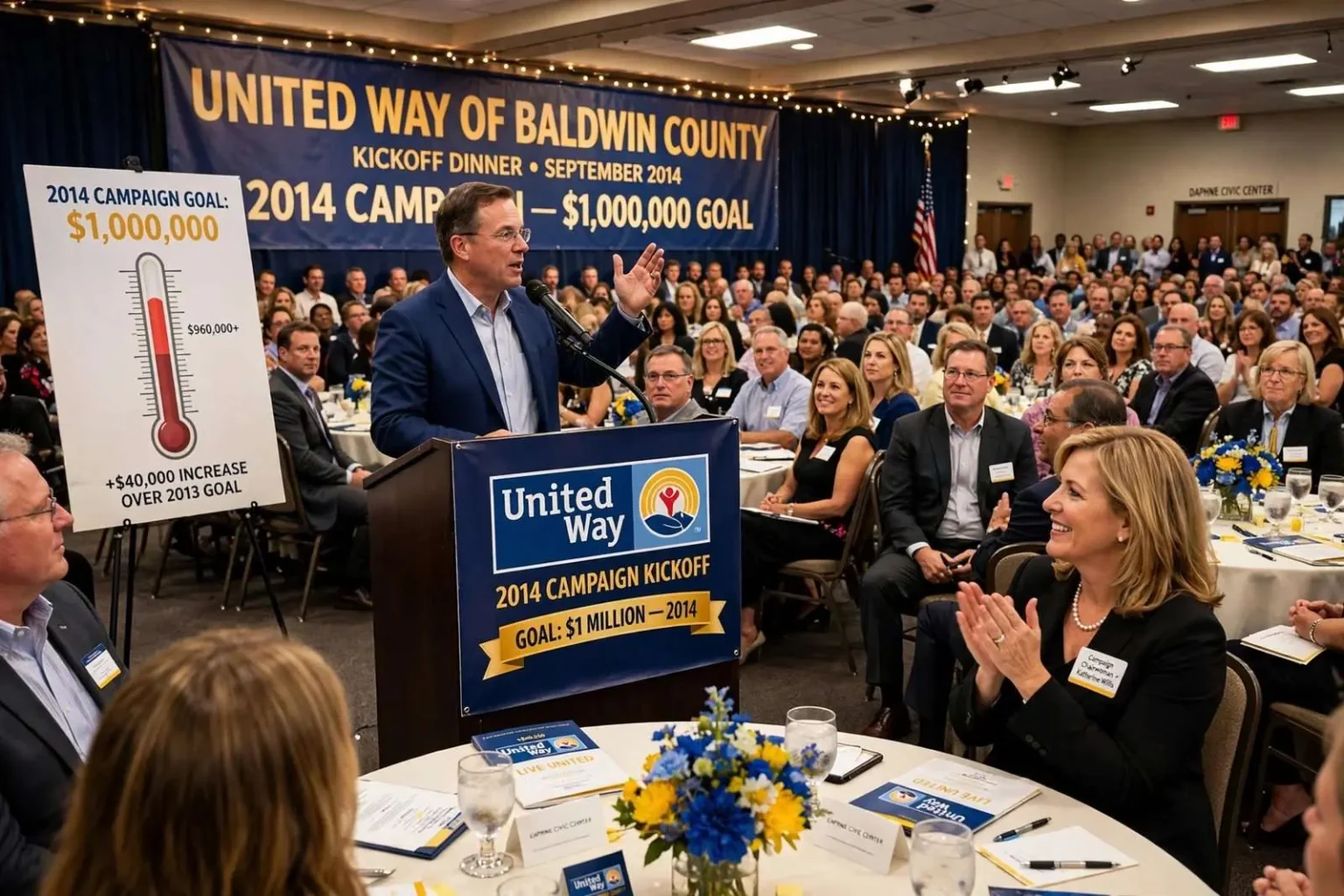
Hundreds of business and community leaders packed the Daphne Civic Center on a Thursday evening to kick off the United Way of Baldwin County’s 2014 fundraising campaign, coming away with a bold new target: $1 million, a jump of roughly $40,000 over the previous year’s goal.
Board member Will Murray announced the figure to the crowd, telling attendees the board had voted on setting an ambitious mark this year. “It’s a goal of $1 million. I think that we definitely could hit that mark,” he said, drawing an enthusiastic round of applause and shouts of approval from the audience.
The civic center on U.S. 98 is the county’s gathering place for events of this scale, and the kickoff campaign dinner doubles as a progress report on local philanthropy. United Way campaigns across the country follow the fall rhythm of workplace giving — corporate pledges, school drives and special events concentrated between Labor Day and Thanksgiving — and Baldwin County’s version draws on a business community that includes a major Publix distribution presence, banks, realty firms and the manufacturing plants along the Interstate 10 corridor. A seven-figure goal in a county of Baldwin’s size represents thousands of individual payroll pledges added together, not a handful of large checks.
Recognizing the top givers
Before the goal was unveiled, Campaign Chairwoman Katherine Wills took the stage to recognize the organization’s top donors from the previous year. Publix was named Large Company of the Year after contributing $179,378 in 2013, while Trustmark Bank earned Small Company of the Year honors with an $8,356 donation. Foley High School, which has led school campaigns for five consecutive years, brought in $4,912 and was recognized as School of the Year. Fairhope Elementary received the School Spirit Award, and Target was honored with the organization’s Spirit Award.
The awards serve a purpose beyond gratitude: they are the campaign’s public scoreboard. Companies that see their name called from the podium return the next fall to defend the title, and school campaigns — run largely by students collecting dollars and coins in classrooms — build a giving habit that organizers hope lasts into adulthood. Foley’s five-year streak as the top school has become a point of pride in the southern part of the county, and Fairhope’s Spirit Award honors the creativity smaller schools bring when they cannot match raw numbers.
Where the money goes
The United Way of Baldwin County funds 29 nonprofit health and human service agencies across the county, along with United Medical Partnership for Children, which provides medical care to Baldwin County public school students who are uninsured or underinsured.
The portfolio stretches across the spectrum of need: emergency assistance, family counseling, disaster response, senior services and youth programs, each vetted through United Way’s citizen review process, in which local volunteers examine agency budgets and outcomes before dollars are allocated. The medical partnership occupies a distinctive niche — a school nurse who spots an untreated condition can connect a student to care that would otherwise be out of reach, and healthier children miss fewer classes. For working families without insurance, the program can be the difference between a treated infection and a semester of absences.
To illustrate the real-world impact of the campaign, organizers brought in two guest speakers.
Frances Holk-Jones, co-founder of the Jennifer Claire Moore Foundation, spoke about how her own connection to United Way deepened after she started the foundation following the death of her daughter in 1997. The foundation now supports Peer Helper programs in both public and private schools throughout Baldwin County, with more than 1,000 students expected to take part as Peer Helpers this year, offering tutoring, mentoring and advocacy support to fellow students navigating everyday struggles.
Peer Helpers turns students into the first line of support for their classmates — trained listeners who spot peers in trouble and connect them with counselors before a struggle becomes a crisis. The model, which grew out of a program framework developed in Alabama schools, pairs naturally with what educators call the mentoring layer of school culture: older students tutoring younger ones, ambassadors welcoming transfers, and trained helpers watching for the classmate eating lunch alone. The foundation named for Jennifer Claire Moore has made Baldwin County one of the state’s densest networks for the approach, and the annual ride and events that carry her name fund the training that keeps the programs staffed.
A story of recovery
The second speaker, Kristy Wells, director of community development for The Shoulder, a Christian addiction treatment center in Spanish Fort, delivered an emotional account of her own recovery from prescription painkiller addiction.
Wells described a period in her life when she was consuming as many as 70 pills a day, overdosing multiple times and losing her relationships with her husband and children before a felony conviction and a stint in the Baldwin County criminal justice system led her to a United Way-supported program that turned her life around.
Wells pointed to her daughter, seated near the back of the civic center, as proof of how far she had come. She told the crowd that every relationship she had once lost has since been restored, crediting the support she received through a local agency funded by United Way donations for helping her rebuild her life from the ground up.
The Shoulder’s residential program in Spanish Fort treats men and women whose addictions have cost them jobs, families and freedom, combining counseling, work requirements and spiritual support over a months-long stay. For the criminal justice system, programs like it have become an alternative to the revolving door of incarceration for drug offenses; for donors, a speaker like Wells puts a face on what an allocation line item actually buys. Her role at the center now — helping other families find the same door she walked through — is the kind of outcome United Way volunteers cite when they ask workplaces to open their pledge campaigns each fall.
The campaign ahead
Organizers said the stories were meant to remind donors that contributions to the campaign translate directly into services for Baldwin County residents facing addiction, poverty, and other hardships, as the United Way works toward its most ambitious fundraising goal yet.
The run to $1 million now moves from the civic center ballroom to the workplaces of the county — pledge luncheons, company campaigns and school coin drives through the fall. Campaign volunteers know the pattern from years past: the early momentum of the kickoff, the mid-campaign lull, and the final December push that decides whether the thermometer downtown reaches the top line. What the evening in Daphne demonstrated is the argument the volunteers will carry into those rooms — that the goal is not an abstraction but a budget for second chances, school nurses in waiting and students trained to look out for one another.
Baldwin County’s own giving infrastructure has grown alongside its population, and the United Way’s campaign sits at the center of a philanthropic network that includes hospital foundations, the community foundation and church-based ministries. The allocation model matters to smaller agencies in particular: a nonprofit serving, say, victims of domestic violence or homebound seniors can spend its energy on clients rather than fundraising when United Way dollars underwrite a dependable share of the budget. The 29 funded agencies represent decades of relationship-building between the United Way and the county’s service organizations, and each fall’s campaign determines how generously that safety net can stretch through the year ahead.
The choice of speakers also reflects how the organization talks about itself as Baldwin County changes. The county’s growth has brought new corporate donors and new needs at once — more children in schools, more seniors, more households one crisis away from trouble. Pairing the story of a foundation born from grief with the story of an addiction recovery shows donors two ends of the same promise: the money stays local, it is screened by local volunteers, and it reaches people whose names a donor will never know but whose recoveries, peer programs and school clinics are measurable. For the volunteers on stage in Daphne, the $1 million figure was less a number than a summary of that case — a target set high enough to meet a growing county, and presented with the stories that make hitting it feel like a shared obligation rather than a hope.
School campaigns, meanwhile, carry a significance beyond their dollar totals. The students who run coin drives at Fairhope Elementary and Foley High are the children of the pledge-paying workforce, and organizers treat the classroom effort as leadership training — student councils chair committees, count and deposit funds, and learn how a spreadsheet becomes a service. Five consecutive years at the top has made Foley’s campaign a school-wide tradition passed from class to class, the sort of institutional habit that outlasts any single year’s chairpersons.