Mobile 9/11 Ceremony Honors First Responders, Renews Call for Unity
First responders and community members gathered at a Mobile cemetery to honor those lost on 9/11 and reflect on unity between police and the public.
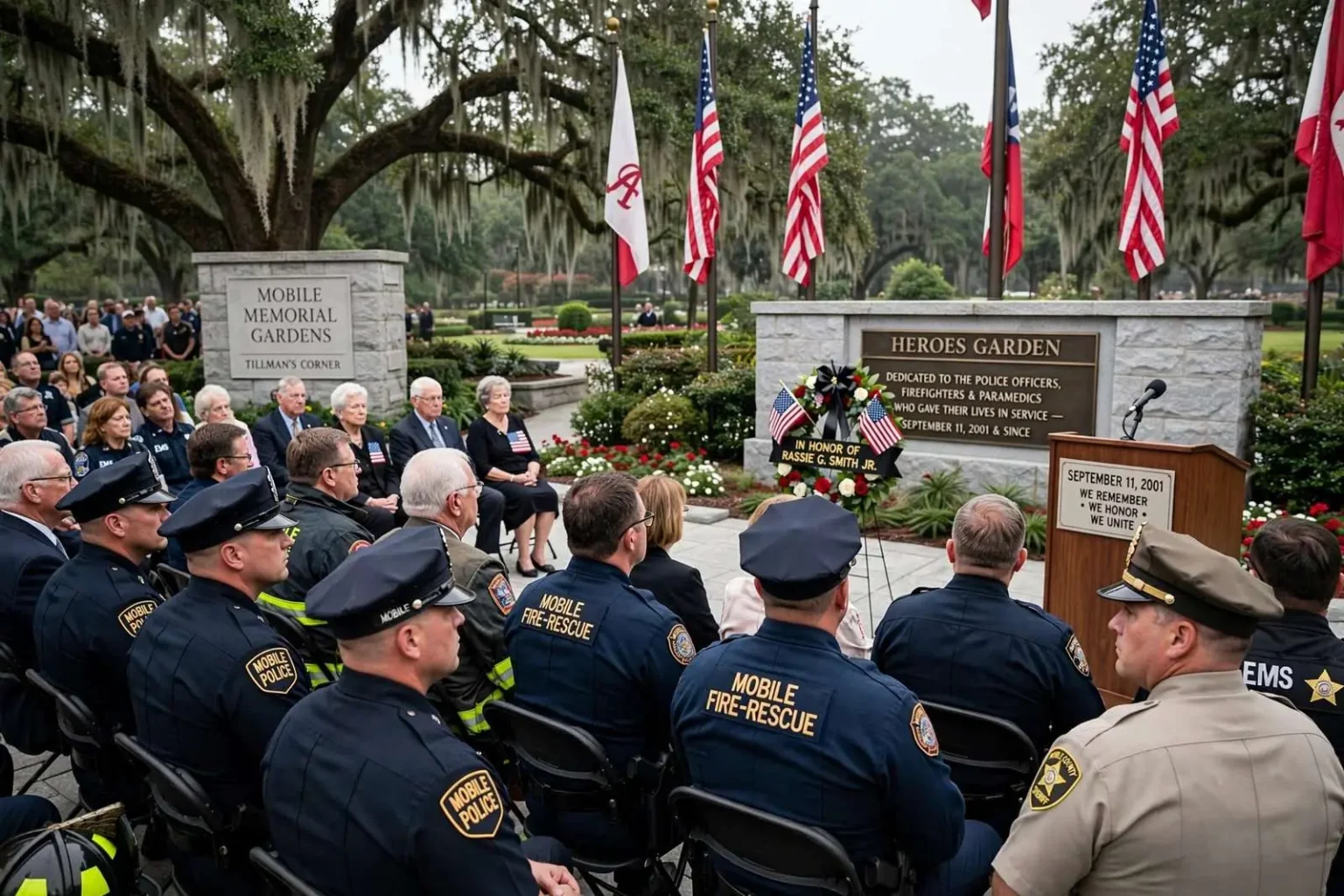
First responders, local officials and community members gathered at Mobile Memorial Gardens in Tillman’s Corner on a Thursday morning to mark the anniversary of the September 11 terrorist attacks, honoring first responders who have died in the line of duty since that day. The annual ceremony has become a fixture of the Mobile area’s observance calendar, drawing officers, firefighters, paramedics and families each September to a site built expressly for their remembrance.
The gathering was held near the cemetery’s Heroes Garden, a site dedicated to the region’s police officers, firefighters and paramedics. The garden provides a permanent resting place and memorial space for public safety personnel, and its grounds set the tone for a ceremony that blends solemnity with gratitude — flags at the entrance, rows of uniforms among the chairs, and families of the fallen seated near the front.
This year’s gathering singled out the memory of Rassie G. Smith Jr., a longtime veteran of the Mobile Police Department and the Mobile County Sheriff’s Office, with a wreath placed in his honor. Smith’s career spanned both of the area’s major law enforcement agencies, and the wreath placed in his name tied the national anniversary to the local men and women who have given their lives in service since the attacks reshaped American public safety.
Reflections on sacrifice
Several speakers reflected on the sacrifices made by first responders both on September 11, 2001, and in the years since. Richard Landolt, a retired Navy rear admiral who now serves as executive director of public safety for the Mobile Police Department, praised those who “go rushing into buildings everyone else is trying to get out of.” The image at the center of his remarks — the defining act of the 343 New York City firefighters and dozens of police officers who climbed the World Trade Center stairs while others fled — resonated with an audience whose daily work is built on the same instinct.
A deputy chief with Mobile Fire-Rescue shared a personal story about his grandfather, who served aboard a Navy PT boat during World War II. He recalled his grandfather saying that the greatest fear was not danger itself, but failing to fulfill one’s oath — a sentiment the deputy chief said still resonates with today’s first responders. The story connected generations of service, from the PT boat crews of the 1940s to the fire crews and patrol officers of the modern Gulf Coast, around a single theme: the weight of the promise made when the uniform is put on.
The ceremony’s keynote speaker, a former New York City firefighter who had been at the scene of the World Trade Center attacks, kept his remarks brief but noted that 9/11 commemorations honor a broad range of people: first responders, military personnel and civilians alike. He now leads a volunteer fire department in the Fowl River community south of Mobile, having traded the biggest fire department in the nation for a small local one, and his presence gave the ceremony a direct link to the day itself.
Meaning beyond a single date
A sheriff’s office chaplain who led the ceremony emphasized that the day’s meaning extends beyond a single date, saying the observance honors everyone lost since the attacks as well. Chaplains occupy a particular place in public safety work — present at scenes no one else wants to see, and called on afterward to help officers and firefighters carry what they have witnessed — and his framing reflected the reality that the losses connected to September 2001 did not end that day, whether in the decades of illnesses suffered by responders at ground zero or in the wars that followed.
Mobile County Sheriff Sam Cochran used his remarks to draw a broader connection between the unity many Americans felt after 9/11 and the tensions he said now strain relationships between law enforcement and the communities they serve. He acknowledged that instances of police misconduct have occurred and said such conduct should be condemned, but argued that individual grievances are sometimes unfairly generalized against entire agencies.
Rebuilding trust, he said, requires outreach and mutual understanding from both officers and residents. The sheriff’s message was aimed at both sides of the divide he described: officers who must engage the public with respect and transparency, and residents who are encouraged to judge agencies by their full record rather than by isolated failures. Coming at a ceremony held in memory of officers and firefighters lost in service, the remarks framed public trust as the working conditions first responders need in order to do their jobs.
The Blue Mass downtown
The Archdiocese of Mobile also marked the anniversary with its annual “Blue Mass” at the Cathedral-Basilica of the Immaculate Conception in downtown Mobile, honoring police officers and other first responders. The Blue Mass tradition, celebrated in cities across the country, takes its name from the blue uniforms worn by police officers, and it brings together officers, firefighters, paramedics and their families for a service of blessing and remembrance.
Organizers said hundreds of local fifth-graders from Mobile and Baldwin county schools were expected to attend the Mass alongside the public. The presence of schoolchildren gave the downtown observance a civic dimension beyond the uniformed ranks — a chance for young students to see the men and women behind the emergency lights, and to learn at an early age why the city sets aside a morning each September for their honor.
Held in one of Mobile’s most historic houses of worship, the Mass also connected the anniversary to the city’s long religious and civic history, with the cathedral’s congregation joining first responders in prayer for those who serve and for the families of those who did not come home.
A recurring theme for the Gulf Coast
Together, the events reflected a recurring theme in Mobile’s annual 9/11 observances: gratitude for the men and women who respond to emergencies, paired with an ongoing community conversation about how to sustain public trust in the agencies that protect it. The two gatherings — one at a cemetery garden in Tillman’s Corner, one in a downtown cathedral — bookended a day that has never been only about the past.
For the officers and firefighters in attendance, the ceremonies served the practical purpose of remembrance: names spoken aloud, wreaths laid, the dead of 9/11 and of local line-of-duty deaths honored in front of their colleagues and their families. For the broader community, they offered a structured moment each September to consider what the region asks of its first responders — and what those responders, in turn, ask of the public in return. As the attendees filed out of the garden and the cathedral, the message both events left behind was the same one spoken from every podium that morning: the promise to remember, and the work of trust, both continue long after the anniversary has passed.
Why Tillman’s Corner hosts the ceremony
Mobile Memorial Gardens sits in the heart of Tillman’s Corner, one of the busiest communities in Mobile County, and its Heroes Garden gives the ceremony a home that belongs entirely to the public safety family. Unlike city halls or courthouse steps, a memorial garden frames the day around the people being honored rather than the institutions involved, and families of fallen responders can return to the site throughout the year, not only on the anniversary.
The location also draws attendance from across the county rather than from downtown alone. Officers from municipal departments, deputies from the sheriff’s office, and fire and EMS crews from the outlying communities all find the site accessible, and the morning ceremony time allows shifts to be arranged so that on-duty personnel can attend without leaving the county uncovered.
A generation shaped by 9/11
For many of the responders seated in the rows of chairs, the anniversary carries personal weight beyond the ceremony itself. The September 2001 attacks reshaped American policing and firefighting — changing training, equipment, emergency communications and the everyday posture of agencies toward large-scale emergencies — and the men and women who joined in the years afterward did so in a profession permanently altered by that day.
The ceremony’s blend of speakers reflected that span. A retired Navy admiral speaking for the police department, a fire deputy chief drawing on a World War II family story, and a New York firefighter now serving a small volunteer department south of the city together covered generations and branches of service. Each reached the same conclusion from a different direction: the oath comes first, and the community’s safety depends on people willing to keep it.
That message is also aimed, in part, at recruiting. Public safety agencies across the Gulf Coast compete for qualified applicants, and events that let young people see the service in a setting of honor — whether at the Heroes Garden or among the fifth-graders filling the cathedral pews downtown — double as an introduction to careers the region continually needs to refill.
Remembering the local fallen
By pairing the national anniversary with a local honoree, the ceremony keeps Mobile’s own losses from being overshadowed by the scale of the 2001 attacks. The wreath placed for Rassie G. Smith Jr. stood for every local officer and firefighter whose name appears on area memorials, and the chaplain’s reminder that the day honors “everyone lost since” extends the observance to responders who died in the line of duty in the years after 9/11, from the Gulf Coast and beyond.
As the morning ended and attendees returned to their shifts and classrooms, the two halves of Mobile’s observance — the garden in Tillman’s Corner and the Blue Mass downtown — had done what the city’s September ceremonies have done year after year: connected a national day of memory to the local men and women who wear the uniform today, and reminded the community that the bond between them is renewed not by speeches alone, but by how the other 364 days are spent.