The Comic Cowboys: Inside Mobile’s Satirical Mardi Gras Tradition
For more than 130 years, Mobile Mardi Gras group the Comic Cowboys has used satirical signboards to poke fun at each year's biggest headlines.
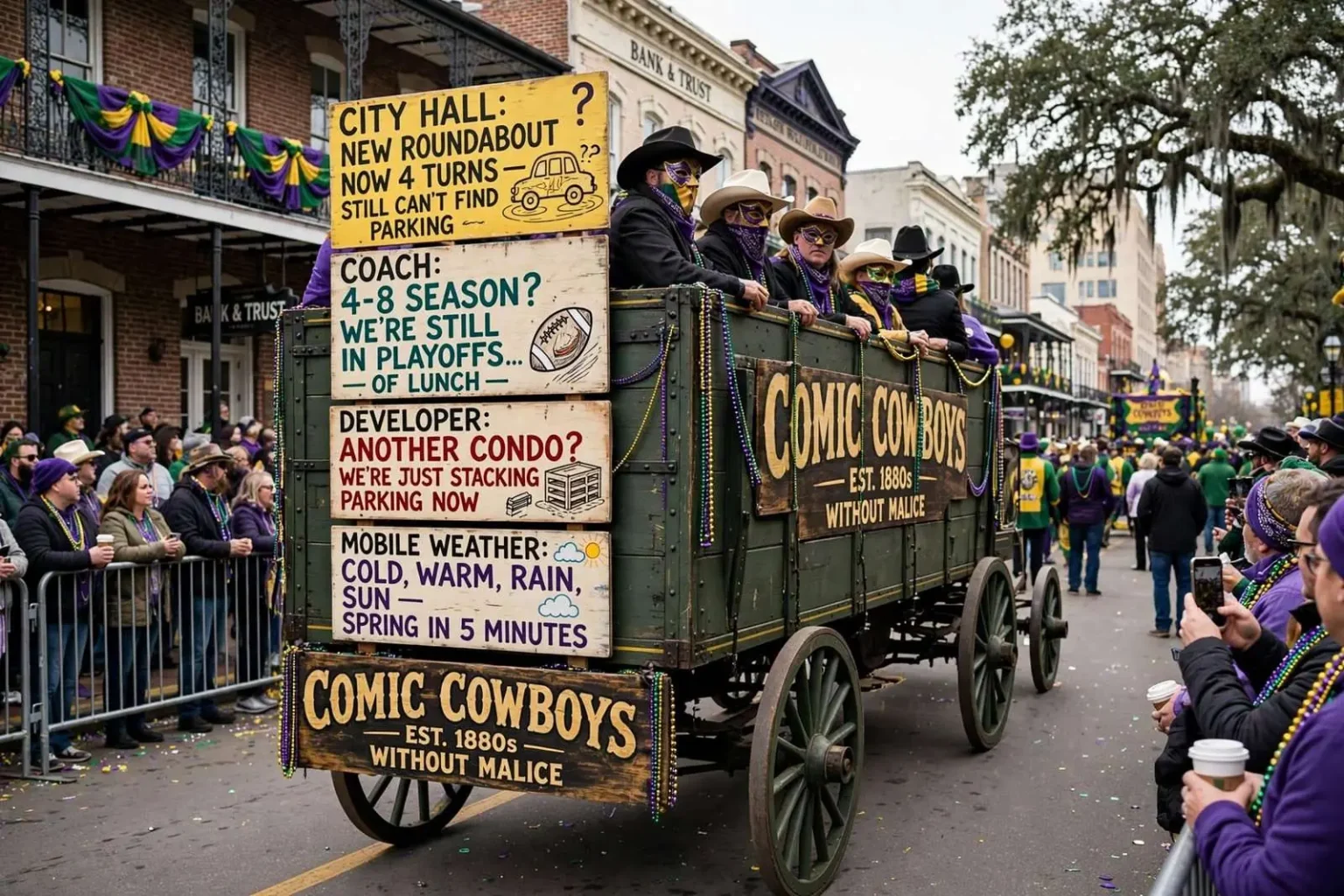
Long before social media commentary and late-night monologues, Mobile had the Comic Cowboys. For more than 130 years, this mystic society has rolled through the streets of Mobile during Mardi Gras with a wagon full of satirical signboards, poking fun at the year’s biggest headlines with a wink and, as members insist, ‘without malice.’ The organization is one of the most distinctive fixtures of the oldest Carnival celebration in America, a parade unit whose product is not throws or bands but laughter aimed at everyone equally.
Mystic societies are the backbone of Mobile’s Mardi Gras, the private organizations that stage balls, build floats and ride the parade routes each Carnival season. Most are known for gowns, masks and moon pie tosses. The Cowboys took a different path from the beginning, trading sequins for satire and becoming, over generations, the city’s one guaranteed source of commentary on whatever — or whoever — dominated the local news that year. Mayors, coaches, developers, scandals, fads: nothing that made headlines in Mobile is safe from the signboards.
Nine Committees, Four Signs Each
Each year, the group’s membership is divided into nine committees, each assigned a different topic such as politics or sports. Every committee is responsible for producing four signboards, all of which are mounted on a single float for the parade. The structure spreads the writing workload across the whole membership and guarantees variety on the route — a rider moving down the street past a Cowboy wagon will pass jokes about city hall, college football, national news and neighborhood gripes in the space of a block.
The signboards themselves ride on wagons that are more than a century old, originally acquired by the Cowboys from the old GM&O railroad in the 1930s. The Gulf, Mobile and Ohio Railroad was once a defining presence in Mobile, and the purchase gave the society rolling stock whose provenance is as local as the jokes themselves. Keeping the original wagons in service for nearly a century has become its own quiet point of pride, a piece of working history that rolls down the route every Mardi Gras Day.
Writing the signs is an art the members take seriously while refusing to take themselves seriously. A good Cowboy sign is short enough to read from the sidewalk, sharp enough to sting, and fair enough that its target can laugh along. The society’s longevity suggests the formula works: an organization that skewered the news of the 1890s is still skewering the news of today with the same wagons, the same route time and the same insistence that the whole thing is done without malice.
Vaudeville Roots
According to a longtime member who, in keeping with tradition, spoke without being named, the group’s brand of satire likely traces back to founder Dave Levi, who had a background in vaudeville comedy. Levi founded the society in the 1880s, when Mobile’s Carnival was already decades old but its parade culture was still taking shape, and he brought to it the timing, punchline discipline and love of the roast that vaudeville performers carried across America in that era.
In the group’s earliest days, in the early 1900s, a single sign would be hung on the side of a car and driven through the streets. Over time, the tradition evolved into wagons carrying two signs, then eventually the four-per-wagon format still used today. The growth mirrors the growth of Mardi Gras itself, which expanded from a handful of processions into the weeks-long season of parades that now fills downtown Mobile from late winter weekends through Fat Tuesday.
The anonymity that surrounds membership is part of the tradition. Cowboys do not attach their names to their work, and members who speak about the society publicly do so without identification, keeping the focus on the signs rather than the sign-makers. In a city where mystic society membership is often a point of family pride, the Cowboys’ deliberate obscurity is a distinguishing trait — the joke matters more than the joker, and the society speaks with one anonymous voice even though many hands write the boards.
That voice has stayed remarkably consistent across 13 decades of American life. The Cowboys have mocked wars, depressions, political machines, sports droughts, and every fashion and folly to pass through Mobile. Generations of local officials have learned that the surest sign they have truly arrived in Mobile public life is seeing their name or their pet project rendered on a Cowboy board — an honor of sorts, bestowed without permission and withdrawn the following year when the news moves on.
Where the Line Is
Every year, the Cowboys’ targets range across the political and cultural spectrum, and members make no apologies for controversy. As one Cowboy put it, the group knows exactly where the line is, and where the community expects it to be drawn, while still making sure ‘there’s something in there that will suit every walk of life.’ The balancing act — sharp enough to be funny, broad enough to be shared — has kept the society welcome on the route even as tastes and sensitivities changed around it.
Local satire holds a particular place in a city of Mobile’s size, where everyone in the audience personally knows many of the people in the headlines. A Cowboy sign about a mayor or a millennial trend lands differently when half the parade-watchers went to school with the subject. Members say that closeness is exactly why the no-malice rule matters: the boards roast the community’s news, but the community is also the audience, and next year’s parade depends on this year’s readers still laughing.
The society’s durability is also a story about how Mobile transmits its traditions. Children who watch the Cowboys from their parents’ shoulders grow up to serve on the committees, and the sign-writing craft passes down the same way the wagon-riding spots do. In a Carnival season defined by inherited memberships and century-old societies, the Cowboys are a textbook example of how Mobile keeps its institutions alive: by changing every joke annually while changing nothing about the format.
The Cowboys occupy a singular niche among Mobile’s Carnival institutions. The oldest parading societies date to the early 1700s and 1800s, and their balls and masked processions carry centuries of pageantry. The Cowboys, by contrast, are the season’s court jesters — the one unit whose members appear, in effect, as themselves, unmasked by comparison, delivering the community’s running commentary on its own news. That role has made them a favorite of parade-goers who come for the spectacle but stay for the punchlines.
The format’s endurance says something about satire itself. A signboard that must be read in the time it takes a wagon to pass enforces brevity, and brevity has kept Cowboy humor sharp across eras of radio, television and the internet. The society never needed to chase new media; its medium — painted boards on hundred-year-old railroad wagons — still works precisely because the jokes are written for the street, by people who live in the neighborhoods the parade rolls through.
Each Carnival season, the Cowboys’ boards are among the most photographed sights on the route, reproduced on social media within minutes of the wagon leaving the staging area. The society that predates every modern communication platform thus finds its work amplified by all of them, a loop its 19th-century founder could never have imagined but would surely have found funny. The wagons roll, the signs speak, and Mobile’s Mardi Gras keeps its oldest running gag very much alive.
High Noon on Mardi Gras Day
The tradition remains a fixture of Mobile’s Mardi Gras season, with the Comic Cowboys parading each year on Mardi Gras Day at high noon, a slot that has become as much a part of the city’s Carnival calendar as any of the evening parades. The noon hour gives the Cowboys the road after the morning’s early processions and before the afternoon’s main events, a place in the schedule that generations of Mobilians plan their Fat Tuesday around.
For longtime Mobilians, catching a glimpse of that year’s signboards is as much a ritual as catching beads or moon pies. Families stake out spots along the route knowing that the Cowboys’ boards will supply the commentary on everything else they watched that season — the punchlines that tie a month of parades together. Visitors are often surprised to find a parade unit whose crowds read as intently as they cheer, but anyone who has stood on Government Street at noon on Fat Tuesday has seen the city squinting at the next board in the line.
Those interested in the deeper history of the Comic Cowboys and their place in Mobile’s broader Mardi Gras tradition can find it explored at the Mobile Carnival Museum, which documents the city’s Carnival from its 18th-century beginnings through the societies that stage today’s parades and balls. The museum’s exhibits give context that a single parade morning cannot: how the Cowboys fit among Mobile’s dozens of mystic societies, how the wagons and the sign format evolved, and why a group founded in the horse-and-buggy era still sets the comedic agenda every Fat Tuesday.
More than 130 years after Dave Levi hung the first sign on the side of a car, the Comic Cowboys remain what they have always been: Mobile’s annual self-examination, conducted from a parade wagon, one four-sign committee at a time, without malice and without missing much. As long as the city produces headlines — and it always has — the Cowboys will be at high noon on Mardi Gras Day, reading the year back to the city that made it.