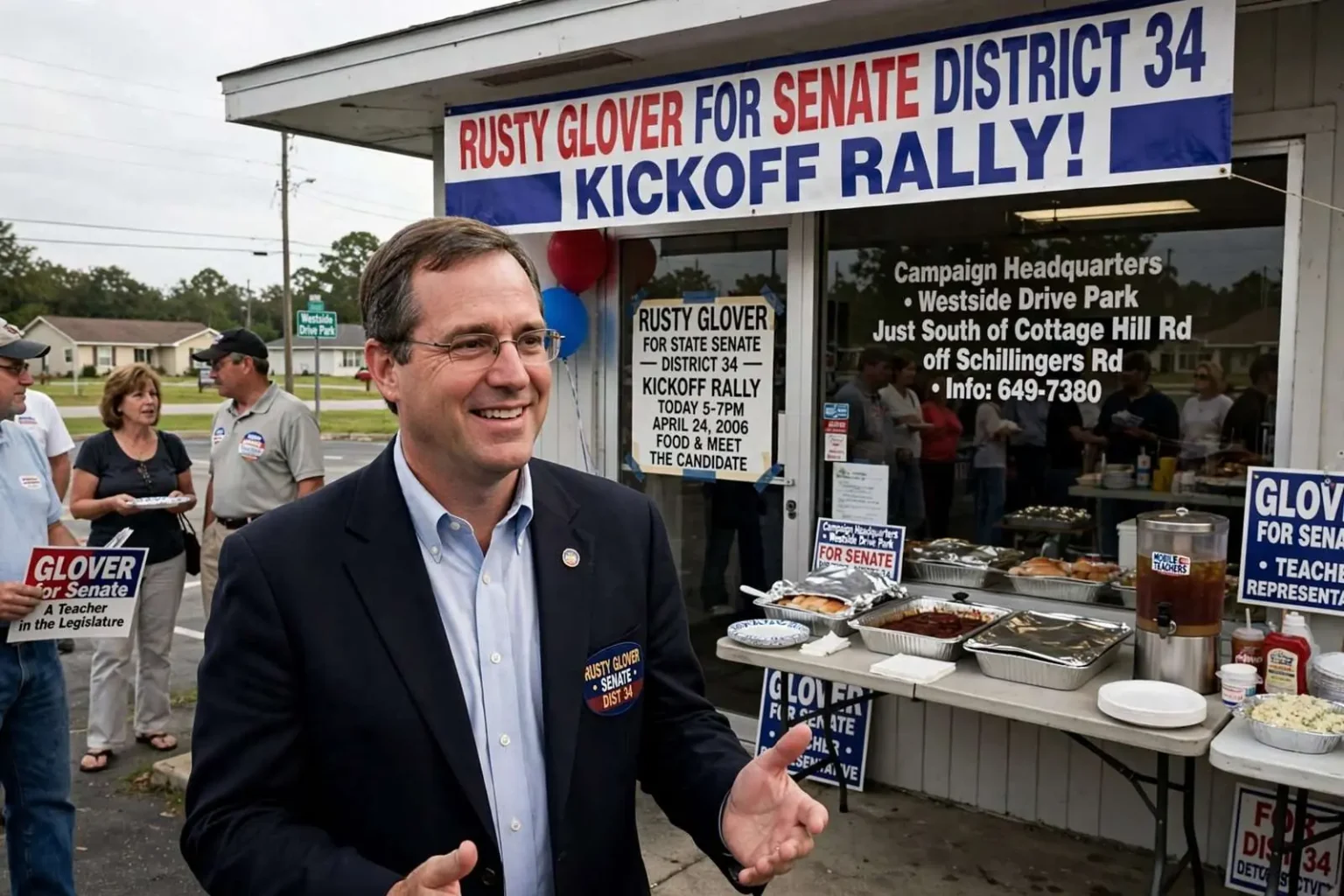
State Rep. Rusty Glover, R-Semmes, scheduled a kickoff rally for his Alabama Senate District 34 campaign from 5 to 7 p.m. on Monday, April 24, 2006, at his campaign headquarters on Westside Drive Park, about three-quarters of a mile south of Cottage Hill Road just off Schillingers Road. The event promised food and an opportunity for voters to meet and talk with the candidate, who at the time represented District 102 in the Alabama House of Representatives. Those wanting more information were asked to call 649-7380.
The headquarters itself told a story about the race. Westside Drive Park sat in the heart of the territory a District 34 candidate had to win — the Schillingers Road corridor, where subdivision after subdivision had sprung up along what had been farm and timber land only a generation earlier. A campaign office placed there, rather than in downtown Mobile, signaled exactly where the votes were: in the driveways and church parking lots of the fast-growing western suburbs.
Kickoff events of this kind are the opening move of Alabama legislative campaigns. The candidate stands in a rented storefront with family, volunteers and a plate of barbecue, and the local press and the party faithful take the measure of the field. For a sitting House member jumping to the Senate, the event also served as a transition announcement of sorts — an introduction to voters who knew Glover’s name from the House ballot but had not yet been asked to send him anywhere else.
A teacher in the Legislature
Glover taught in the Mobile County Public School System, a fact that shaped his political identity in a state where the education establishment and the Legislature have long been entangled. A classroom teacher serving in Montgomery occupies a particular position in Alabama politics, close to the questions of school funding, the Education Trust Fund and teacher pay that dominate every legislative session.
The Mobile County Public School System is the largest school district in Alabama, and its teachers had long been among the most politically organized constituencies in the state, watching every budget cycle, every PEEHIP insurance debate and every tenure bill in Montgomery. A legislator who stood in front of those classrooms by day carried a credibility on education issues that colleagues could not borrow — and, depending on the audience, a suspicion to overcome from those who saw the teachers’ lobby and the Legislature as too close already. Glover had spent his House tenure navigating exactly that terrain.
He was seeking to move from the House to the Senate, a step up in a chamber where a single senator commands considerably more leverage over the flow of legislation. In the Alabama Statehouse, the Senate’s rules concentrate power to a degree the House does not match: filibusters, local legislation consent and seniority-driven committee posts make a Senate seat a long-term investment. Legislators who make the jump from the 105-member House to the 35-member Senate do so, as a rule, intending to stay.
A crowded Republican field
The seat was open because incumbent state Sen. Hap Myers was retiring, and the vacancy drew a substantial field of Republicans competing for the nomination. Alongside Glover, those seeking the nod included Chris Pringle, a former state representative; Connie Hudson, a Mobile city councilwoman; Todd Burkhalter, a music industry executive; Keith Graham, a local certified public accountant; and Shawn Williams.
Six candidates for one open seat is a strong signal about the political character of a district. In much of Mobile County by 2006, the Republican primary had effectively become the decisive election for many offices, and an open Senate seat in a reliably Republican district was a rare and valuable opportunity. Candidates of that caliber, including a sitting city councilwoman and a former state representative, do not enter a race they expect to be a formality in November.
The bench strength in the field also reflected the district’s demography. District 34’s voters were, by the mid-2000s, among the most reliably Republican in south Alabama — a shift that had taken shape over the preceding two decades as west Mobile’s new subdivisions filled with voters who brought or adopted Republican loyalties. A Democrat running there in 2006 would be starting from a deep structural deficit, which meant that the June 6 primary — and, with six candidates, a likely runoff afterward — was where the seat would actually be decided.
Each of the six brought a distinct base. Glover had his House district, his teaching colleagues and the Semmes-area network; Hudson had the city council seat and its west Mobile constituents; Pringle had name identification from legislative service and the county’s GOP activist circles. In a low-turnout primary with six names on the ballot, the contest would reward whichever campaign could convert its existing network into votes twice — once in June and, if necessary, again in a runoff weeks later.
The district
Senate District 34 took in the western and northwestern reaches of Mobile County, including the Semmes area, the Schillingers Road and Cottage Hill corridors and the fast-growing suburban territory spreading out from the city limits. It was, in that period, one of the fastest-changing parts of the county, with subdivisions replacing timberland and pasture, and with the attendant pressures on schools, roads, water and sewer service, and drainage.
Semmes itself had not yet incorporated as a municipality; it would not become a city until 2011. The area’s growth, and the question of how it should be governed and paid for, was precisely the sort of issue a District 34 senator would be handling. West Mobile in 2006 was a landscape of new rooftops and strained infrastructure: school buildings added in phases to keep up with enrollment, two-lane connectors carrying traffic volumes they had never been designed for, and unincorporated communities depending on the county commission for services that cities provided their own residents.
Those realities shaped the politics. Residents of unincorporated west Mobile paid some of the county’s fastest-rising property valuations and wanted representation that would bring road money, school construction and drainage relief back home. Candidates for the open Senate seat spent the spring talking about growth management and infrastructure in exactly the terms that the Schillingers Road corridor’s daily experience suggested. The kick-off rally on Westside Drive put the candidate physically in the middle of that conversation.
The shape of the campaign
A neighborhood headquarters rally, food on the table and a candidate available to talk is the standard, and often decisive, form of legislative campaigning in Alabama. In a primary with six names on the ballot and a likely runoff, the winner is typically the candidate who has shaken the most hands in the churches, civic clubs and subdivisions of the district.
Glover brought two assets to that fight: an existing legislative record from the House seat he already held, and a day job in the county’s classrooms that put him in contact with families across the district. Legislative service carries its own network — the constituent casework, the office hours, the returned phone calls — and a teacher’s schedule in the Mobile County school system meant summers free for exactly the kind of door-to-door work that contested primaries demand.
The April rally on Westside Drive marked the formal beginning of a campaign that would run through the June 6 primary. For voters in the growing communities west of Mobile, the contest would determine who carried their concerns, about schools, roads and the pace of development, into the Alabama Senate for the following four years. The invitation asked for two hours on a Monday evening; the campaign it opened would be measured in the months of church dinners, civic club speeches and subdivision visits that decide Alabama legislative races.
What a Senate seat meant in 2006
The 2006 legislative elections arrived at a moment of realignment in Alabama politics. Republicans held the governor’s office and had been steadily consolidating legislative strength, while Democrats still controlled both chambers of the Legislature and defended that control in every cycle. A seat like District 34 sat at the intersection of those forces: a district that had already tipped decisively Republican at the top of the ticket, represented in the Senate by whoever won the GOP primary, but casting its lot within a Legislature whose chamber-level balance was genuinely contested.
That made the individual senator’s seniority and committee position all the more valuable. Whoever won the open seat would inherit Myers’ place in a chamber where appropriations for Mobile County — for the port, for the roads feeding it, for the schools swelling in its suburbs — depended on relationships built over many sessions. Voters in the district were not merely choosing a partisan label; they were choosing who would carry a decade of seniority forward for west Mobile.
Education politics, Glover’s specialty, ran through that agenda. The Education Trust Fund budgets of the period, the annual fights over teacher pay raises, the debates over accountability and testing, and the perennial questions of school construction funding all landed on the desks of Mobile County’s delegation, whose districts contained both the county’s most overcrowded schools and its fastest-growing enrollment. A senator who taught in those schools would arrive in Montgomery with an insider’s grasp of what the budget numbers meant in a classroom.
For the candidates, the calculus from April forward was simple and unforgiving: six names, one seat, a June 6 primary and the likelihood of a runoff against the leading finisher. The rally on Westside Drive Park was the first organized chance for voters in the Schillingers Road corridor to put faces with the names on the sample ballot — and the first test of whether Glover’s House record, teacher’s credentials and suburban base could carry him the extra distance to the Senate.