As Omicron Strains Staffing, Mobile Prepares for Its Biggest Mardi Gras in Years
Mobile geared up for its first pandemic-era Mardi Gras as omicron drove shortages — but Visit Mobile still expected one of the biggest crowds in years.
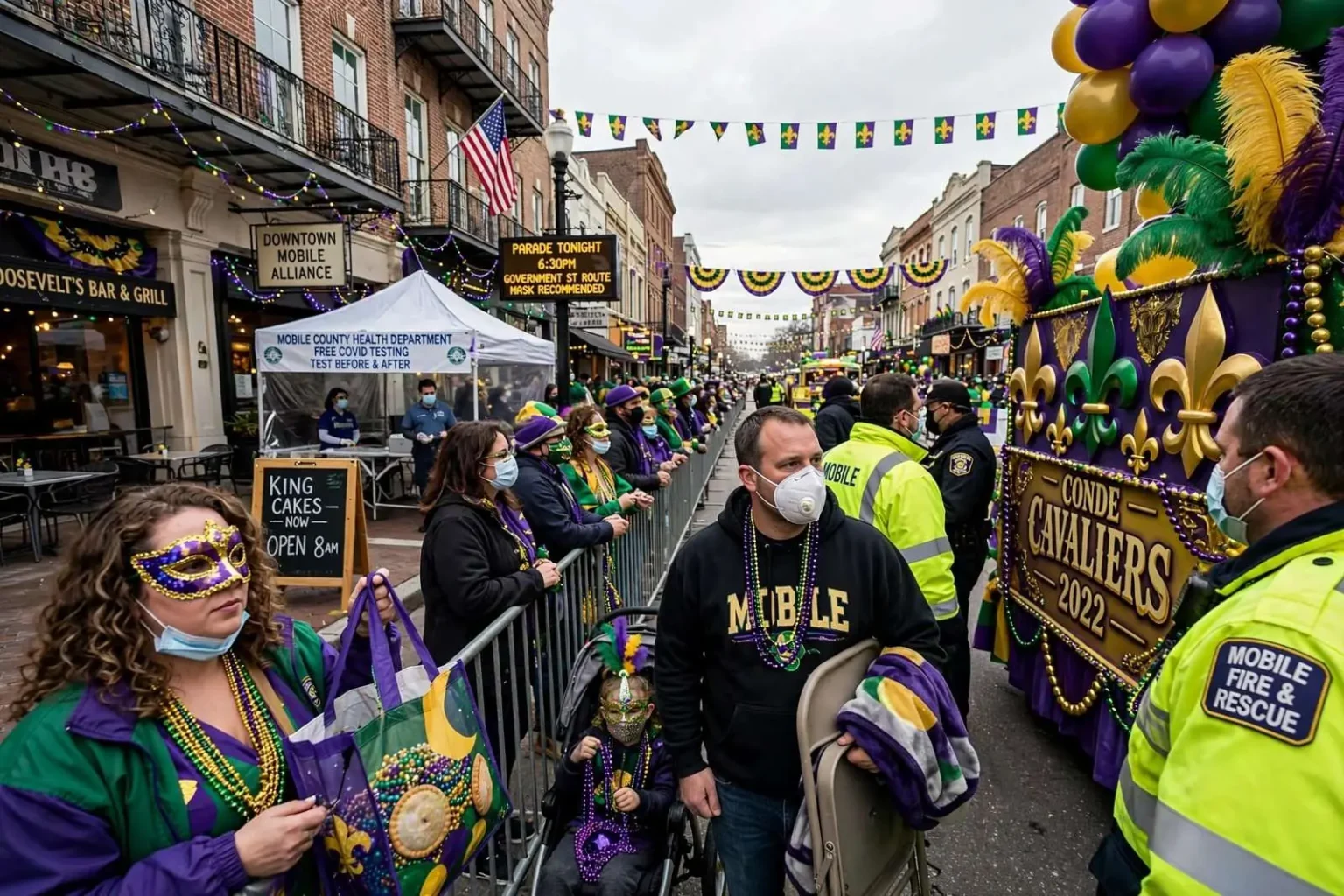
Mobile was weeks away from its first Mardi Gras of the pandemic era, and the city was watching two numbers at once: the omicron case count and the expected crowd size. Visit Mobile estimated that pre-COVID celebrations drew roughly one million people to downtown over three weeks of parades, a scale of gathering that no other event on the Gulf Coast approaches — and one that made the 2022 season a test of both public health and civic tradition.
President and CEO David Clark predicted 2022 would be “one of our biggest celebrations in years because people are excited to get back to our beloved Carnival traditions.” After a 2021 season reduced to skeleton parades and drive-through moon pies, the city’s mood heading into the season was less hesitation than hunger, with families, mystic societies and downtown businesses all planning for crowds that had been pent up for two years.
That enthusiasm came with complications. Omicron was sweeping through workplaces across the region at the very moment the city needed every sector humming, and the shortages that defined the pandemic’s later stages were visible well beyond the tourism industry.
Shortages Everywhere but Downtown
With omicron sweeping through workplaces, Dr. Rhinid Murphree of the Mobile County Health Department described staffing shortages hitting “all factors of life” — schools, daycares, nursing homes, hospitals, businesses and restaurants. The pattern was familiar by then: an employee tested positive, a whole shift quarantined, and a business that had survived two years of disruption found itself closing early for lack of hands.
For carnival season specifically, his concern centered on the people who keep the streets safe. “We are really concerned about the safety of our first responders, including security,” Murphree said. Mobile’s police, fire and emergency medical crews are stretched every Mardi Gras by the sheer volume of parades and spectators, and an omicron wave that thinned their ranks posed the same dilemma as a shortage of parade marshals — except with public safety attached.
The city said it was monitoring COVID cases across all municipal departments to keep parades rolling without disruption. The message to the public was continuity: route barricades would go up, floats would roll and the city would adapt behind the scenes rather than cancel in front of the crowds.
The Downtown Mobile Alliance, meanwhile, reported no advance concerns about shortages — product or otherwise — and businesses downtown were simply gearing up for the crowds. King cakes, beads, throws and restaurant supplies were flowing, and merchants along Dauphin Street and Government Street reported that the pent-up demand of two missing seasons looked like a business opportunity worth any staffing squeeze.
A Masked Party Either Way
Clark urged revelers toward what he called personal responsibility: “Mardi Gras always features masks, but this year you may need to wear one of a different kind!” He reminded visitors to wash hands frequently and distance indoors, and voiced confidence that Mobile’s hotels, restaurants and attractions would deliver despite thin staffs.
The wordplay underscored a genuine tension. Carnival’s whole appeal is density — shoulder-to-shoulder sidewalks, packed restaurants, full hotels — and outdoor parades are about as low-risk as large gatherings get, while the indoor celebrations around them are not. Public-health officials across the Gulf Coast had spent two years urging caution at exactly the kinds of gatherings Mardi Gras is made of, and Mobile’s approach leaned on persuasion rather than prohibition.
Regular parade-goer Wesley Wyatt summed up the mood on the street: not worried about shutdowns, because “we’ve been through it before. It’ll just be more of the same if that happens.” The sentiment reflected a community that had already absorbed the disappointment of a lost season and had decided, broadly, that the celebration would happen in whatever form circumstances allowed.
The health department’s advice for attendees: test before and after the festivities, and get vaccinated. Officials framed the guidance in the same practical terms they applied to other large events — know your status, protect the vulnerable people you go home to, and give the season’s workers the same consideration you would want for your own family.
Mobile’s Carnival Comes Back
Mobile’s claim as the original home of American Mardi Gras runs back to the city’s colonial founding in 1702-1703, when French colonists brought the Carnival tradition to the Gulf Coast generations before New Orleans staged its first parade. The city’s mystic societies — secret Carnival organizations with names like the Conde Cavaliers, Comic Cowboys and Mobile Carnival Association — spend all year planning each season, and their parade schedules structure the city’s social calendar for weeks.
That institutional weight is one reason the 2022 season carried such significance. For the societies, the season is a heritage obligation as much as a party; for downtown merchants, it is the sales event of the year; and for families across Mobile and Baldwin counties, parade nights are childhood memories in the making. Two years of disruption strained all three at once, and the omicron surge threatened a third.
The economics sharpened the stakes. The pre-pandemic celebration drew roughly a million people downtown over the three-week parade season, filling hotels from the Elder Street district to the Eastern Shore and pouring sales tax receipts into city coffers during what would otherwise be a slow winter month. Restaurants that count on carnival crowds for a meaningful share of annual revenue entered the season short-staffed but optimistic, hiring what they could and simplifying menus where they must.
Hotels reported bookings that suggested the crowd would indeed arrive, and event planners across downtown noted that group reservations — the balls, luncheons and private parties that surround the public parades — had returned to near-normal levels. The crowds’ composition was expected to skew heavily local and regional, since fewer visitors were flying in than in past years, but parade organizers noted that locals are the backbone of the celebration anyway.
What Visitors Should Know
For families planning to attend, the city’s guidance blended carnival tradition with pandemic practicality. Arrive early to claim a spot along the route, bring chairs and bags for throws, and keep hand sanitizer alongside the moon pies. The health department’s testing advice was aimed especially at households with elderly relatives or unvaccinated children, groups for whom a breakthrough infection during carnival week would carry the highest cost.
First responders’ unions and the police department had spent the fall recruiting parade-season officers and crossing guards, knowing that omicron could strip a roster at any moment. The contingency plans circulating at City Hall included shifting personnel between routes and extending shifts where needed — measures familiar to any Mardi Gras veteran of hurricane years, when the city has repeatedly proven it can improvise around disruption.
The season’s ultimate verdict belonged to the crowds, and early signs pointed to a celebration that matched Clark’s prediction. Ladder chairs were staked out along Government Street days before the first parades, masking — the glittering, feathered kind — was underway in craft rooms across the metro area, and the debate over N95 versus sequins had become a running local joke that captured the moment exactly.
Public-health officials in Mobile County continued to publish case numbers through carnival season, and the health department maintained testing sites across the county for residents who wanted to follow the test-before-and-after guidance. Vaccination efforts likewise continued through the season, with clinics accommodating walk-ins and answering the questions of hesitant residents one conversation at a time.
A Tradition That Outlasts Hard Years
If history is a guide, the 2022 season will be remembered less for its case counts than for its persistence. Mobile’s Carnival has survived wars, depressions, hurricanes and now two pandemic years, and each disruption has produced variations — shortened seasons, rearranged routes, alternate celebrations — rather than cancellations of the tradition itself. The mystic societies that anchor the season have weathered worse and kept their charters, their floats and their place in the city’s identity.
What the omicron surge added to that history was a new kind of stress test: not a storm that blows the city down, but a wave of illness that quietly empties workplaces while the party goes on. How well Mobile navigated it depended on the mundane details — enough officers on each route, enough cooks in each kitchen, enough testing capacity at the right moments — that make a celebration look effortless from the sidewalk.
By the time the last parade rolls and the streets are swept, the city will have its answer. The prediction from Visit Mobile was confident, the health department’s guidance was clear, and the parade-goers interviewed along the routes were, like Wesley Wyatt, untroubled. Mobile’s beloved Carnival traditions, it turned out, were ready to roll — masks of one kind or another on every face, and a whole city cheering them on.
Residents and visitors can find parade schedules, route maps and parking information through the City of Mobile and the Downtown Mobile Alliance, and up-to-date health guidance from the Mobile County Health Department. Whether this Mardi Gras goes down as one of the biggest celebrations in years or simply the strangest, the beads will be flying — and Mobile will be watching, with a mask nearby, just in case.