West Mobile Couple Acquitted in Washington County Horse Cruelty Case
A west Mobile couple with a long history of keeping animals was found not guilty of cruelty charges tied to a horse that died in Tibbie, closing a case that had lingered for more than a year.
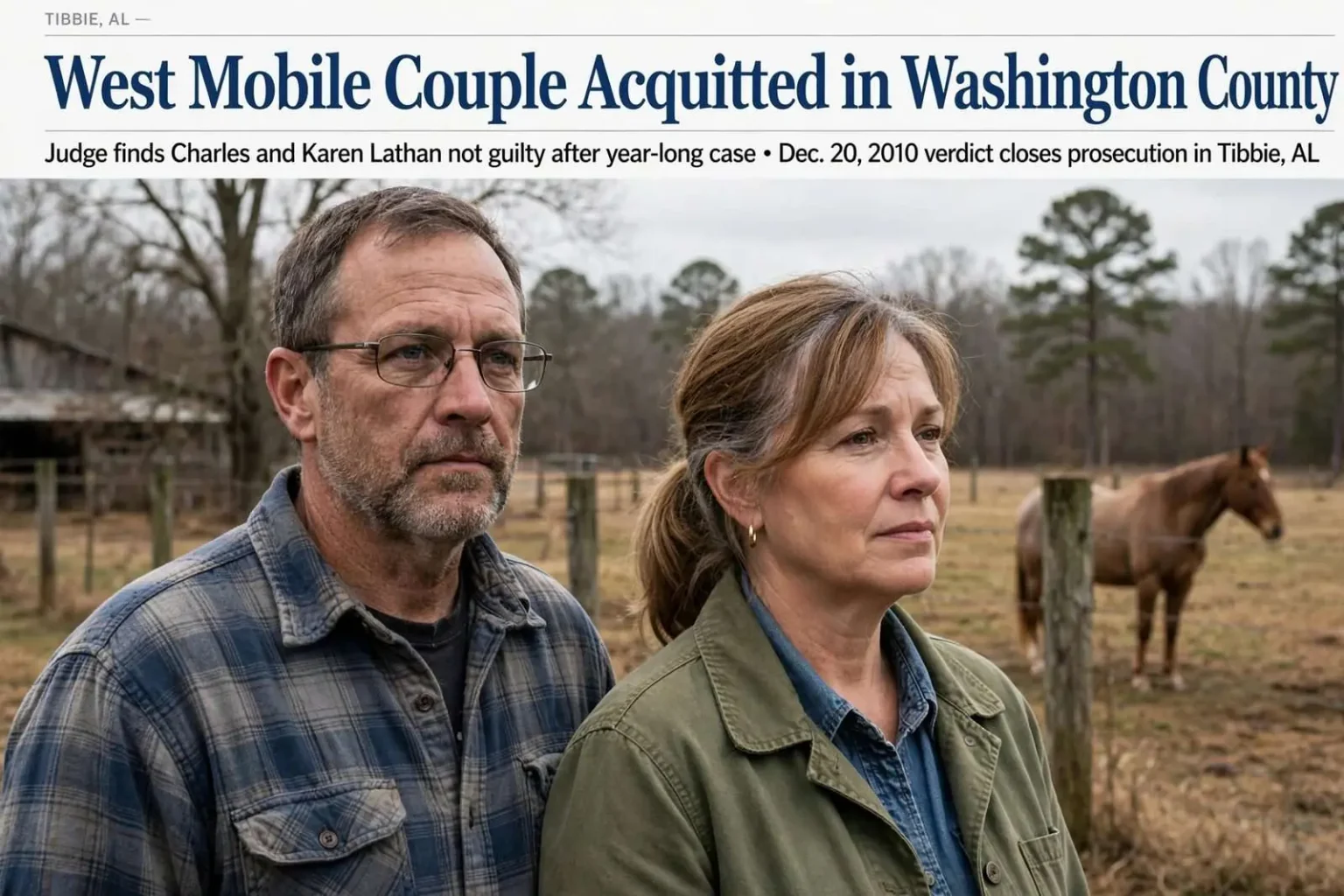
A west Mobile couple whose history of caring for animals had drawn notice over the years was acquitted of animal cruelty charges that Washington County authorities had filed more than a year earlier, alleging the pair allowed a horse to die of starvation in the rural Washington County community of Tibbie. The acquittal closed a case that had traveled a long and winding path — from a suburban zoning dispute inside Mobile’s city limits to a criminal courtroom in one of Alabama’s most rural counties — and that cast a light on how difficult animal cruelty cases can be to prove.
A verdict a year in the making
Judge Jerry L. Turner found Charles and Karen Lathan not guilty of the charges, which had been brought on Dec. 3, 2009. Turner rendered his verdict on Dec. 20, 2010 — more than a year after the charges were lodged and nearly 10 months after he heard the evidence in a bench trial, meaning the judge rather than a jury weighed the facts and decided the outcome. The gap between the hearing of evidence and the ruling was unusually long, and observers of the case noted that such delays, while uncommon, are not unheard of in smaller-county courts where judges carry heavy dockets.
The charges against the Lathans were Class B misdemeanors under Alabama law, the classification the state applies to basic animal cruelty offenses — less severe than the felony-grade aggravated cruelty charges reserved for the most extreme conduct. A Class B misdemeanor in Alabama can carry jail time and fines, though the case never reached that stage because Turner acquitted the couple outright.
At the time the charges were filed, Washington County Sheriff Richard Stringer offered a stark description of the animal’s decline. “We have pictures of the horse, before and after, and we could see it progressively deteriorating,” Stringer said. “At the end, it was laying on the ground, spinning around and around, just suffering.”
An earlier zoning fight
The Lathans had previously been in the news for a very different reason — a civil zoning battle inside the Mobile city limits. The City of Mobile filed suit to force them to get rid of seven goats at their Patricia Drive residence in the Cypress Shores area of west Mobile, a neighborhood of larger lots tucked along the western reaches of the city. Neighbors had complained about the noise and smell from the goats and chickens on the couple’s seven-acre spread, and the complaints eventually produced a lawsuit rather than a simple citation.
The Lathans countered that they loved their animals and treated them like pets. The city argued that R-1 zoning — the single-family residential designation that governs most of Mobile’s suburban neighborhoods — prohibited keeping farm animals, regardless of how well cared for they might be. The dispute landed before Mobile County Circuit Judge John Lockett, who, in a decision likened to that of a barnyard Solomon, split the verdict: the goats had to go, but the chickens could remain.
According to Stringer, after that ruling the animals, including the goats and the horse, ended up in Tibbie, a small community in Washington County near the Tombigbee River in the state’s rural southwestern corner. Washington County is a place of timberland and scattered settlements where lots are large, neighbors are few, and livestock is a common sight — an environment where authorities said the couple’s animals were later found in troubling condition.
Competing accounts
Testimony offered in the Lathans’ defense suggested a more sympathetic reading of events. According to that account, the couple may have sought to rescue the horse, which they said they found in an emaciated condition in south Mobile County and moved to Tibbie in an effort to save its life. If the defense account was accurate, the animal’s decline predated its arrival in Washington County, and the Lathans’ role was that of would-be rescuers rather than neglectful owners.
The sheriff, however, claimed the Lathans checked on the animals only once or twice a week, and said that because the couple had an unlisted telephone number, he was unable to alert them to the horse’s failing condition. That gap in communication became one of the disputed facts of the case, with the defense and prosecution drawing opposite conclusions from the same circumstances.
The trial also touched on a reported family feud between Mrs. Lathan and her siblings over the handling of their mother’s estate, a matter the defense suggested colored some of the complaints and attention the couple had received. A defense attorney for Karen Lathan described her as genuinely soft-hearted toward all animals and “like a child” in her devotion to them, portraying a woman whose affection for animals was so consuming that it shaped nearly every part of her life.
Intent versus outcome
The case highlighted the difficulty of sorting intent from outcome in animal welfare disputes, a challenge that recurs in cruelty prosecutions across Alabama and the Gulf Coast. Prosecutors and the sheriff pointed to the condition of the horse as evidence of neglect, while the defense framed the couple as would-be rescuers overwhelmed by an animal that was already in dire shape. In a bench trial, the judge must weigh those competing narratives without a jury, and the outcome often turns on whether the state can prove that a defendant knowingly or recklessly allowed an animal to suffer.
Alabama’s animal cruelty framework distinguishes sharply between grades of conduct, reserving its harshest penalties for intentional acts of torture or aggravated cruelty and treating lesser neglect as a misdemeanor matter. That structure means cases like the Lathans’ — where the condition of an animal is undisputed but the owners’ knowledge and intent are contested — often come down to credibility determinations and circumstantial detail: how often the owners visited, whether they sought veterinary care, and what they knew and when they knew it.
For rural counties like Washington, such cases carry practical weight. Sheriff’s deputies are frequently the first — and sometimes only — responders to reports of neglected livestock, and counties have limited resources for housing, feeding and caring for seized animals while charges are pending. An acquittal like the Lathans’ does not erase those costs, and it underscores why authorities approach animal cruelty cases with care before filing charges.
In the end, after a lengthy interval between the bench trial and the ruling, Turner sided with the defense, and the Lathans were cleared of the misdemeanor charges that had hung over them for more than a year. For the couple, the verdict ended a legal ordeal that began with a suburban dispute over goats and chickens and ended in a rural courtroom far from their Patricia Drive home. For Washington County officials, it closed a chapter on a case that had drawn attention well beyond the county line. And for anyone following the dispute, the outcome served as a reminder that in animal welfare cases, as in so many others, the story told in court is rarely as simple as the one told at the scene.
How the case unfolded in court
Bench trials of this kind are decided on the paper record of the investigation and the testimony of a handful of witnesses. In the Lathan case, that record included photographs of the horse at different stages, the accounts of deputies who responded to the Tibbie property, and the testimony of those who knew the couple and their long habit of keeping animals. Because the defense chose to put its account before the court rather than simply contest the state’s evidence, the trial became a contest of narratives rather than a dispute over a single disputed fact.
Cases that move from one county to another also complicate prosecution. The events in the Lathan case spanned two jurisdictions — the city of Mobile, where the zoning fight took place, and Washington County, where the criminal charges were filed — and the passage of time between the zoning ruling, the relocation of the animals, and the eventual charges gave both sides room to argue about what happened when. Defenders of the couple pointed to that timeline as evidence that the horse’s decline was set in motion before the animals reached Tibbie; prosecutors treated the move as the moment the couple assumed full responsibility for the animal’s welfare.
The year that separated the filing of the charges from the verdict also carried a cost for the couple, who lived for more than twelve months under the cloud of a criminal accusation that, in the end, did not survive trial. Acquittals in misdemeanor animal cases rarely attract much attention, but the Lathan case drew notice precisely because the couple’s earlier zoning fight had already made their names familiar to Mobile readers — and because the allegations, once made public, followed them through a full year of uncertainty before a judge finally cleared them.