Mobile’s Oakleigh House Museum Loans Rare Portrait to D.C. Museum
Mobile's Historic Oakleigh House Museum loaned its rare portrait of suffragist Alva Belmont to a Washington museum for Women's History Month.
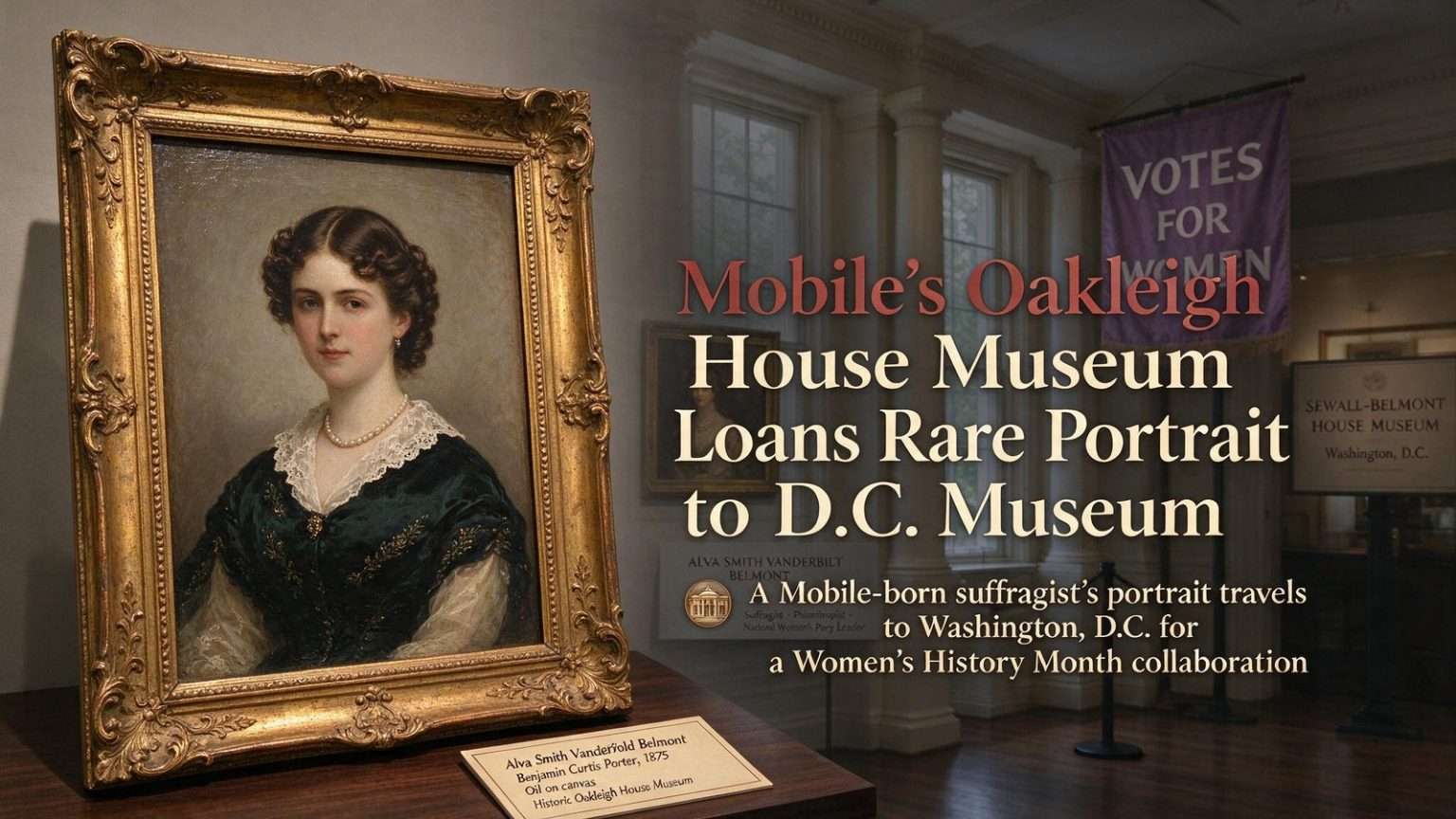
A rare portrait housed at Mobile’s Historic Oakleigh House Museum traveled to Washington, D.C. this month, where it was set to be unveiled at the Sewall-Belmont House Museum in honor of Women’s History Month. The journey of a single painting across a thousand miles represents an unusual act of collaboration between two historic house museums, and for Mobile it means one of the city’s least-known treasures will spend the season in the nation’s capital, telling a story that begins on the streets of the Port City.
The painting depicts Alva Smith Vanderbilt Belmont, a nationally influential suffragist who was born in Mobile in 1853. Belmont’s life carried her from a childhood in antebellum Mobile to the drawing rooms of New York society and, ultimately, to the front ranks of the American women’s suffrage movement, where she used her fortune and her formidable will to bankroll the campaign that won women the vote. Few figures with Mobile roots have played as large a role on the national stage, and fewer still are as little known in the city of their birth.
The Sewall-Belmont House Museum is named in her honor, and museum officials in both cities said the loan represented a meaningful partnership between two institutions dedicated to preserving different chapters of her story. The Washington museum occupies one of the oldest buildings on Capitol Hill and served for decades as the headquarters of the National Woman’s Party, the organization Belmont helped fund and lead. Displaying her portrait there returns the suffragist, in a sense, to the place where her life’s work is remembered.
“This is a dynamic partnership between two house museums, with two different missions,” said Melanie Thornton, museum collection manager for the Historic Oakleigh House Museum, which is operated by the Historic Mobile Preservation Society. “We are very excited that one of our most historical works of art will be introduced to newer, broader audiences.” For a collection the size of Oakleigh’s, a loan to a national institution is a significant validation, and it extends the museum’s reach to visitors who may never have reason to visit Mobile itself.
From Mobile to New York Society
Belmont was born to Murray Forbes Smith, a Mobile cotton factor, and Phoebe Desha Smith. Her family relocated to New York not long after the Civil War. Cotton factors stood at the center of antebellum Mobile’s economy, selling the region’s cotton crop on commission and connecting inland planters to the shipping houses of Europe, and the Smith family’s prosperity placed young Alva among the city’s social elite before the war upended that world.
The postwar move north followed a pattern familiar to many families whose fortunes were tied to the old cotton economy, and it put Alva Smith into the marriage market of Gilded Age New York, where southern pedigree and northern money blended into the era’s most powerful social alliances. She navigated that world with an ambition that would define her entire life, first as a debutante navigating New York society, later as one of its most formidable strategists.
At 22, she married William Kissam Vanderbilt, and the couple had three children before divorcing in 1895, an unusually public split for the era that left her with a substantial settlement, including the Marble House estate in Newport, Rhode Island. The Vanderbilt marriage joined her to the wealthiest family in America, and Marble House, a mansion of marble and gilded splendor built as a summer cottage on the Newport shore, remains one of the surviving monuments to that world, now preserved as a museum itself.
She remarried the following year, to Oliver Hazard Perry Belmont, and after his death in 1908 devoted her fortune and public influence to the women’s suffrage movement. The turn was remarkable for a woman of her class and age. Society matrons of the Gilded Age were expected to patronize charities quietly; Belmont instead put her name, her homes and her money behind a movement whose pickets and marches were routinely denounced in the press, treating the cause with the same organizational discipline she had once applied to society functions.
A Life Devoted to the Vote
She became president of the National Woman’s Party after ratification of the 19th Amendment in 1920 and held that role until her death in 1933. The National Woman’s Party had been the militant wing of the American suffrage effort, famous for picketing the White House through the First World War, and after victory it turned its attention to the Equal Rights Amendment, which Belmont championed long before such a proposal entered mainstream political debate.
Her fundraising for the cause was legendary. Belmont subsidized suffrage publications, underwrote the party’s headquarters and operations, and opened her houses for movement events, understanding as well as any strategist of her era that a political movement runs on money as much as conviction. Historians of the suffrage movement credit her with keeping the National Woman’s Party solvent and assertive through the decades when the movement’s future direction was most contested.
“We have quite a few influential historical female figures with strong ties to Mobile,” Thornton said. “By loaning Belmont’s portrait, we are contributing to her story on a national level.” The observation points to a broader truth about the city’s past. Mobile’s history books have traditionally centered on Cotton Port commerce, Mardi Gras and military installations, but the women who shaped national movements from a Mobile beginning have often gone uncelebrated at home, something the Oakleigh museum has worked to change.
A Portrait with a Dramatic History
The portrait, painted by Benjamin Curtis Porter shortly after Belmont’s marriage to Vanderbilt in 1875, is believed to be the only commissioned portrait of her still in existence. Porter was a New York artist of established reputation whose portraits of society figures hang in collections today, and the painting captures Belmont at the very moment she entered the highest tier of American society, decades before she would trade society’s approval for the suffrage movement’s battles.
According to museum officials, one biography of Belmont claimed she had the portrait destroyed after devoting herself to the suffrage cause, but the painting survived and was later willed to the Historic Mobile Preservation Society by Belmont’s daughter, Consuelo Vanderbilt Balsan, in 1965. The story of the supposed destruction says something about Belmont herself, who reportedly wanted to distance her public suffrage identity from the society matron in the fine gown, but the survival of the canvas preserved for Mobile a direct link to one of the most consequential women the city has produced.
The 1965 bequest placed the portrait in Mobile at a moment when the Historic Mobile Preservation Society was building its collection around Oakleigh, the antebellum house it had saved and opened as a museum. Consuelo Vanderbilt Balsan, herself a famous figure who had been married away in a society match and later became a prominent suffragist in England, understood the painting’s significance and sent it back to the city where her mother began her life.
Page Harrington, executive director of the Sewall-Belmont House and Museum, said the loan would allow the Washington institution to highlight Belmont’s national impact on the suffrage and equal rights movements over the following two years. The two-year display window gives the painting a long residency in Washington, where it will hang among the artifacts of the movement Belmont financed, from banners and documents to the rooms where the National Woman’s Party did its work.
Mobile’s Place in Women’s History
The loan underscored Mobile’s often-overlooked connection to national women’s history, a link the Historic Oakleigh House Museum has worked to spotlight through its collection of Gulf Coast artifacts and portraiture. Oakleigh itself, an 1833 Greek Revival house museum in the Oakleigh Garden Historic District, draws visitors into the city’s 19th-century world, and exhibits like this loan help connect that local story to the national currents that carried a Mobile-born woman to the forefront of the fight for the vote.
For the museum, the departure of its most valuable portrait is also an act of institutional confidence. Loans between museums rest on careful conservation review, insurance arrangements and trust, and Oakleigh’s willingness to send the painting north for two years signals a collection that is professionally managed and nationally relevant. When the portrait eventually returns to Mobile, it will carry with it the added prestige of having hung in the nation’s capital, in a museum that bears the name of the woman in the frame.
Until then, visitors to the Sewall-Belmont House Museum on Capitol Hill will meet Alva Vanderbilt Belmont twice over, in the exhibits that tell her story and in the face that Benjamin Curtis Porter painted in 1875, the face of a Mobile-born suffragist who helped change the American constitution.