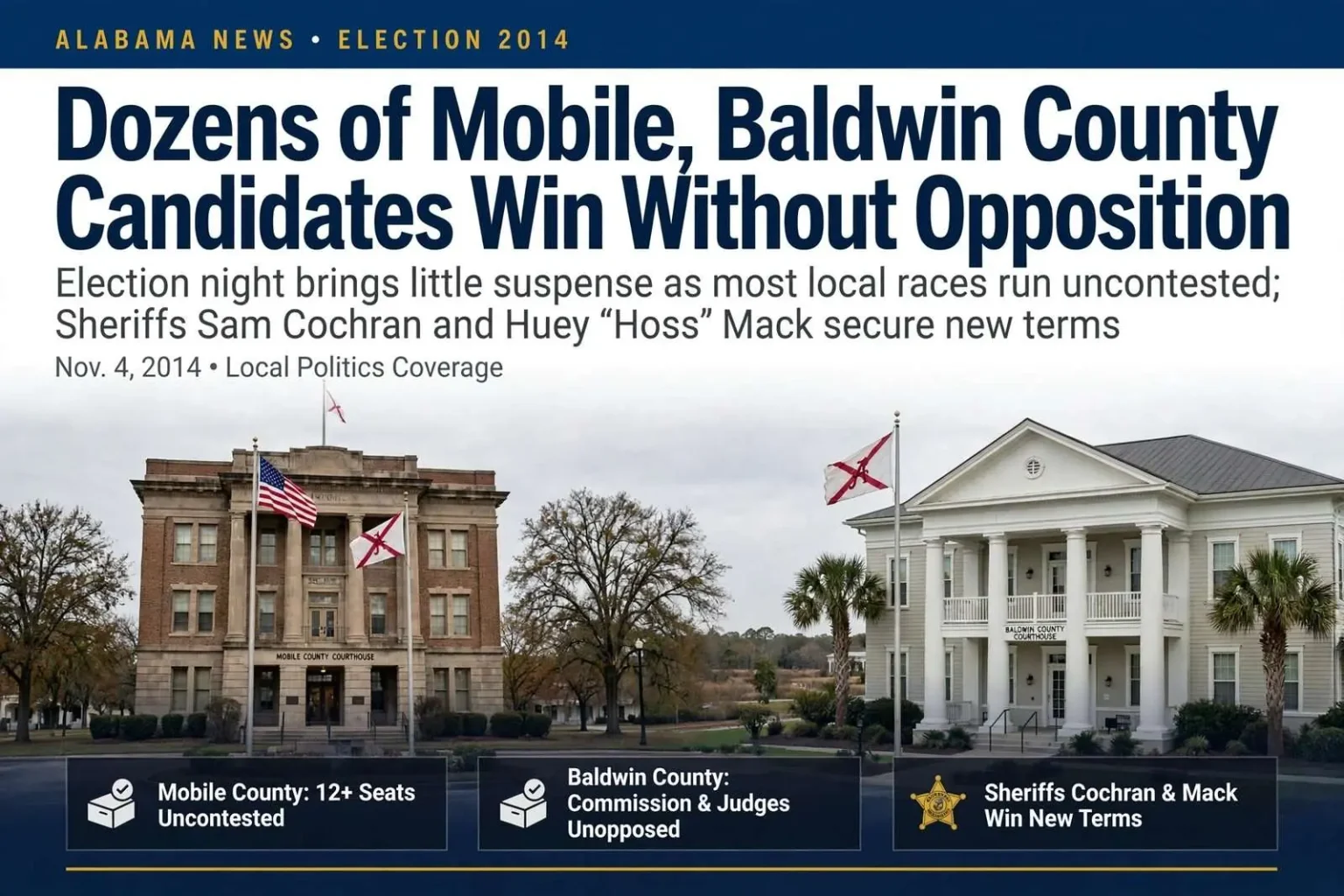
Election night brought little suspense for most local races in Mobile and Baldwin counties on Tuesday, as the overwhelming majority of candidates on the ballot faced no opponent at all.
Both counties’ top law enforcement posts were among the uncontested seats. Sheriff Sam Cochran secured another term in Mobile County, while Sheriff Huey “Hoss” Mack did the same in Baldwin County, with neither facing a challenger.
In Mobile County, school board seats went to Reginald Crenshaw and Robert Battles Sr. without opposition, while District Judges Jay York and Joe Basenberg also cruised to new terms. Kim Hastie was set to continue as the county’s revenue commissioner. On the legislative side, a lengthy list of Mobile-area lawmakers ran unopposed, including Adline Clarke, James Buskey, Victor Gaston, Chris Pringle, Jack Williams, Margie Wilcox and David Sessions.
Baldwin County saw a similar pattern up and down the ballot. Circuit judges J. Lang Floyd and Carmen Bosch both won new terms without a challenger, as did state representatives Harry Shiver, Alan Baker, Thomas “Action” Jackson, Joe Faust, Steve McMillan and Randy Davis. Every member of the Baldwin County Commission — Frank Burt, Tucker Dorsey, Chris Elliott and Charles “Skip” Gruber — ran unopposed, along with school board members Tony Myrick, Angie Swiger and Cecil Christenberry.
A handful of statewide and appellate races involving south Alabama connections were similarly one-sided. Jeremy Odom and Chris “Chip” Beeker, who had already fought through a contested primary earlier in the year, faced no general election opposition in their bids for seats on the Alabama Public Service Commission. State Treasurer Young Boozer likewise ran without a challenger in either the primary or general election.
Several judicial races on the statewide ballot were also uncontested, with Beth Kellum, Mary Windom, Scott Donaldson and Bill Thompson all winning appellate court seats without opposition. Alabama Supreme Court Justice Greg Shaw rounded out the list of unopposed statewide judicial candidates.
The pattern reflects a broader trend common in Alabama’s off-year general elections, where many local offices attract only a single serious candidate once the party primary season concludes, particularly in strongly one-party areas of the state. For voters in Mobile and Baldwin counties, Tuesday’s ballot offered relatively few genuine choices, with most of the drama in local politics having already played out months earlier during the primary contests.
Turnout in uncontested races often lags behind more competitive contests, but local election officials in both counties still prepared for a full slate of polling operations to accommodate voters casting ballots in the small number of races that did feature a choice, as well as any statewide or national contests on the same ballot.
Mobile is the county seat of Mobile County in southwest Alabama and the state’s only saltwater port. Situated where the Mobile River meets Mobile Bay near the northern Gulf of Mexico, the city has long served as a commercial and cultural gateway between Alabama and the wider Gulf Coast. Founded in 1702 as Fort Louis de la Louisiane and ruled in turn by France, Britain, and Spain before joining the United States in 1813, Mobile carries a layered heritage distinct from the rest of the state.
Today Mobile anchors a metropolitan area spanning Mobile County and neighboring Baldwin County, and it remains a center for shipping, aerospace, healthcare, and higher education in the region. Its downtown and waterfront have seen sustained revitalization, while historic neighborhoods preserve architecture from its colonial and antebellum past. The city’s identity is shaped as much by its working port and industrial base as by its festivals and food culture, making it a frequent focal point for news about growth and change in southern Alabama.
Baldwin County sits directly east of Mobile County across Mobile Bay and is the largest county in Alabama by land area. It encompasses the Eastern Shore communities of Daphne, Fairhope, Spanish Fort, and Foley and stretches south to the beaches of Gulf Shores and Orange Beach along the Gulf of Mexico.
Long among the fastest-growing counties in the state, Baldwin blends suburban development near the bay with tourism-driven coastal economies. Its proximity to Mobile and its position on the Eastern Shore make it a recurring subject of regional news covering growth, infrastructure, schools, and the balance between development and coastal preservation.
Alabama is a state in the southeastern United States bordered by Tennessee, Georgia, Florida, the Gulf of Mexico, and Mississippi. Often called the Heart of Dixie, it spans Appalachian foothills in the north and flat coastal plains in the south. Its largest cities include Birmingham, Montgomery, Huntsville, and Mobile.
Alabama’s history encompasses Indigenous roots, Spanish and French colonial settlement, a cotton-plantation economy, the Civil War and Reconstruction, and the Civil Rights Movement of the 1950s and 1960s, followed by a shift toward manufacturing, aerospace, and technology. Local news across the state frequently reflects this mix of tradition and change.
Local government in the Mobile area operates through a combination of mayor-council or commission structures at the municipal level and a county commission in Mobile County, with elected officials handling budgets, public safety, infrastructure, and zoning. Baldwin County has its own commission and a collection of incorporated municipalities.
Decisions made in council chambers and commission meetings affect roads, school funding, economic development, and quality of life, which is why coverage of local government is a staple of regional journalism. The interplay between city, county, and state authorities often determines how effectively the area can address shared challenges.
Because many services residents rely on are delivered at the local level, the choices of elected officials have direct, everyday consequences. Budget priorities, in particular, reveal a community’s values and shape the trajectory of growth and public welfare for years to come.
Probate courts in Alabama handle matters distinct from the trial courts that hear criminal and civil cases, including wills, estates, guardianships, and involuntary commitments for mental-health treatment. In Mobile County the probate judge is an elected official with broad administrative and judicial duties.
Cases involving involuntary psychiatric commitment require the court to balance an individual’s liberty interests against concerns for their safety and the safety of others, a sensitive legal threshold that has drawn scrutiny in many jurisdictions. The procedures governing such hearings, including who must appear and testify, are set by state law and local rule.
Disputes over those procedures often surface tensions between healthcare providers, the court, and advocates for patients. Because the stakes involve both liberty and wellbeing, courts and clinicians alike face pressure to honor the law while ensuring that people in crisis receive timely and appropriate care.
Local law enforcement across South Alabama is carried out by municipal police departments, county sheriff’s offices, and state agencies that together cover a mix of urban, suburban, and rural territory. City departments handle policing within municipal limits, while sheriff’s offices provide courthouse security, jail operations, and patrol in unincorporated areas.
Cooperation among these agencies, and with federal partners, is central to tackling problems that cross jurisdictional lines, from drug trafficking to violent crime. Joint task forces that pair federal agents with local officers have become a standard mechanism for sharing information and concentrating resources on threats that no single agency could address alone.
Public-safety agencies in the region also contend with staffing, training, and community-relations challenges common to departments nationwide. How they allocate patrols, respond to calls, and engage neighborhoods is a regular subject of local oversight and news coverage, particularly where residents expect both accountability and visible protection.
Education in South Alabama spans public school systems in Mobile and Baldwin counties, a network of private and parochial schools, and institutions of higher learning including the University of South Alabama, Spring Hill College, and community colleges. Public-school governance rests with locally elected boards.
Boards oversee budgets, curricula, and facilities, often amid debates over funding equity and student achievement. The region’s colleges contribute not only to the workforce pipeline but also to healthcare, research, and cultural life, and education policy set in Montgomery frequently shapes what local districts can do.
Schools are also central to community stability. Enrollment trends, facility conditions, and graduation outcomes are watched closely by families and employers alike, making education a persistent focus of public attention and news coverage across the Gulf Coast.
Collegiate athletics are a major part of life in southern Alabama, where the University of South Alabama in Mobile fields the Jaguars across a range of sports. The university’s football program, which began competition in the 2000s, has become a rallying point for students, alumni, and residents and a source of regional pride.
Beyond the campus, youth, high-school, and recreational leagues across Mobile and Baldwin counties sustain a deep local sports culture, and tailgating and game-day traditions reflect the social fabric of the community. Coverage of local teams regularly intersects with broader themes of economic impact, community engagement, and the role of athletics in mid-sized Southern cities.
Sports also serve as a lens on community investment. Stadium construction, scheduling, and the success of local programs ripple into nearby businesses and neighborhoods, making them a recurring and widely followed subject in regional reporting.