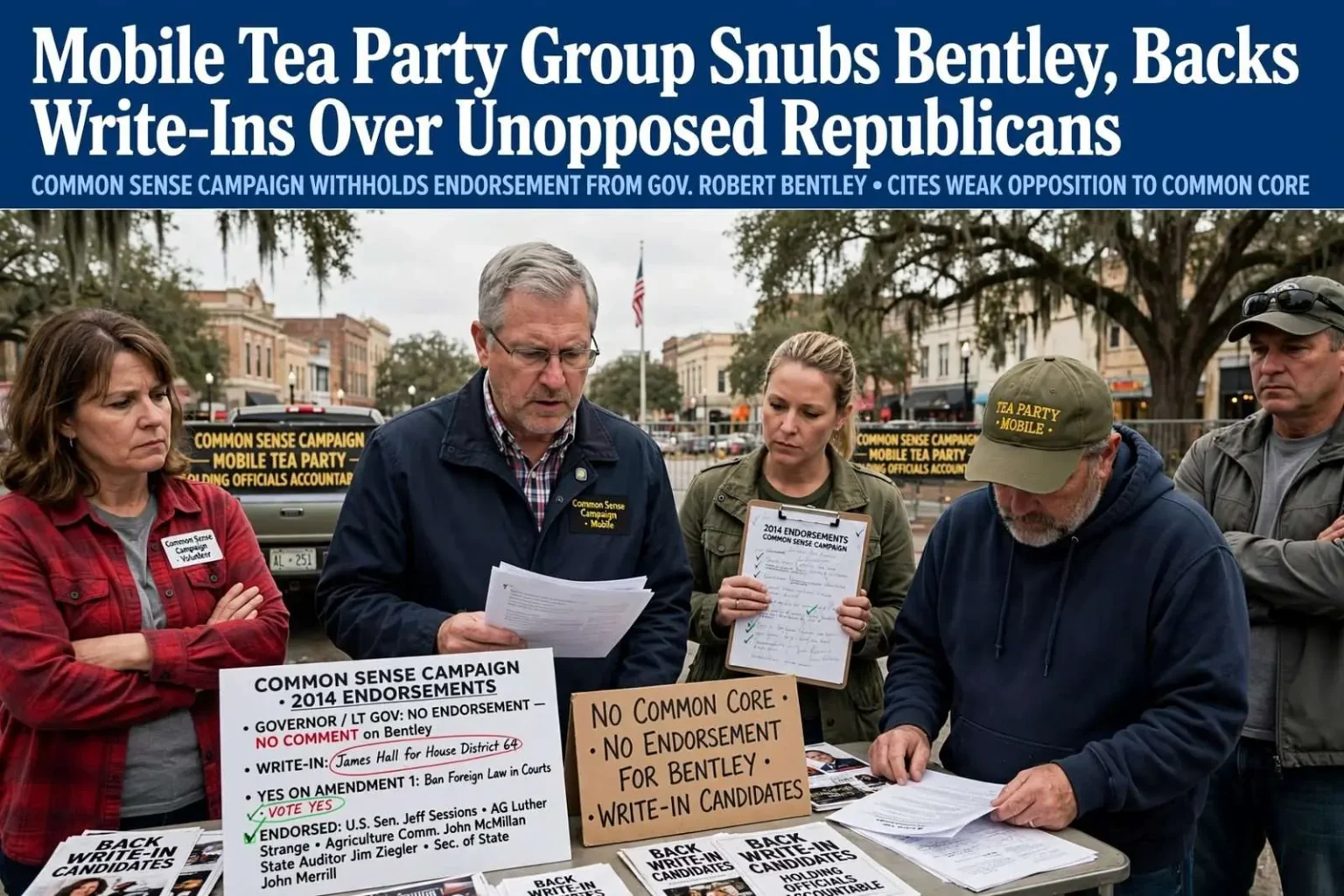
A Mobile-based tea party organization is withholding its endorsement from Gov. Robert Bentley ahead of Tuesday’s election, citing frustration with what members see as his weak opposition to the Common Core education standards. The Common Sense Campaign listed “no comment” for both governor and lieutenant governor on the slate of endorsements it released, a pointed snub of the incumbent Republican governor.
Lou Campomenosi, the group’s president, said Bentley simply has not done enough to back up his stated opposition to Common Core. He said the governor has failed to lobby the Legislature or the state Board of Education on the issue and did not publicly support a slate of anti-Common Core candidates who challenged pro-Common Core members of the state school board earlier in the election cycle. Campomenosi made clear the group’s frustration does not translate into support for Bentley’s Democratic opponent, Parker Griffith, saying members would rather leave the governor’s race blank on the ballot than vote for him.
The group did offer full-throated endorsements elsewhere on the statewide ballot, backing U.S. Sen. Jeff Sessions, Attorney General Luther Strange, Agriculture Commissioner John McMillan, state auditor candidate Jim Ziegler and secretary of state candidate John Merrill, all Republicans.
Locally, the Common Sense Campaign backed state Sens. Trip Pittman of Montrose and Bill Hightower of Mobile, along with Senate hopeful Greg Albritton, plus state House candidates Wayne Biggs and Ralph Carmichael. In the Baldwin County district judge race, the group initially declined to endorse either Republican incumbent Michelle Thomason or independent challenger Ginger Poynter, before reversing course days before the election to back Thomason.
Notably, being unopposed did not guarantee the group’s support. Members recommended voters write in James Hall for House District 64 rather than back unopposed incumbent Harry Shiver, after Hall had lost a GOP primary challenge to Shiver earlier in the year. The group briefly floated a similar write-in push for Craig Stephenson in the Baldwin County Board of Education District 5 race, but withdrew that recommendation after Stephenson said he did not want to run as a write-in candidate against incumbent Angie Swiger. Among four unopposed Baldwin County Commission seats, the group endorsed only one commissioner, Frank Burt.
On statewide ballot measures, the Common Sense Campaign endorsed only one of five proposed constitutional amendments, urging a “yes” vote on a measure barring judges from citing foreign law in their rulings, widely seen as a preemptive move against the use of Shariah law in Alabama courts. Campomenosi said the group opposed most of the other amendments partly over process concerns, since none of the measures went through a public input stage before landing on the ballot, and partly out of skepticism that some proposals, including one aimed at strengthening gun rights, could have unintended consequences given that the Second Amendment already guarantees those rights.
Mobile is the county seat of Mobile County in southwest Alabama and the state’s only saltwater port. Situated where the Mobile River meets Mobile Bay near the northern Gulf of Mexico, the city has long served as a commercial and cultural gateway between Alabama and the wider Gulf Coast. Founded in 1702 as Fort Louis de la Louisiane and ruled in turn by France, Britain, and Spain before joining the United States in 1813, Mobile carries a layered heritage distinct from the rest of the state.
Today Mobile anchors a metropolitan area spanning Mobile County and neighboring Baldwin County, and it remains a center for shipping, aerospace, healthcare, and higher education in the region. Its downtown and waterfront have seen sustained revitalization, while historic neighborhoods preserve architecture from its colonial and antebellum past. The city’s identity is shaped as much by its working port and industrial base as by its festivals and food culture, making it a frequent focal point for news about growth and change in southern Alabama.
Baldwin County sits directly east of Mobile County across Mobile Bay and is the largest county in Alabama by land area. It encompasses the Eastern Shore communities of Daphne, Fairhope, Spanish Fort, and Foley and stretches south to the beaches of Gulf Shores and Orange Beach along the Gulf of Mexico.
Long among the fastest-growing counties in the state, Baldwin blends suburban development near the bay with tourism-driven coastal economies. Its proximity to Mobile and its position on the Eastern Shore make it a recurring subject of regional news covering growth, infrastructure, schools, and the balance between development and coastal preservation.
Alabama is a state in the southeastern United States bordered by Tennessee, Georgia, Florida, the Gulf of Mexico, and Mississippi. Often called the Heart of Dixie, it spans Appalachian foothills in the north and flat coastal plains in the south. Its largest cities include Birmingham, Montgomery, Huntsville, and Mobile.
Alabama’s history encompasses Indigenous roots, Spanish and French colonial settlement, a cotton-plantation economy, the Civil War and Reconstruction, and the Civil Rights Movement of the 1950s and 1960s, followed by a shift toward manufacturing, aerospace, and technology. Local news across the state frequently reflects this mix of tradition and change.
Local government in the Mobile area operates through a combination of mayor-council or commission structures at the municipal level and a county commission in Mobile County, with elected officials handling budgets, public safety, infrastructure, and zoning. Baldwin County has its own commission and a collection of incorporated municipalities.
Decisions made in council chambers and commission meetings affect roads, school funding, economic development, and quality of life, which is why coverage of local government is a staple of regional journalism. The interplay between city, county, and state authorities often determines how effectively the area can address shared challenges.
Because many services residents rely on are delivered at the local level, the choices of elected officials have direct, everyday consequences. Budget priorities, in particular, reveal a community’s values and shape the trajectory of growth and public welfare for years to come.
Education in South Alabama spans public school systems in Mobile and Baldwin counties, a network of private and parochial schools, and institutions of higher learning including the University of South Alabama, Spring Hill College, and community colleges. Public-school governance rests with locally elected boards.
Boards oversee budgets, curricula, and facilities, often amid debates over funding equity and student achievement. The region’s colleges contribute not only to the workforce pipeline but also to healthcare, research, and cultural life, and education policy set in Montgomery frequently shapes what local districts can do.
Schools are also central to community stability. Enrollment trends, facility conditions, and graduation outcomes are watched closely by families and employers alike, making education a persistent focus of public attention and news coverage across the Gulf Coast.
Probate courts in Alabama handle matters distinct from the trial courts that hear criminal and civil cases, including wills, estates, guardianships, and involuntary commitments for mental-health treatment. In Mobile County the probate judge is an elected official with broad administrative and judicial duties.
Cases involving involuntary psychiatric commitment require the court to balance an individual’s liberty interests against concerns for their safety and the safety of others, a sensitive legal threshold that has drawn scrutiny in many jurisdictions. The procedures governing such hearings, including who must appear and testify, are set by state law and local rule.
Disputes over those procedures often surface tensions between healthcare providers, the court, and advocates for patients. Because the stakes involve both liberty and wellbeing, courts and clinicians alike face pressure to honor the law while ensuring that people in crisis receive timely and appropriate care.
The economy of the Mobile region is diversified across shipping and logistics, aerospace and shipbuilding, healthcare, tourism, and manufacturing. The Port of Mobile is one of the nation’s busiest seaports and a cornerstone of the local and state economy.
Major employers in aviation and defense contribute to a skilled workforce, while economic-development organizations aim to attract investment and jobs through incentives and infrastructure improvements. Small businesses, from restaurants to professional services, form the backbone of neighborhood commerce.
The health of the regional economy is a frequent subject of public discussion and reporting. Workforce development, recruitment of industry, and the fortunes of local retailers all feed into a broader picture of how the Gulf Coast competes and adapts in a changing national economy.
Mobile Bay is a shallow estuary in southern Alabama where freshwater from the Mobile, Tensaw, and other rivers mixes with saltwater from the Gulf of Mexico. It is among the largest estuarine systems in the United States and supports commercial and recreational fishing, shipping through the Port of Mobile, and wetlands that buffer the coastline from storms.
The bay’s Eastern Shore, in Baldwin County, includes Daphne, Fairhope, and Spanish Fort, while the Western Shore lies in Mobile County. Its ecology and economy have guided settlement for centuries, and the bay figures in regional debates over development, navigation, and conservation. Events on either shore are routinely covered as part of the interconnected life of the Mobile metro area.
The Gulf of Mexico borders Alabama’s southern edge and defines much of the state’s coastal identity. Alabama’s Gulf coastline, centered on Dauphin Island, Gulf Shores, and Orange Beach, supports a tourism industry built around beaches, charter fishing, and marine recreation, while offshore waters host shipping lanes and energy interests.