Redistricting Fight Comes to Mobile as Rep. Randy Davis, Joe Reed Headline Luncheon
Rep. Randy Davis and Alabama Democratic Conference Chairman Joe Reed will debate Alabama's redistricting fight at a Mobile luncheon.
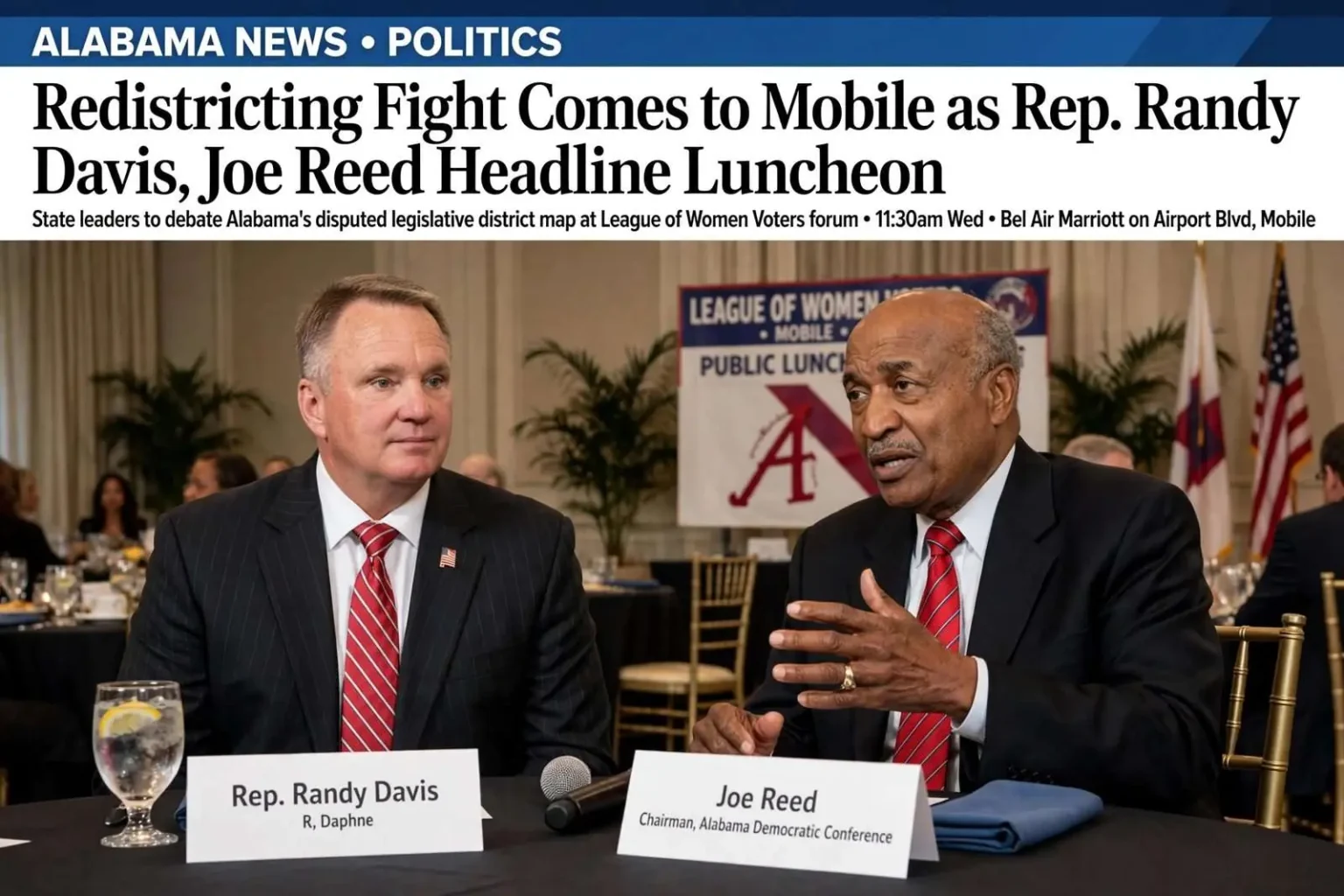
A statewide political fight over Alabama’s legislative district lines is set to play out locally next week, when two of the debate’s most prominent voices appear together at a public luncheon in Mobile. State Rep. Randy Davis, a Republican from Daphne, and Alabama Democratic Conference Chairman Joe Reed will share their competing perspectives on the state’s disputed redistricting plan at an event sponsored by the League of Women Voters.
The luncheon is scheduled for 11:30 a.m. next Wednesday at the Bel Air Marriott on Airport Boulevard in Mobile, and organizers say the event is open to the public. Bringing the two men together offers local residents a rare chance to hear both sides of a legal and political dispute that has drawn national attention, all in one Mobile ballroom.
At the center of the disagreement is how Alabama’s legislative districts were redrawn following the 2010 census, a process states are required to undertake once a decade. Alabama’s Republican-controlled Legislature approved a new map in 2012 that increased the concentration of black residents in a number of majority-minority districts. Black Democratic lawmakers and allied organizations objected almost immediately, arguing the changes amounted to a form of racial gerrymandering that diluted black political influence by packing voters into fewer districts rather than spreading their voting power more broadly.
The dispute escalated all the way to the U.S. Supreme Court, which heard oral arguments in the case the same week as the Mobile luncheon. A ruling was expected sometime in the following year. At issue before the justices was whether race was the predominant factor state lawmakers used in drawing the new district boundaries, or whether the map reflected ordinary partisan redistricting aimed at benefiting the Republican majority, a practice that courts have historically treated very differently under the law.
Reed, a longtime political power broker in Alabama Democratic politics, leads an organization that was among the plaintiffs challenging the redistricting plan in court. Davis, by contrast, served as a member of the legislative committee responsible for drawing the new district lines, giving both men direct, firsthand roles in the fight rather than outside commentary.
For Mobile-area residents, the luncheon offered a chance to engage directly with a debate that could reshape political representation across the state for the next decade, with local implications for how Mobile and Baldwin county communities are grouped into state legislative districts going forward.
What the Supreme Court decided
The case, Alabama Legislative Black Caucus v. Alabama, was argued on Nov. 12, 2014. On March 25, 2015, the Supreme Court ruled 5-4 for the challengers. It found that the lower court had wrongly treated the racial gerrymandering claims as a challenge to the state as a whole, when each district had to be judged on its own. It also found that the Legislature had misread the Voting Rights Act by trying to keep the same percentage of Black voters in majority-Black districts. The justices vacated the ruling and sent the case back to the three-judge federal court for more review.