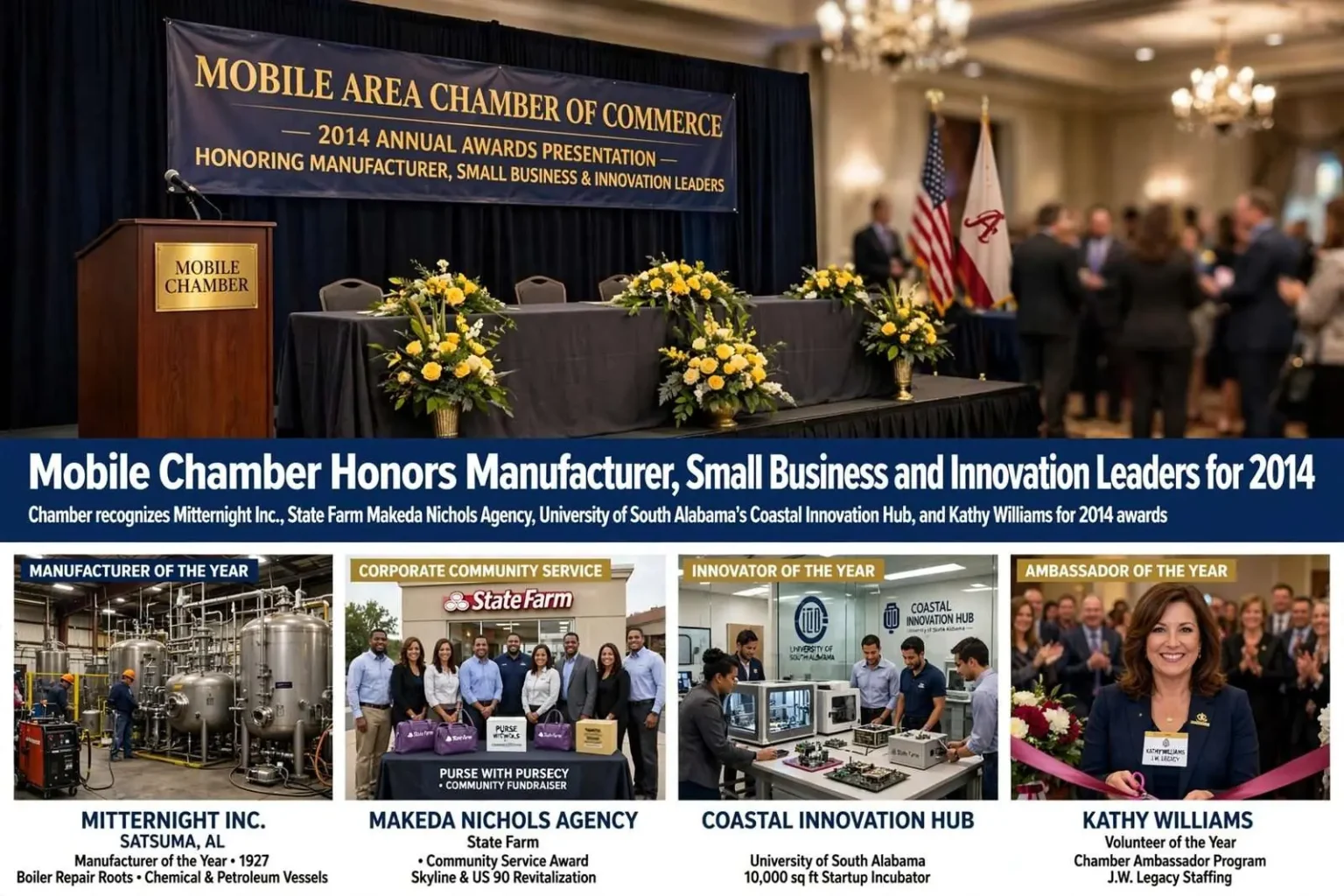
The Mobile Area Chamber of Commerce honored three companies and one longtime volunteer during its annual awards presentation, recognizing standout performance and community involvement over the past year.
The awards were announced during a joint meeting of the Chamber’s governing board of directors, board of advisers and economic development investors. Satsuma-based Mitternight Inc. took home the Manufacturer of the Year honor. What began in 1927 as a boiler repair shop has grown into a manufacturer of complex vessels for the chemical and petroleum industries, counting Fortune 500 companies such as DuPont, Dow Chemical and Royal Dutch Shell among its clients. The company was recognized earlier in the year by Gov. Robert Bentley for its work in international trade and has invested more than $250,000 in its 18-acre facility, while partnering with workforce groups AIDT and Mobile Works on recruiting and training.
The Corporate Community Service Award, presented jointly by the Junior League of Mobile and the Chamber, went to the State Farm Makeda Nichols Agency. Despite being an eight-person office, the agency’s volunteer footprint included organizing the long-running Purse with Purpose fundraiser started by agency owner Makeda Nichols a decade earlier, supporting revitalization efforts along Skyline and U.S. 90, participating in breast cancer and diabetes awareness walks, taking part in Bellingrath Gardens’ Balloon Glow and helping repair a storm-damaged church.
The University of South Alabama’s Coastal Innovation Hub earned the Innovator of the Year award in just its first full year of operation. The 10,000-square-foot facility, billed as the only high-tech business incubator between New Orleans and Jacksonville, Florida, has housed as many as 25 startup companies at a time, with roughly half of its activity coming from non-university-affiliated ventures. Tenants have access to consulting, professional networking, lab space, conference rooms and university resources as they work to bring new technology to market.
Kathy Williams, a professional recruiter with locally owned staffing firm J.W. Legacy, received the Ambassador of the Year award for her volunteer work with the Chamber’s Ambassadors program. In her first year volunteering, Williams was named Ambassador of the Month twice, helped with ribbon-cutting ceremonies and networking events, and took an active role in the Chamber’s annual fundraising drive.
Chamber officials said the annual awards are meant to spotlight the range of ways local businesses and volunteers contribute to the Mobile area’s economy, from established manufacturers to first-year startups and dedicated volunteers working largely behind the scenes. The honorees represent sectors spanning heavy manufacturing, insurance, higher education innovation and small-business volunteerism, reflecting what Chamber leaders described as the diversity of Mobile’s business community heading into the new year.
Mobile is the county seat of Mobile County in southwest Alabama and the state’s only saltwater port. Situated where the Mobile River meets Mobile Bay near the northern Gulf of Mexico, the city has long served as a commercial and cultural gateway between Alabama and the wider Gulf Coast. Founded in 1702 as Fort Louis de la Louisiane and ruled in turn by France, Britain, and Spain before joining the United States in 1813, Mobile carries a layered heritage distinct from the rest of the state.
Today Mobile anchors a metropolitan area spanning Mobile County and neighboring Baldwin County, and it remains a center for shipping, aerospace, healthcare, and higher education in the region. Its downtown and waterfront have seen sustained revitalization, while historic neighborhoods preserve architecture from its colonial and antebellum past. The city’s identity is shaped as much by its working port and industrial base as by its festivals and food culture, making it a frequent focal point for news about growth and change in southern Alabama.
Alabama is a state in the southeastern United States bordered by Tennessee, Georgia, Florida, the Gulf of Mexico, and Mississippi. Often called the Heart of Dixie, it spans Appalachian foothills in the north and flat coastal plains in the south. Its largest cities include Birmingham, Montgomery, Huntsville, and Mobile.
Alabama’s history encompasses Indigenous roots, Spanish and French colonial settlement, a cotton-plantation economy, the Civil War and Reconstruction, and the Civil Rights Movement of the 1950s and 1960s, followed by a shift toward manufacturing, aerospace, and technology. Local news across the state frequently reflects this mix of tradition and change.
The economy of the Mobile region is diversified across shipping and logistics, aerospace and shipbuilding, healthcare, tourism, and manufacturing. The Port of Mobile is one of the nation’s busiest seaports and a cornerstone of the local and state economy.
Major employers in aviation and defense contribute to a skilled workforce, while economic-development organizations aim to attract investment and jobs through incentives and infrastructure improvements. Small businesses, from restaurants to professional services, form the backbone of neighborhood commerce.
The health of the regional economy is a frequent subject of public discussion and reporting. Workforce development, recruitment of industry, and the fortunes of local retailers all feed into a broader picture of how the Gulf Coast competes and adapts in a changing national economy.
Charitable and nonprofit organizations form a vital safety net across South Alabama, addressing needs from hunger and homelessness to disaster relief and holiday assistance. Groups such as The Salvation Army operate local corps that provide shelter, food, and seasonal programs funded largely by community donations.
The generosity of Gulf Coast residents, often mobilized after hurricanes and economic hardship, underscores how tightly knit many of these communities are. Local philanthropy also relies on volunteers and corporate partners, and the progress of fundraising efforts is a recurring subject of regional news because it reflects the community’s capacity to care for its most vulnerable members.
Holiday campaigns in particular reveal the scale of need and the reach of volunteer networks. The rhythm of annual giving, from food drives to toy distributions, is woven into the regional calendar and into the coverage that keeps residents informed about how to help and where support is most needed.
Education in South Alabama spans public school systems in Mobile and Baldwin counties, a network of private and parochial schools, and institutions of higher learning including the University of South Alabama, Spring Hill College, and community colleges. Public-school governance rests with locally elected boards.
Boards oversee budgets, curricula, and facilities, often amid debates over funding equity and student achievement. The region’s colleges contribute not only to the workforce pipeline but also to healthcare, research, and cultural life, and education policy set in Montgomery frequently shapes what local districts can do.
Schools are also central to community stability. Enrollment trends, facility conditions, and graduation outcomes are watched closely by families and employers alike, making education a persistent focus of public attention and news coverage across the Gulf Coast.
Collegiate athletics are a major part of life in southern Alabama, where the University of South Alabama in Mobile fields the Jaguars across a range of sports. The university’s football program, which began competition in the 2000s, has become a rallying point for students, alumni, and residents and a source of regional pride.
Beyond the campus, youth, high-school, and recreational leagues across Mobile and Baldwin counties sustain a deep local sports culture, and tailgating and game-day traditions reflect the social fabric of the community. Coverage of local teams regularly intersects with broader themes of economic impact, community engagement, and the role of athletics in mid-sized Southern cities.
Sports also serve as a lens on community investment. Stadium construction, scheduling, and the success of local programs ripple into nearby businesses and neighborhoods, making them a recurring and widely followed subject in regional reporting.
The natural environment is central to life on the Gulf Coast, where barrier islands, bays, rivers, and wetlands support fisheries, recreation, and storm protection. Coastal Alabama faces challenges common to low-lying regions, including hurricane exposure, erosion, and the management of fragile ecosystems.
The Mobile-Tensaw Delta, one of the largest river deltas in the country, is a particularly significant natural asset. Conservation efforts, fisheries regulation, and shoreline restoration are frequent points of collaboration among state agencies, federal bodies like the Army Corps of Engineers, and environmental groups.
How the region plans for growth while protecting its natural assets is a recurring theme in local reporting. The tension between development pressure and ecological stewardship plays out in zoning fights, infrastructure projects, and disaster-recovery decisions that shape the coast for generations.
Baldwin County sits directly east of Mobile County across Mobile Bay and is the largest county in Alabama by land area. It encompasses the Eastern Shore communities of Daphne, Fairhope, Spanish Fort, and Foley and stretches south to the beaches of Gulf Shores and Orange Beach along the Gulf of Mexico.
Long among the fastest-growing counties in the state, Baldwin blends suburban development near the bay with tourism-driven coastal economies. Its proximity to Mobile and its position on the Eastern Shore make it a recurring subject of regional news covering growth, infrastructure, schools, and the balance between development and coastal preservation.
Mobile Bay is a shallow estuary in southern Alabama where freshwater from the Mobile, Tensaw, and other rivers mixes with saltwater from the Gulf of Mexico. It is among the largest estuarine systems in the United States and supports commercial and recreational fishing, shipping through the Port of Mobile, and wetlands that buffer the coastline from storms.