University of South Alabama Mobile
Congressional Field Hearing in Mobile to Examine NLRB Franchise Ruling
Two U.S. House members brought a rare field hearing to the University of South Alabama to weigh the fallout of a labor board ruling on franchises.
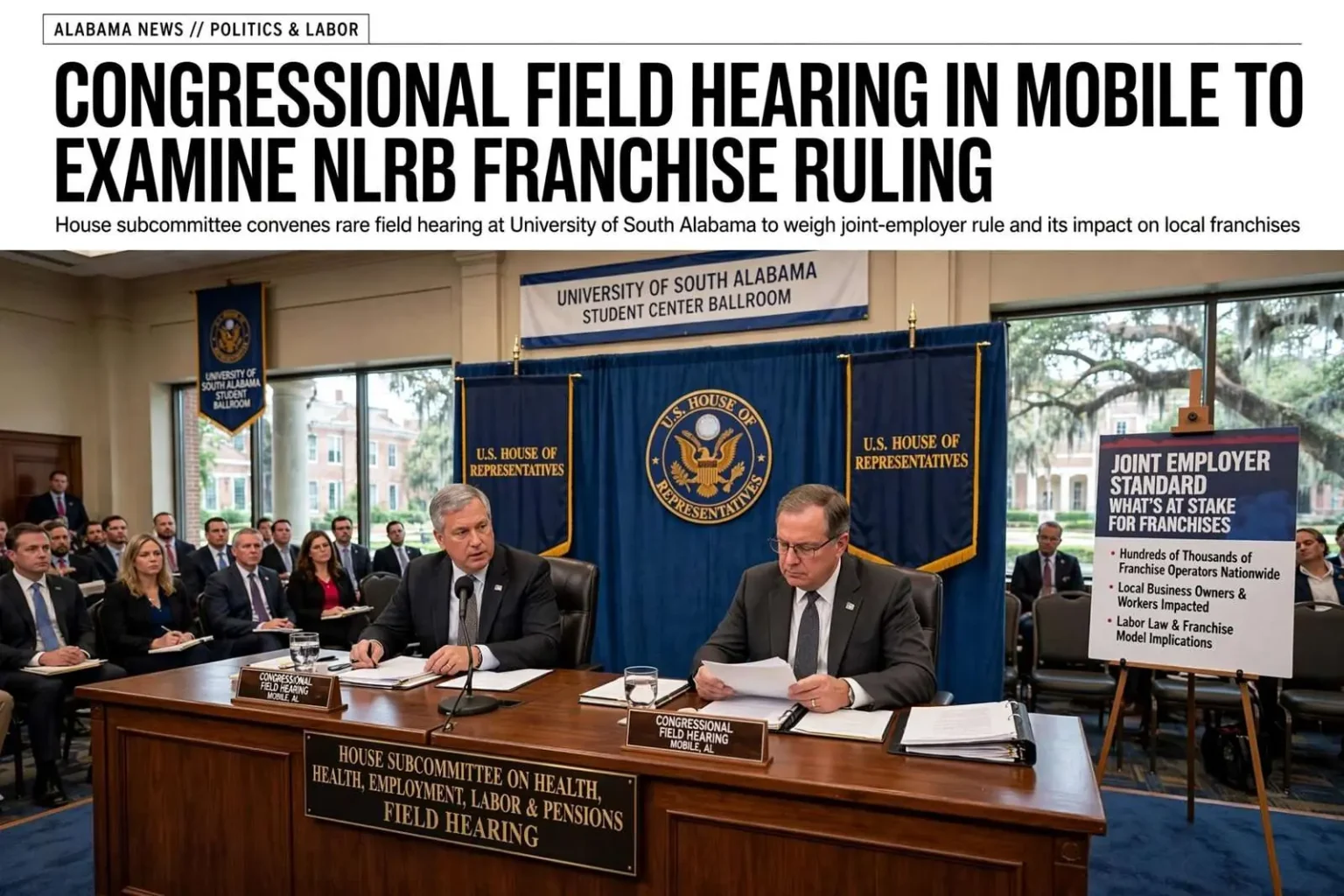
A labor dispute with potential consequences for hundreds of thousands of franchise operators nationwide was set to get a public airing in Mobile this week, as two members of Congress convened a rare field hearing on the University of South Alabama campus. The hearing brought a fight usually confined to Washington boardrooms and federal courtrooms to the Gulf Coast, where franchise businesses employ thousands of workers across the retail, restaurant and service economy.
U.S. Rep. Bradley Byrne, R-Fairhope, invited U.S. Rep. Phil Roe, R-Tennessee, chairman of the House subcommittee on Health, Employment, Labor and Pensions, to lead the session at the university’s Student Center Ballroom on Campus Drive. The pairing put the subcommittee’s chairman — a physician and longtime voice on labor policy in the House — on Byrne’s home turf, with the university’s ballroom serving as a stand-in for the hearing rooms of Capitol Hill.
Byrne described the underlying issue as consequential for businesses well beyond the coast. “This will affect every franchise and franchisee in the nation,” Byrne said in the days leading up to the hearing, framing the matter not as a niche labor dispute but as a question about the basic structure of American small business.
What the NLRB ruling changed
The hearing was called in response to a National Labor Relations Board decision that redefined when a parent corporation can be considered a “joint employer” alongside its franchisees. Under the old standard, a franchisor was generally responsible only for the terms of its franchise agreements, while the franchisee — the local owner who signs the contract, hires the workers and runs the day-to-day operation — bore the legal duties of an employer. The board’s new standard blurred that line, holding that a company can be a joint employer even where its control is indirect, exercised through contracts, suppliers, technology and brand standards rather than direct supervision.
Under the new standard, companies like fast-food chains could be held legally responsible for labor practices at independently owned locations, including wages, working conditions and collective bargaining rights, even when those locations are run day-to-day by a franchisee rather than the corporation itself. For franchisors, the ruling threatened liability for misconduct they never witness; for franchisees, it raised the prospect that corporate parents would respond by tightening control of franchise agreements — or by reconsidering the franchise model itself, converting company-owned stores or refusing to expand.
Labor organizers, for their part, celebrated the ruling as a long-sought correction. Their argument: large franchisors already exercise deep operational control — dictating menus, uniforms, pricing, scheduling software and supplier relationships — and should therefore share responsibility when workers at their branded locations are underpaid or mistreated. Treating the brand and the store as legally separate, organizers contend, lets corporations harvest the profits of control while disclaiming its duties.
The organizing campaign behind it
The ruling followed years of organizing by fast-food workers pushing for higher pay, with many calling for a $15 hourly minimum wage well above the federal floor of $7.25. The movement began with one-day walkouts at New York City restaurants in 2012 and spread into a national campaign, backed by the Service Employees International Union, that targeted the industry’s largest brands and, crucially, aimed its demands at the corporate headquarters rather than the local franchise owner.
It also came shortly after the board rejected an attempt by a major fast-food chain to delay or overturn the joint-employer designation, a decision the company has said it intends to appeal. That denial cleared the way for the case to move toward federal court, where a ruling would carry consequences far beyond one company — and it gave the House subcommittee its reason to act while the issue remained in legal limbo.
Why it matters in south Alabama
Byrne’s office said the Mobile hearing would give lawmakers a chance to hear directly from people affected by the change, including franchise owners and a labor attorney from Alabama, rather than debating the issue only in Washington. The witness list reflected the hearing’s practical orientation: local operators who can describe what joint-employer liability would mean for a single restaurant or retail store, and a lawyer who can translate the board’s legal standard into terms a business owner can act on.
A spokesman for Byrne said such field hearings are uncommon, and that securing one for Mobile was notable. Committees occasionally take hearings on the road, but a full field hearing on labor law landing at a South Alabama university campus marked the district’s most visible brush with national labor policy in years — and gave university students, many of whom work the very franchise jobs at issue, a front-row seat.
Byrne added that the ripple effects could extend beyond fast food into contracting, subcontracting and other industries that rely on franchise-style business structures across the country. Construction staffing, hotel management, healthcare staffing and delivery networks all operate on variations of the same model, and a broad joint-employer standard could reshape each of them.
While litigation over the ruling was expected to play out in federal court, Byrne suggested Congress had its own role to play, saying lawmakers could pursue legislation to clarify federal labor statutes governing joint-employer status. The hearing, open to the public, offered South Alabama residents an uncommon opportunity to watch a national economic policy debate unfold in their own backyard, with direct implications for local franchise owners across the retail, restaurant and service industries in Mobile and the surrounding region.
The franchise economy on the Gulf Coast
Few regions illustrate the stakes better than the Gulf Coast. The Mobile area’s restaurant rows, hotel corridors along I-65 and Airport Boulevard, and retail strips across Baldwin County are built substantially on franchise businesses — sandwich shops, cleaning services, hotel properties, staffing agencies and auto care centers, each operated by a local owner who invested savings and borrowed capital to buy into a national brand. Those owners are, simultaneously, small businesspeople and extensions of a corporate system, and the joint-employer question sits exactly on that fault line.
Local franchise owners who testified described the calculation the ruling forces on them. If corporate liability for labor practices increases, franchisors can be expected to demand more control in franchise agreements — dictating wages, scheduling and discipline more directly — which erodes the independence that led many owners into the model in the first place. Others warned that brands might simply reduce their footprint in right-to-work states, slow expansion, or raise franchise fees to hedge their new legal exposure, costs that land on the local operator and, eventually, the consumer.
South Alabama’s economy gives the debate a human face. Mobile’s tourism and hospitality sector, the port’s logistics network, and the Eastern Shore’s rapid retail growth all rely on the franchise structure, and the students who staff those businesses — many of them University of South Alabama undergraduates — are the workers whose wages and conditions the ruling was designed to reach.
The hearing as political theater and substance
Field hearings serve both purposes, and this one was no exception. Politically, the session let Byrne and Roe showcase the issue before a home-state audience and put the NLRB’s action on the congressional record in a district where its effects are tangible. Substantively, the testimony collected in Mobile becomes part of the legislative record that any future bill clarifying the National Labor Relations Act’s joint-employer standard would cite.
The subcommittee chairman’s presence lent the hearing weight. Roe, who chairs the Health, Employment, Labor and Pensions subcommittee with jurisdiction over labor law and workforce policy, has been a consistent critic of the board’s direction, and bringing HELP’s gavel to Mobile signaled that the issue is on the House’s active agenda rather than in the complaint pile.
The business community in Mobile took notice. Chambers of commerce and franchise associations in the region have tracked the joint-employer fight closely, since their members’ business models depend on its outcome, and several local owners used the hearing’s public comment window to describe their concerns in detail — the kind of testimony that rarely makes it into a Washington hearing room on a weekday afternoon.
What comes next for the ruling
The legal path forward runs through the federal courts, where the fast-food company’s appeal will test whether the board’s expanded standard survives judicial review. At the same time, a change in the board’s composition — its five members serve staggered terms appointed by the president — could shift the doctrine back, as board precedent has oscillated on joint employment for decades. Congress, if it acts, could end the oscillation with a statutory definition, though any such bill would face the same political fault line the hearing itself illustrated.
For south Alabama’s franchise owners, the message of the week was engagement. A national labor rule that most had followed as a legal abstraction arrived in their city with a congressman, a subcommittee chairman and a witness table, and left them with a clearer understanding of what hangs on the outcome: their contracts, their autonomy, and the structure of the businesses they have spent years building.