Sell 200,000 Bushels: The Mobile Surgeon Who Traded Soybeans From the Operating Room
Part ten of a memoir of a bygone Mobile: a Mobile eye surgeon ran enormous soybean positions from the operating table, and made his broker the top producer in the office.
The tenth installment of this serialized memoir of a bygone Mobile returns to the commodity market, and to the most extraordinary client of the author’s career: a Mobile physician who traded soybeans in six-figure quantities while operating on his patients’ eyes. It is a story about the strange bond between a broker and the one client nobody else could have managed, and about a city where the commodity market, for a handful of men, was as much a profession as medicine or law.
By the late 1950s, the author’s own production as a Mobile commodity broker had been climbing steadily, if unspectacularly, for years. He had a modest book of accounts, a modest income, and no reason to expect anything different. Then the doctor came back into the market with a bang, and the equity market ran to one of its finest years. The author’s production soared, and so did his pay. He set an all-time record for a single year in the firm’s Mobile office, a mark that measured how far one determined client could carry a broker.
The setting matters for understanding what followed. Soybean futures traded at the Chicago Board of Trade, the great grain exchange where farmers, processors and speculators met in the open pits to set the price of the nation’s crops. By the late 1950s soybean contracts were among the most actively traded futures in the country, and a Mobile broker with clients in the bean market spent his mornings on the telephone to Chicago, relaying orders and margin calls between the Gulf Coast and the Midwest.
The limit that was never a limit
When the doctor re-entered the market, he gave his broker an instruction that showed how well he understood himself. “I am going to buy soybeans,” he said. “However, when I reach a position of 500,000 bushels, I want you to say to me, ‘Doctor, you have reached your limit. You cannot buy any more.’ Will you do that for me?”
It was not long before the limit arrived. The broker dutifully reminded him of it, as he had agreed to do. The doctor was silent a moment. “Just this once,” he said, “let me take on more.” It was a game they played, and the broker was not about to stop him.
The doctor knew exactly what he was doing. He knew he had a compulsion to build a pyramid that would eventually collapse on him. He also knew he could not resist adding another course of bricks. The limit, in other words, was never really a limit. It was a ritual, a moment of theater between two men who both knew how the story would end and who both found the drama irresistible.
The arithmetic of holding on
The arrangement was enormously profitable for the brokerage. The doctor would build a position of, say, 600,000 bushels. The market would turn against him and a large margin call would loom. Rather than liquidate, he would hedge — selling a different delivery month against the position, capping the potential loss and eliminating the call. When beans rallied, he would lift the hedge and hope for enough strength to get through the session. If the strength did not come, he would hedge again at the close, in whatever size was needed to avoid the call.
The technique the doctor used is one of the oldest in the futures business. A hedger who sells a distant delivery month against a long position does not close the trade; he postpones its settlement. The spread between the two months absorbs the loss for the moment, and the margin clerk, who marks only the net of the two positions, no longer sees an account that owes money. It is a maneuver that buys time rather than safety, and time is what a man like the doctor was always buying.
On one day he traded as many as 400,000 bushels. Commissions on a trade that size ran about $1,200 — real money in Mobile in that era. The author’s production soared on the back of that kind of volume, and the firm’s Mobile office had never seen a year like it.
The scale is worth pausing over. At the prices of the period, when 200,000 bushels of soybeans were worth about $700,000, a single session’s turnover in the doctor’s account could approach $1.4 million in beans changing hands — in a Gulf Coast city where the commodity market was, for most residents, a rumor from another world. That a man could direct that much paper from an operating room, between incisions, says something about both the market and the man.
The clock that governed everything
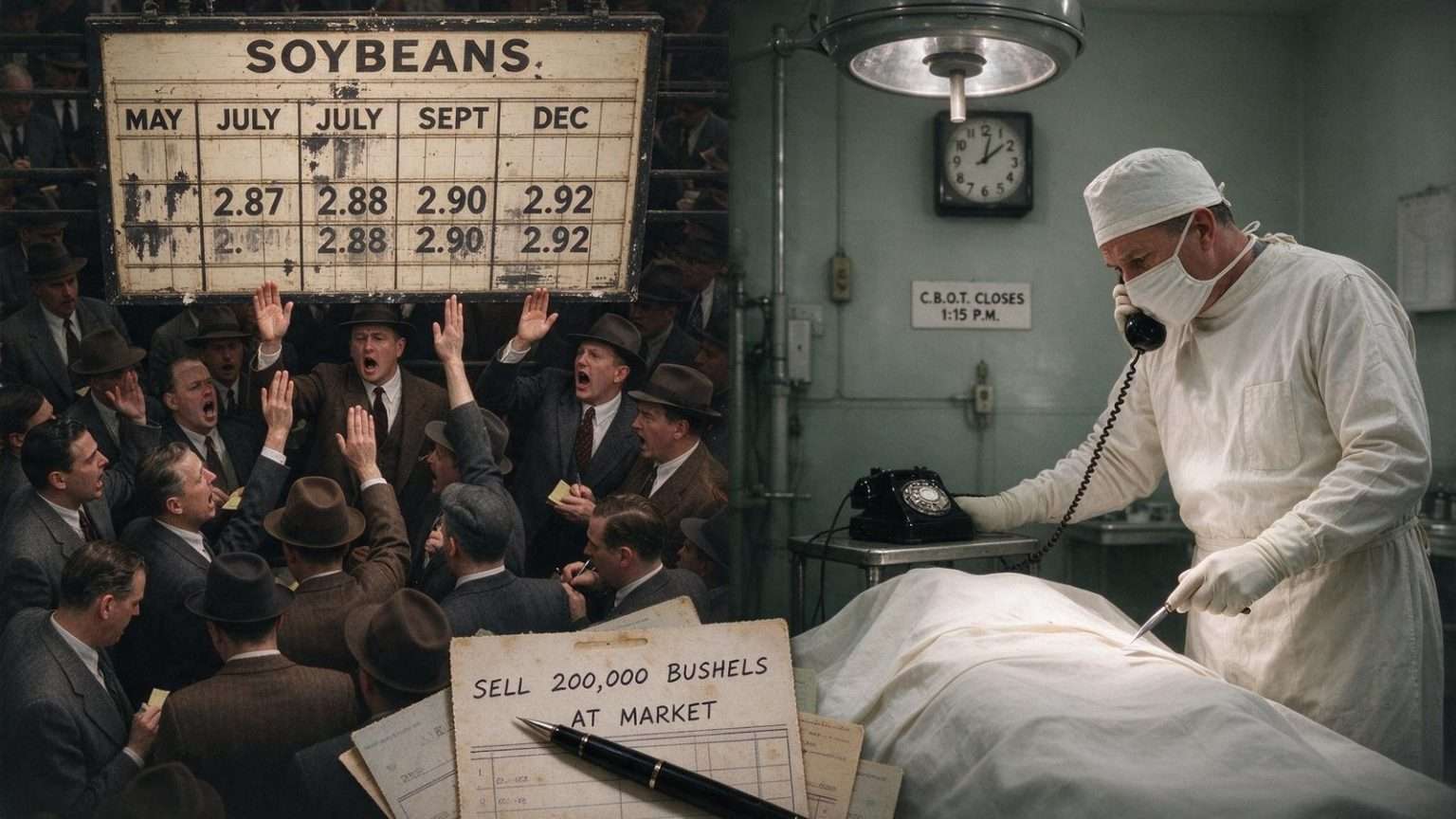
All of it depended on the broker being able to reach his client at any moment between the 9:30 a.m. opening and the 1:15 p.m. close of the Chicago Board of Trade grain markets. That included the hours when the doctor was operating on his patients’ eyes. There was no such thing as calling back later. Soybean prices moved by the minute, and a hedge that worked at 1:00 p.m. might fail by 1:10.
For the broker, the arrangement meant living by two clocks at once: the grain pit’s clock in Chicago and the surgical schedule in Mobile. Every morning brought the same question — where is the doctor today, and can I reach him if the market turns? The answer, more often than anyone would have liked, was: on a table somewhere, holding a scalpel, with a telephone within arm’s reach.
1:13 in the operating room
The memoirist invites the reader to imagine being one of those patients. It is 1:10 p.m. He reaches the doctor in the operating room. The beans have gone against him, and the close is twenty-five minutes away.
The broker has done everything he can do in advance. He has scribbled figures across a pad, worked out the number of contracts that must be hedged against a probable closing price, and filled out an order blank in advance so he can move the instant they hang up. He lays out the situation: the position, the probable close, the size of the hedge that will keep the margin clerk away.
The doctor muses about the possibility of a little strength in the closing minutes, which might mean selling fewer contracts. The seconds tick away. Then: “Excuse me a minute,” the doctor says. The broker can hear him turn to his assistant and issue instructions in technical language that, for all the broker knows, means remove the eyeball. He comes back. It is now 1:13. He sighs deeply. “Sell 200,000 bushels of beans at the market.”
Two hundred thousand bushels of soybeans were then worth about $700,000. The order went out as the pit emptied toward the close, and the doctor returned to his patient as if he had merely paused to check the weather.
The author reflects on what he witnessed. He would not care to have an eye operated on by anyone, he adds — but he would have felt safer with that doctor, even under those circumstances, than with any other surgeon he ever knew. He was, in the phrase of the day, one cool cat. The coolest the author ever met.
There is a lesson in the scene that goes beyond the size of the order. The doctor’s discipline in the operating room and his discipline in the market were the same discipline, turned to two different purposes. He prepared, he measured, he decided in an instant, and he did not flinch after he had decided. A man who could keep a steady hand at 1:13 in the afternoon could keep one at any hour.
A dime for the Coke
Ironically, the doctor died on the day soybeans hit an all-time record price. His lifetime record as a commodity trader, the memoirist is certain, showed a loss. He does not believe it bothered him in the slightest. It was never the money he loved. It was playing the game.
The author remembers one small scene that captures the man better than any account statement. He rarely came into the office. One late afternoon he did, and after they had talked awhile he asked whether there was a Coke machine. The broker started for the machine in the automobile hotel out back.
“Just a minute,” the doctor said. “I will pay for it.”
“No, doctor, I’ll get it. I want one, too.”
“No,” the doctor said, “here’s a dime for my Coke.”
He would not let his broker buy him a soft drink, and he would not buy his broker one either. He was from the old school. Theirs was a business relationship, and even the price of a Coke, in his mind, might be construed as buying a favor.
In an era when commission houses courted large accounts with lunches, tickets and favors of every kind, the doctor’s refusal was almost radical. He drew a hard line between the professional and the personal, and he held it even over ten cents. Perhaps it was the same instinct that let him trade $700,000 worth of beans with a scalpel in his hand: a clean line, held without exception, in everything he did.
The next installment in the series takes up the lesson every speculator eventually learns: nobody rings a bell and says, “This is the top of the market. Get out.”