Councilman Clinton Johnson Reports $16,550 Haul as He Seeks a Sixth Term
Veteran Mobile City Councilman Clinton L. Johnson Sr. raised $16,550 for the final reporting period of his all-but-certain bid for a record sixth term in the city's Aug. 23 municipal elections.
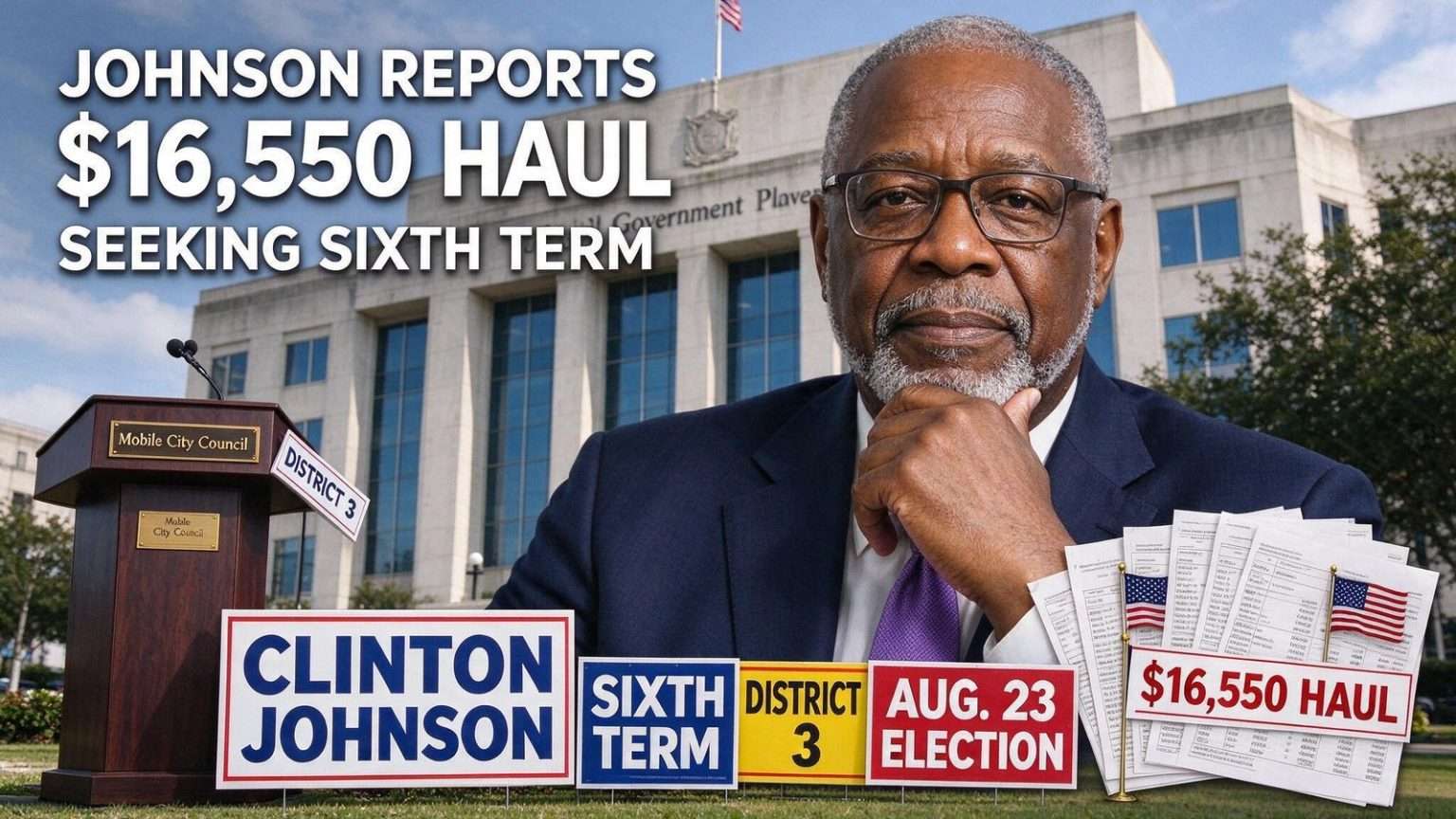
Veteran Mobile City Councilman Clinton L. Johnson Sr. raised $16,550 during the final campaign finance reporting period ahead of his all-but-certain bid for re-election to the District 3 seat on the Mobile City Council, records showed. The Baptist preacher entered the closing days before the Tuesday, Aug. 23 municipal elections as a heavy favorite to claim a record sixth term.
Johnson first won the District 3 seat in the city’s inaugural mayor-council elections in 1985, and the district he represented encompassed much of southeast Mobile. The 1985 elections were themselves a landmark — the first contests under the mayor-council form of government that replaced Mobile’s old city commission, and the first that gave each of the city’s seven districts a dedicated council member with district residents’ interests to answer for.
Two decades later, Johnson stood as one of the longest-serving members of that inaugural council generation, a tenure that made him both a fixture of District 3 neighborhoods and one of the body’s institutional memory-keepers.
A Comfortable Cushion
By most accounts, Johnson was unlikely to need the money to defeat challenger Alphonse Hardy, who posed little threat to the 20-year incumbent. Some longtime local political observers regarded Hardy’s candidacy as opposition welcomed by both Johnson and Mobile mayoral hopeful Sam Jones, on the theory that placing Johnson’s name on the ballot might drive a larger turnout among the councilman’s supporters — and Jones’s — in District 3.
The theory reflected the arithmetic of municipal elections in a district where Johnson’s name carried decades of accumulated goodwill. A contested race gives voters a reason to turn out for a contest they might otherwise skip, and every additional Johnson voter was a potential vote for the mayoral candidate aligned with him. Few municipal campaigns are so efficiently marketed as an incumbent’s nominal re-election bid.
The Johnson campaign opened the reporting period with a balance of $4,314.25 and spent only $2,601.37, leaving it with $18,262.88 in the campaign account as the election neared. The numbers describe a campaign running on fumes of formality — a healthy cushion, minimal burn rate, and no sign of the advertising blitz that characterizes a genuinely contested race.
Who Was Writing the Checks
The pre-election disclosure listed a broad roster of business and professional donors. Among the larger contributions were $1,500 from the Alabama Realtors PAC; $1,250 from G.B. Saad; and $1,000 apiece from B. White-Spunner, former Lt. Gov. Stephen Windom and David J. Cooper. The donor list reads like a cross-section of Mobile’s real estate, development and professional establishment — the interests most likely to appear before a city council that controls zoning, annexation and development approvals.
Numerous engineering firms, law offices, political action committees and local companies chipped in $500 contributions, including Volkert & Associates, The Mitchell Co., Airland Corp. and the Atchison Law Firm. Engineering and development firms in particular have long been steady donors to council incumbents, since infrastructure projects and subdivisions alike pass through the council’s agenda. Individual contributors at the four-figure level — a former lieutenant governor among them — underline how a 20-year incumbent draws support well beyond his own district’s borders.
Where the Money Went
Johnson’s modest expenditures reflected a low-key campaign. They included $675 to Cumulus Broadcasting, $550 to ABC Signs and $355.24 to the local daily newspaper for advertising — the standard trio of municipal campaign spending: radio, yard signs and print. No expenditure in the report suggested more than routine visibility maintenance, the political equivalent of keeping a light on in the window.
The report also listed $300 to First Baptist Church on Baltimore Street and a $300 outlay described as covering “the burial of a young man from B.C. Rain” — a reminder of the constituent-service role a long-tenured council member often played in his community. B.C. Rain High School sits in the heart of District 3, and a contribution toward a young resident’s burial speaks to the kind of need a district councilman in a historically Black district has traditionally fielded alongside the potholes and zoning cases.
With a sizable balance still in hand and only token opposition on the ballot, Johnson appeared well positioned to extend a council tenure that already stretched back two decades to the city’s first district-based elections.
What the Numbers Say About Incumbency
Campaign finance reports are the clearest public record of how local power works in a city like Mobile, and Johnson’s disclosures sketch the economics of incumbency in miniature. An incumbent with two decades of service raises money without trying: the PAC checks arrive because the committees know who chairs committees and who controls the flow of council business, and the business donors arrive because access to a council member who will still be in office after August is worth $500 or $1,500 in August itself.
The spending side tells the complementary story. A challenger must spend to introduce himself; an incumbent with 20 years of name recognition spends only to remain visible. Johnson’s $2,601 in expenditures — radio spots, signs, a newspaper ad, a church contribution and a constituent’s funeral — is the budget of a campaign that regarded the election as a formality to be observed rather than a contest to be won.
The turnout arithmetic that observers attributed to the Johnson-Hardy race also illustrates how intertwined Mobile’s municipal campaigns were in 2005. The mayor’s race and the council races ran on the same ballot, and district-level strategy was inseparable from citywide strategy. A heavy favorite for a sixth term, running a nominal challenger he did not discourage, was simultaneously performing a service for an allied mayoral candidate — campaign finance as choreography.
District 3 and the Council Johnson Built
The seat Johnson held was created by the governmental overhaul Mobile adopted in the mid-1980s, when voters replaced the three-member city commission with a mayor and a seven-member council elected entirely by district. The change followed a federal Voting Rights Act lawsuit that challenged the citywide elections of the commission era, which had diluted the influence of Mobile’s Black voters. The district system made it possible for a majority-Black district in southeast Mobile to elect its own representative — and Johnson, a Baptist preacher with deep roots in the community, became that representative in 1985 and never gave it up.
Over five terms, the role evolved from freshman member to senior statesman. Council districts in Mobile are compact enough that a two-decade incumbent knows the district street by street: the schools, the churches, the neighborhood associations, the drainage ditches and the rezoning fights. Constituents came to a district councilman with everything from garbage collection complaints to funeral expenses, and Johnson’s disclosure — from radio advertising to a burial contribution — reflects the full, unglamorous range of the job.
The institutional consequences of that tenure extended beyond District 3. Council longevity translates into committee positions, procedural knowledge and the relationships with department heads and the mayor’s office that move a project from request to budget line. By 2005, Johnson’s seniority made him one of the people to see in City Hall for any matter touching his district — or, given his donor list, any matter touching the interests that helped keep him there.
The Donor Coalition Behind a Council Incumbent
The composition of Johnson’s contribution list rewards a closer look. Realtors and developers — the Alabama Realtors PAC, The Mitchell Co. — invest in council members because the council writes the zoning map. Engineering firms such as Volkert & Associates, a Mobile-headquartered firm with a national practice, follow public infrastructure wherever it flows, and the council sets local priorities within city limits. Law firms contribute across municipal races as a matter of maintaining relationships with the body that regulates business licensing and adjudicates local disputes. Individual donors of the stature of former Lt. Gov. Stephen Windom, who had served as a state legislator and judge before his statewide term, represent the network a two-decade incumbent accumulates across Alabama politics generally, not merely Mobile municipal politics.
Against that roster, the two smallest expenditures in the report may be the most telling. Three hundred dollars to a neighborhood church and three hundred dollars toward a young man’s burial occupy the same disclosure as $1,500 PAC checks, and both ends of the ledger are part of the same transaction: a council district that funds its incumbent, and an incumbent who absorbs the district’s needs as they arrive, in whatever denomination they come.
As the Aug. 23 election approached, none of that seemed in doubt. The cushion was healthy, the opposition was nominal, and the only real question left in District 3 was the margin — and what a record sixth term would mean for the council Johnson had been shaping since its first session in 1985.