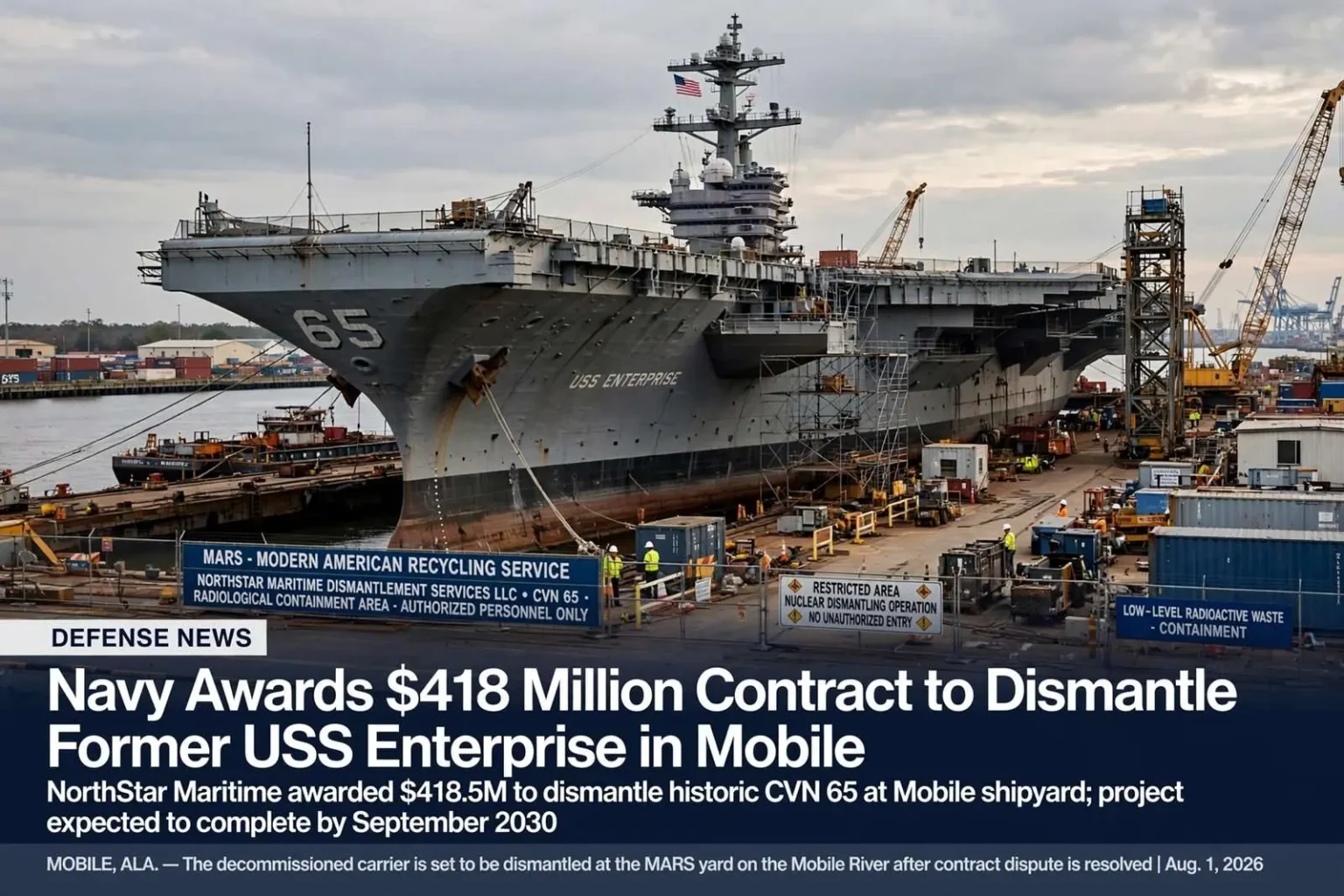
The U.S. Navy has awarded a new $418.5 million contract to dismantle, recycle and dispose of the former USS Enterprise, the nation’s first nuclear-powered aircraft carrier, with the work set to take place in Mobile. NorthStar Maritime Dismantlement Services LLC, based in Vernon, Vermont, received the firm-fixed-price contract, valued at $418,497,668, to carry out the complete dismantling of the carrier, known formally as CVN 65.
The Navy says all materials removed from the ship, including hazardous materials and low-level radioactive waste, will be properly recycled or disposed of, with waste packaged and transported to licensed disposal facilities.
The award comes in well below earlier cost projections. The Government Accountability Office had previously estimated the project could cost the Navy more than $1 billion, and the new contract is roughly $118 million less than an earlier $536.7 million award granted to NorthStar in 2025.
A Contract Forged in Litigation
That earlier award, billed as the first commercial dismantling of a U.S. nuclear-powered warship, was thrown into question after a competing firm, HII Shipcycle, challenged the Navy’s procurement process in federal court, arguing it had been unfairly excluded from the competition after technical issues prevented it from submitting a proposal on time. A judge with the U.S. Court of Federal Claims agreed, ordering the Navy to halt the existing contract and reopen the bidding among the original competitors, a decision that was later appealed.
The new contract reflects the Navy’s fresh award following that legal dispute. NorthStar won the rerun competition at a price roughly $118 million below its original bid, though the completion date moved about ten months later than the original November 2029 target. Nearly the entire contract value, about $415.5 million, was obligated up front from fiscal 2025 Navy operations and maintenance funds when the award was signed.
The saga made the Enterprise disposal one of the most closely watched procurement fights in the Navy’s ship-disposal program. A contract of this size, for a project of this complexity, draws bidders from across the shipbreaking and marine salvage industry, and the challenge turned not on who was best qualified but on whether the losing competitor had been given a fair chance to compete at all. The court’s decision to order the bidding reopened — and the appeal that followed — pushed the timeline back and left the project in limbo while the carrier, already inactivated and stripped of its fuel, sat waiting for a yard to take it.
With the dispute resolved and the fresh award in place, the Navy can move ahead with a project that has no true precedent in scale or complexity for the yard that will receive the hull.
The Ship Itself
The Enterprise was commissioned in 1961, inactivated in 2012 and formally decommissioned in 2017. She has been stored in Newport News, Virginia, since then. At 1,123 feet, she remains the longest naval vessel ever built, and her service spanned the Cuban Missile Crisis, the Vietnam War, the Persian Gulf War and the War on Terror. Its dismantlement has drawn significant attention in Mobile given the carrier’s historic status, its size and the complexity of safely handling its nuclear legacy.
As the first nuclear-powered aircraft carrier ever built, the Enterprise occupies a singular place in Navy history — a ship so long and so distinctive that sailors nicknamed her “the Big E,” and one whose eight nuclear reactors freed her from the fuel-limited range of every carrier before her. Her service record spanned the Cuban Missile Crisis era through the Vietnam War and into the conflicts of the 2000s, and by the time she was inactivated she had served longer than any nuclear carrier in the fleet. That history is precisely what complicates her disposal: the Navy has never before had to break up a nuclear carrier of this generation, and the techniques developed in Mobile will be studied for every retirement that follows.
Work under the new contract is expected to be completed by September 2030, making Mobile the site of one of the most complex aircraft carrier disposal projects in Navy history.
The reactor compartments are the heart of the job. Navy documents show the Enterprise was completely drained of nuclear fuel more than eight years ago, but the hull still holds an estimated 8,000 tons of hazardous or radiological material. A 2023 environmental impact statement concluded that the health and safety issues associated with dismantling the ship would be small, and the contract requires contaminated material to be removed in fully contained areas to eliminate any risk of release to the public or the environment. Low-level radioactive and mixed hazardous waste is expected to go to a licensed disposal facility out of state.
No nuclear-powered carrier has ever been commercially dismantled before; the Navy has historically handled such work in public shipyards. The Navy has said the commercial approach saves roughly $1 billion compared with the traditional shipyard route.
Mobile’s Role in the Navy’s Long Goodbye
The project lands in a city with a deep maritime resume. Mobile’s riverfront yards have handled Navy and commercial work for generations, and the region’s shipbuilding and repair workforce is among the reasons the Navy selected the area for a hull of this size. The Enterprise contract adds years of specialized employment to that base, from radiation-survey technicians to heavy equipment operators, alongside the spinoff work of moving, storing and recycling tens of thousands of tons of steel, copper and other materials. Navy documents have indicated the dismantlement could support as many as 94 jobs in Mobile.
The Chamber Stands Down
Update (Aug. 1, 2026): The Mobile Chamber, which had opposed the dismantlement project, has dropped its objections now that the contract dispute is resolved.
“The Mobile Chamber raised questions earlier in this process on behalf of our members,” said Mobile Chamber President and CEO Bradley Byrne. “That process has now concluded, and the contract has been awarded. Our role going forward is the same one we have played for 190 years, supporting a strong and diverse regional economy and working with industry, local officials and our state and federal partners to make sure Mobile continues to grow.”
The Chamber’s board had previously warned in 2024 that a large-scale dismantlement operation could undermine downtown development, including a new civic center, the Interstate 10 bridge and Bayway.
That objection was never abstract. Downtown Mobile’s recent decades have been built on the idea that the waterfront and the districts behind it can attract conventions, tourists and residents, and city leaders have pursued a new civic center and the massive I-10 Mobile River Bridge and Bayway project as anchors of the next round of investment. A nuclear shipbreaking operation a short distance from that footprint raised questions — about perception, about industrial traffic, about what the skyline and shoreline look like while a 1,100-foot carrier is cut apart — and the Chamber said so on behalf of members whose businesses depend on downtown’s trajectory.
Byrne’s statement marks the organization’s formal pivot from opposition to accommodation. With the contract awarded and the legal fight over, the Chamber’s position is that the project is happening and Mobile’s job now is to make the most of it — a stance that reflects both the scale of the economic activity involved and the practical reality that the Navy’s decision is final.
Where the Big E Will Be Scrapped
When the former carrier arrives, it will be taken to the Modern American Recycling Service (MARS) yard on the west bank of the Mobile River, situated south of the National Maritime Museum of the Gulf and north of the APM container terminal. NorthStar Maritime Dismantlement Services is a partnership between NorthStar Group Services and the Mobile yard’s operator, Modern American Recycling Services, which has also been described as Modern American Recycling and Radiological Services.
The location puts the dismantlement in the industrial heart of the working river — a stretch lined with terminals, yards and service companies, and buffered from the tourist-facing blocks of downtown by geography and by the port itself. The National Maritime Museum of the Gulf nearby gives the site a certain symmetry: the museum preserves the story of the Gulf’s maritime economy while, a short distance away, the Navy’s most storied carrier is fed back into it.
A tow date has not yet been set, according to PAE Maritime, the newly created Navy office now overseeing surface ship disposal.
Towing a decommissioned nuclear carrier from the Virginia coast around Florida to Mobile is itself a major marine operation — the hull has no propulsion of its own, and the tow will require escort vessels, weather windows and coordination with port authorities along the route. The absence of a scheduled date underscores that the project’s most visible phase is still ahead.
Steel With a Second Mission
Planners expect to recover roughly 35,000 tons of steel from the Enterprise, some of which the Navy intends to reuse in the new carrier bearing the same name, CVN-80.
That detail has given the project an emotional dimension rare in disposal work. The idea of Big E steel sailing again aboard a future Enterprise has been embraced by veterans’ groups and naval historians as a way for the ship’s material legacy to outlive the hull, following a tradition the Navy has applied to other storied vessels. For the sailors who served aboard CVN 65 across five decades, the recycling is not erasure but succession.
The Cost Picture
As of this week, the overall cost of scrapping the ship has climbed to $1.3 billion, though that figure includes broader program costs beyond the $418 million dismantlement contract itself.
The distinction matters. The contract signed with NorthStar covers the dismantlement work at the yard; the program total includes the years the Navy has spent defueling the reactors, storing the inactivated hull, designing the nuclear-disposal protocols and managing the program from headquarters — costs that accrued throughout the decade the ship has been out of service. The gap between the GAO’s earlier estimate of more than $1 billion and the new competitive award suggests the rebid produced genuine savings on the core work, even as the program-wide total kept rising with each year of delay.
Firm-fixed-price contracts of this kind shift the cost risk onto the contractor: NorthStar is paid the agreed $418.5 million regardless of what the work actually costs it, which gives the yard a strong incentive to work efficiently but also raises the stakes of any underestimate. For the Navy, the structure caps its exposure on the dismantlement itself.
A Preview of the Nimitz Era
The project is also being watched as a preview of things to come: the USS Nimitz is due to leave active service in 2027, the first of a class of 10 carriers the Navy will eventually need to retire and dispose of.
That arithmetic is what makes Mobile’s role significant beyond the Enterprise itself. The Nimitz class has been the backbone of the carrier fleet since the 1970s, and as the ships age out one by one over the coming decades, the Navy must dismantle ten nuclear hulls — each roughly the size of the Enterprise and each carrying its own reactor plant. How the first-of-a-kind work goes in Mobile will shape the scheduling, the cost estimates and the yard capacity the Navy relies on for an entire generation of retirements. PAE Maritime, the office now running surface ship disposal, was created precisely because that pipeline of nuclear carrier disposals requires management at a scale the Navy has never before needed.
For Mobile, the implication is a longer runway than a single ship. If the Enterprise work goes well, the city stands positioned to compete for a share of the retirements that follow — years of specialized work on the working river, in a yard district already geared for heavy marine industry.
What Comes Next
The near-term milestones are straightforward. A tow date will be announced once the Navy and its contractors settle the logistics of moving the hull to the Gulf. Arrival in Mobile will mark the first time most residents see the ship in person — a carrier of that size, even dead in the water and under tow, is a sight that will redraw the riverfront view temporarily. The dismantlement itself proceeds in phases, from surveying and reactor removal through the cutting and recycling of the hull, with completion targeted for September 2030.
Between now and then, the project will be a fixture of Mobile’s industrial waterfront: a decade of Navy history arriving by tug, a yard scaling up for the largest job it has handled, and 35,000 tons of steel waiting to serve again. The legal fights are over, the Chamber’s objections are withdrawn, and the Big E is, at last, headed for the Gulf.