Austal USA Lands $230.5M Contract to Build EPF 16, Newest Class of Navy Transport
The U.S. Navy awarded Austal USA a $230.5M contract to build EPF 16, adding surgical and medical rooms to the proven Spearhead-class transport design.
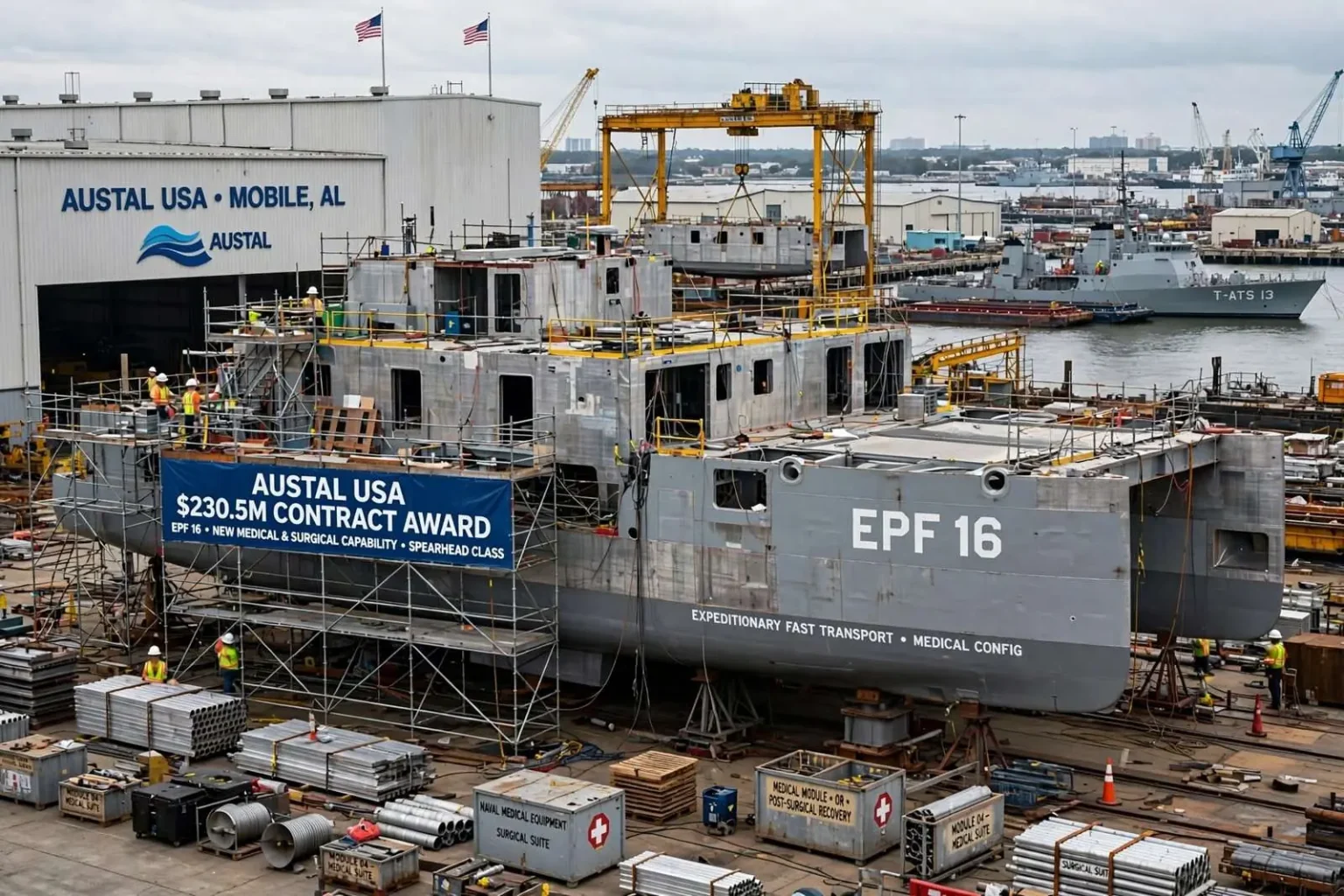
The U.S. Navy has awarded Austal USA a $230.5 million contract to build EPF 16, the 16th Expeditionary Fast Transport vessel in the Spearhead class, adding new medical and surgical capabilities to a proven ship design.
The award extends one of the most consistent production programs in the modern Navy, and it lands at a shipyard that has become one of the cornerstones of Mobile’s industrial economy. For the city’s shipbuilding workforce, the contract means work extending years into the future on a vessel class the yard has already mastered.
Battle-proven design with a new medical suite
The new EPF 16 builds on 12 Expeditionary Fast Transports that Austal USA has already delivered to the Navy, all on schedule and on budget. What sets EPF 16 apart from earlier ships in the class is the addition of configurable spaces that can be converted into operating and postsurgical recovery rooms, significantly expanding the ship’s medical mission capability.
The Expeditionary Fast Transport design is unlike most warships in the fleet. The Spearhead class consists of high-speed aluminum catamarans built to move troops, vehicles and equipment quickly across shallow coastal waters, with a flight deck capable of supporting helicopter operations and a vehicle deck that can carry everything from armored vehicles to disaster relief supplies. Their shallow draft lets them reach ports and beaches that deep-draft ships cannot, which has made the class a workhorse for theater transport, humanitarian assistance and disaster response missions.
The medical variant embodied in EPF 16 takes that flexibility a step further. By converting configured spaces into operating rooms and postsurgical recovery areas, the ship can serve as a floating surgical platform close to shore — a capability that matters for casualty evacuation scenarios, humanitarian missions and disaster response, where injured patients need surgery before they can survive a long flight or sea passage to a hospital.
Austal USA President Rusty Murdaugh credited the shipyard workforce. “Like the previously delivered EPFs, EPF 16 will benefit from the serial production of this program, resulting not only in a world-class ship but also providing assurance to the U.S. Navy that capability will be delivered on budget and on schedule,” he said. “Our reputation for delivering quality is a direct reflection of the commitment and dedication of our talented shipbuilders and suppliers.”
Serial production as a strategy
Murdaugh’s reference to serial production points to the economic logic that has made the EPF program a model for Navy shipbuilding. Building the sixteenth ship of a class is fundamentally different from building the first: designs are mature, suppliers are established, and the workforce has completed every installation dozens of times. Each successive hull comes together faster, with fewer surprises, and the per-ship cost falls accordingly — a rare dynamic in an industry where programs have more often been known for delays and overruns.
For the Navy, that reliability is the product. A program that delivers on schedule and on budget, hull after hull, allows fleet planners to make commitments years in advance with confidence, and it justifies continued investment in the class. For the shipyard, it means a steady drumbeat of work that supports hiring, training and supplier contracts across the region.
The modular approach used at the Mobile yard reinforces those efficiencies. Ships are assembled from large modules built in the facility’s covered production halls, then joined and outfitted — a method that keeps work out of the weather, allows parallel construction of multiple hulls and supports the precision that serial programs demand.
A heavy contract load at the Mobile yard
Construction on the new ships was expected to begin in 2022, with delivery targeted for 2025. At the time of the award, Austal USA held active contracts for multiple Navy programs in addition to the EPF fleet, including the Independence-variant Littoral Combat Ship, the Navajo-class Towing, Salvage and Rescue ships (T-ATS), and supporting Navy unmanned vessel programs through its advanced machinery control systems.
That portfolio makes the Mobile yard one of the busiest defense shipbuilders in the country. The Independence-variant Littoral Combat Ships are large, fast surface combatants built on the same aluminum trimaran design philosophy that underpins Austal’s commercial high-speed vessel heritage. The Navajo-class T-ATS ships, by contrast, are purpose-built ocean tugboats that tow damaged vessels, salvage equipment and support rescue operations. The work on unmanned vessel programs positions the yard at the leading edge of the Navy’s push toward autonomous systems.
Running multiple programs in parallel is a demanding feat of production management. Each class has its own supply chain, its own engineering standards and its own workforce skills, and the yard must schedule dry docks, outfitting berths and sea trials so that programs advance simultaneously without colliding. The EPF 16 award adds another hull to that pipeline rather than starting a program from scratch — the kind of work a yard in full serial production can absorb efficiently.
What EPFs do for the fleet
The Expeditionary Fast Transport class has become one of the Navy’s most versatile utility platforms. The ships move combat equipment and personnel across theater at speeds far above conventional sealift, delivering vehicles, supplies and special operations forces to shallow ports in hours rather than days. They have supported humanitarian missions and disaster relief, where their speed, shallow draft and cargo capacity made them valuable for moving relief supplies to damaged ports.
The class takes its name from the lead ship, USNS Spearhead, and its vessels are crewed by Military Sealift Command — a civilian-manned fleet element that frees Navy sailors for combatant crews. The ships’ combination of speed, flexibility and relatively modest operating cost has kept them in demand for missions ranging from Africa partnership station visits to theater security cooperation across the Pacific and the Mediterranean.
Adding a medical-capable hull extends those missions. A fast transport that can convert to surgical capability brings battlefield medicine closer to the point of injury, and the same configuration serves civilian disaster response, where regional hospitals can be knocked offline by hurricanes or earthquakes and a floating surgical unit can fill the gap.
Mobile’s shipbuilding economy
The EPF 16 contract brought the total number of EPF-class ships under contract to 16 at the Mobile shipyard, cementing Austal USA’s position as a leading producer of expeditionary transport vessels for the U.S. Navy. The yard sits on the Mobile River in the heart of the city’s industrial district, where it ranks among the largest private employers in the region and anchors a supplier network that stretches across south Alabama and the Gulf Coast.
Shipbuilding’s economic footprint reaches well beyond the shipyard’s gates. Machine shops, metal fabricators, electrical suppliers and engineering firms across the region feed components and services into the programs, and each contract award sustains that broader industrial base along with the yard’s direct workforce. The trade skills shipbuilding demands — welding, pipefitting, electrical work, marine design — are supported by training pipelines through local schools and community colleges, giving Mobile residents a path into skilled industrial careers without leaving the region.
The city’s waterfront has long been defined by defense shipbuilding, and the continuation of the EPF program into a sixteenth hull confirms that the role will extend well into the next decade. Construction beginning in 2022 and delivery targeted for 2025 means the workforce now building the Navy’s newest transport will see the program’s latest medical-capable ship through from first steel to sea trials — another hull in a series that has become a Mobile specialty.
The Navy’s expeditionary posture and what comes next
The EPF award fits into the Navy’s broader investment in expeditionary and distributed operations. Fleet planners have emphasized the ability to move, sustain and support forces across shallow coastal waters — environments where large deep-draft warships cannot operate easily — and the fast transport class is central to that concept. The ships link ports, staging areas and forward positions, and their medical variant adds a casualty-care dimension to a fleet that has historically depended on large hospital ships for surgical capability at sea.
For Austal USA, the contract reinforces a run of program wins that has diversified the yard beyond its original franchise. What began as a yard focused on high-speed commercial ferries evolved through the Littoral Combat Ship program into a multi-program defense shipbuilder, and the additions of the Navajo-class auxiliary ships and unmanned vessel work have deepened that portfolio. Serial production across several classes simultaneously is a position most American shipyards would envy, and it underwrites the hiring and capital investment that keep the Mobile operation competitive for future programs.
The shipbuilding industry’s health has become a matter of national policy debate, with Navy leaders regularly warning that the nation’s yard capacity is stretched thin. In that context, a yard that delivers hulls on schedule and on budget — as the EPF program has done across more than a dozen ships — carries weight in budget decisions about which yards and which programs receive the next contracts.
From contract to keel to commissioning
The path from a contract award to a delivered ship runs through years of coordinated work. Construction beginning in 2022 will start with material procurement and module fabrication, as the yard’s production halls turn aluminum plates, pipe spools and electrical assemblies into the large sections that will become the catamaran’s twin hulls and central cross-deck. Outfitting follows as modules take shape, with machinery, habitability and mission systems installed while the sections are still accessible on land.
Launch and final assembly bring the modules together in the water, where the remaining systems are tested and integrated. Sea trials follow — the Navy’s opportunity to verify that the ship meets the class’s speed, maneuvering and mission requirements before acceptance. Delivery in 2025, if the schedule holds, will put EPF 16 into service with the same on-time record that has defined the class.
For Mobile, the cycle repeats yet again. EPF 16 will be the sixteenth Spearhead-class ship contracted at the yard, the thirteenth following twelve delivered before it, and the first configured for surgical capability. The $230.5 million contract is, in the end, both a military procurement and a local economic event: work for the shipbuilders Murdaugh credited, orders for the suppliers who support them, and one more entry in Mobile’s long ledger as one of America’s shipbuilding cities.