Three Baldwin County Attorneys in Contention for District Judge Seat
Baldwin County's Judicial Commission has forwarded three area attorneys to Gov. Robert Bentley to consider for a vacant District Judge seat.
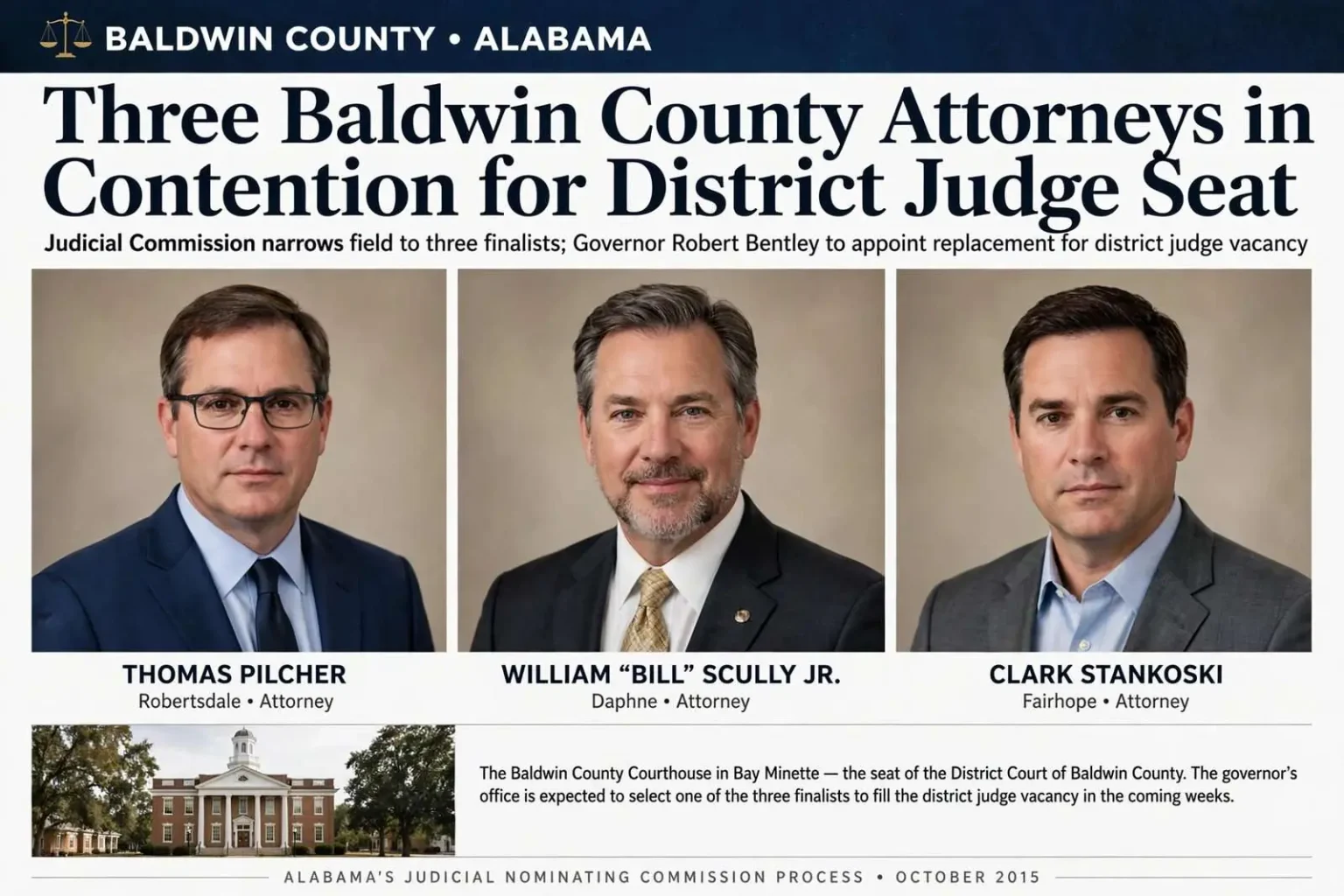
Baldwin County has a District Judge vacancy to fill, and the decision now rests with the governor’s office after a local judicial panel narrowed the field to three finalists. The Baldwin County Judicial Commission selected three area attorneys as candidates for the open seat: Thomas Pilcher of Robertsdale, William “Bill” Scully Jr. of Daphne, and Clark Stankoski of Fairhope. Alabama Gov. Robert Bentley is expected to make the final appointment from among the trio.
The judicial commission process is Alabama’s constitutional method for filling mid-term judicial vacancies. Rather than leaving appointments entirely to gubernatorial discretion, the state’s system requires a local nominating commission — typically composed of lawyers and appointed members drawn from the circuit — to interview candidates and certify three names to the governor, who must appoint one of the three to serve the remainder of the unexpired term.
For the three finalists, the nomination caps a process that began with applications and interviews before the commission, and for Baldwin County’s legal community it sets up a period of waiting while the governor’s office reviews the panel’s recommendations and conducts its own due diligence on each candidate.
How the vacancy opened
The vacancy opened up in late June after a reshuffling of judicial posts in the county. Circuit Judge Robert Wilters had retired from the bench earlier in the month, and Bentley tapped then-District Judge Scott Taylor to move up and fill Wilters’ unexpired term on the circuit court. That promotion left Taylor’s former District Judge seat open, setting the current selection process in motion.
Domino effects of this kind are common in Alabama’s courts. When a circuit or district judge retires mid-term, the appointment chain moves judges up and leaves openings at the lower rungs, each requiring its own commission process. Baldwin County — one of the fastest-growing counties in Alabama, with a court system that has expanded repeatedly to keep pace with its population — has seen several such reshuffles as judges have moved between benches over the years.
The District Court of Baldwin County operates from the county courthouse in Bay Minette, the county seat, with satellite dockets and services serving the population centers of the Eastern Shore and the south end of the county. District judges there run one of the busier trial courts on the Gulf Coast, handling tens of thousands of filings each year across their several divisions.
Three communities, three candidates
The three finalists represent different pockets of Baldwin County’s legal community. Robertsdale, Daphne and Fairhope each have active local bars, and having a nominee from each city gives the governor a range of professional backgrounds and geographic ties within the county to weigh before making an appointment.
Robertsdale anchors the county’s central farming corridor along the U.S. 90 and Highway 59 routes, Daphne is among the largest cities on the Eastern Shore along U.S. 98, and Fairhope — perched on the bluff above Mobile Bay — has grown into one of the region’s most distinctive small cities. Each community maintains its own legal practice base, and candidates’ home bases matter to court patrons who value a judge familiar with their part of the county.
Judicial nominating commissions are not permitted to weigh party affiliation, and the commission’s interviews focus on legal experience, temperament and community standing. The finalists’ names now go to the governor, whose appointments to judicial vacancies in Baldwin County have historically gone to candidates with deep roots in local practice.
Wilters’ return to the political arena
Adding a wrinkle to the local judicial landscape, Wilters, the retired circuit judge, did not step away from public life. He announced plans to challenge incumbent Baldwin County District Attorney Hallie Dixon in the Republican primary set for March 1, 2016, putting a familiar name from the bench into a contested county race.
The prospect of a longtime circuit judge running for district attorney reshapes the county’s political season. A challenger with decades on the bench brings name recognition and courtroom experience to the race, while the incumbent defends a record in office. Whoever prevails in the March primary will face the general election in November 2016 with no Democratic opposition expected in a county where Republicans dominate countywide offices.
The overlapping developments — a retirement, a promotion, a vacancy and a challenger entering the DA’s race — have made the courts a running storyline in Baldwin County politics. Local observers note that the county’s judicial seats have attracted competitive races in recent election cycles as the county’s growth has raised the profile of the bench.
What the district court does
District judges in Baldwin County handle a broad docket that includes misdemeanor criminal cases, traffic offenses, small claims, and preliminary hearings in felony matters before they are bound over to circuit court. The position plays a significant day-to-day role in how residents across Bay Minette, Robertsdale, Foley, Daphne, Fairhope and the rest of the county experience the local justice system.
Alabama’s district courts are where most residents encounter the judiciary. Misdemeanor sentencing, evictions, small claims up to the statutory limit, domestic violence protective order hearings, and the first appearance of every felony defendant all happen at the district level, and a district judge’s calendar runs crowded sessions in criminal, civil and small claims divisions throughout the week.
Preliminary hearings carry particular weight in the system. At those hearings, the district judge decides whether the prosecution has produced probable cause to hold a felony defendant for the grand jury — decisions that shape how felony cases proceed from their earliest days. District judges also handle initial bail determinations, weighing public safety against the presumption of innocence for defendants awaiting trial.
In Baldwin County, the caseload reflects the county’s growth. The county’s population has climbed past 200,000, swelled by retirees, military families connected to the region’s bases, and commuters to Mobile’s shipbuilding and aerospace industries. Court filings have grown with the population, and the county has added judgeships and staff over the years to manage the volume.
How Alabama fills judicial vacancies
Judicial vacancies in Alabama’s circuit and district courts are typically filled by appointment through the nominating commission process, with the appointee serving until the next general election, when voters decide who completes the term. That hybrid system — appointment followed by election — means whoever Bentley appoints will face the electorate sooner or later, and the seat could attract candidates in the 2016 election cycle regardless of whom the governor selects.
The Baldwin County Judicial Commission operates under state law governing local judicial nominating commissions in counties that have adopted them. Its members serve staggered terms, interview applicants under procedures designed to evaluate professional competence, and certify three names without ranking them. The governor is bound to appoint from the list, a constraint designed to balance executive discretion with local input from the bar and community.
Once appointed, the new district judge takes the oath and assumes a full docket almost immediately, since district court sessions run continuously throughout the week in Bay Minette. The transition from Taylor’s promotion has been managed so that the district court’s divisions continue operating while the appointment process concludes.
The stakes for the Eastern Shore bench
The appointment matters beyond the courthouse in Bay Minette. Baldwin County’s district judges sit in one of Alabama’s most consequential local courts — the county’s population boom has made its dockets among the state’s largest, and its position across Mobile Bay from a major port city means its courts handle everything from tourist-season traffic cases to serious felony preliminary matters.
Local attorneys say the quality of the district bench shapes the county’s business climate as much as its justice system. Small claims and eviction dockets are the daily commerce of a growing county, and predictable, efficient courts are part of what draws residents and businesses across the bay.
The three finalists — Pilcher from the central county, Scully from the Eastern Shore’s largest city, and Stankoski from Fairhope — each bring that perspective to the governor’s decision. Whichever name the governor sends to the courthouse, the appointee will inherit a bench known for its busy calendar and will serve the remainder of the term that Taylor vacated on his way up to the circuit court.
Historically, governors have made such appointments within weeks of receiving a certified list, though the timing varies with the office’s workload. Candidates typically submit to background review, and the governor may interview the finalists personally before selecting. In counties like Baldwin, where the bench is closely watched, the announcement is usually followed quickly by the new judge’s first session on the docket.
The governor’s office has not announced a timeline for the appointment. Meanwhile, the district court continues its regular sessions, and the county’s legal community waits to learn which of the three names will appear next on the courtroom door in Bay Minette.