Baldwin County Judge Resumes Issuing All Marriage Licenses
Baldwin County Probate Judge Tim Russell resumed issuing marriage licenses to all applicants after the Supreme Court's same-sex marriage ruling.
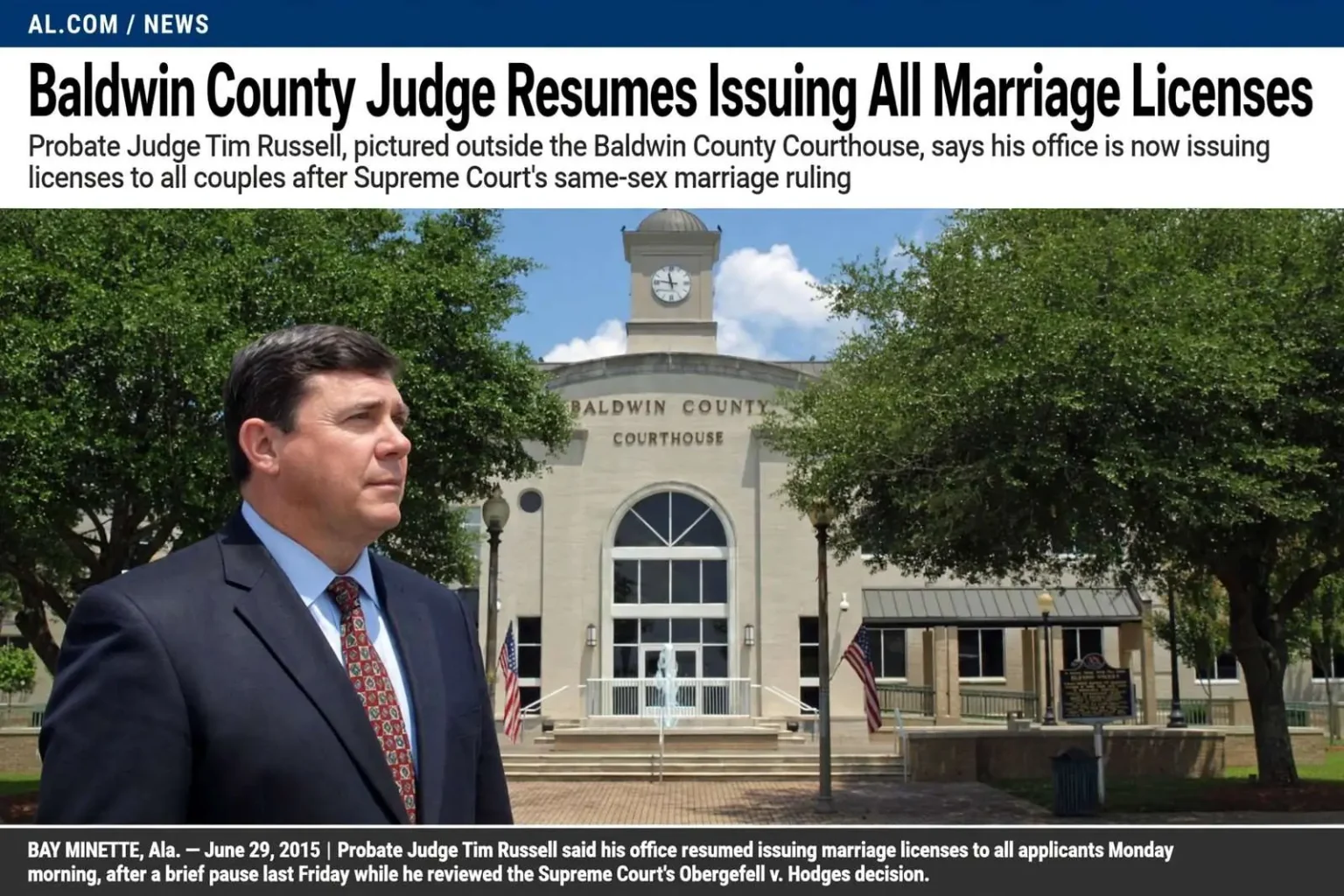
Baldwin County Probate Judge Tim Russell said his office was issuing marriage licenses to all applicants, days after the U.S. Supreme Court’s ruling legalizing same-sex marriage nationwide. Russell had briefly paused issuing any licenses the previous Friday while he reviewed the court’s decision, saying he wanted to be certain his office was interpreting the ruling correctly before resuming operations the following Monday morning. The brief suspension meant that couples planning to marry in Baldwin County — one of Alabama’s fastest-growing counties — waited through a weekend while the probate office worked out its response to a decision that had reached every county courthouse in the state at once.
“Some people asked why wait until 10 o’clock today, but I felt I owed it to the citizens to read the case and I read it over and over to make sure that we were understanding the case completely,” Russell said. “According to what we interpreted, we have to go ahead and issue them.” His reading of the opinion put the Bay Minette probate office in compliance with the Supreme Court’s mandate within one business day of the ruling, a pace that not every Alabama county matched in the days that followed.
The Supreme Court’s decision in Obergefell v. Hodges, announced Friday, June 26, 2015, held that the Fourteenth Amendment requires states to license and recognize same-sex marriages. The ruling invalidated bans in the more than a dozen states that still maintained them, and it landed on Alabama with particular force, because the state had been through its own round of litigation on the question only months earlier.
Alabama’s Months of Confusion
Russell’s decision put him in step with the Supreme Court ruling despite earlier guidance some Alabama probate judges had received from state Supreme Court Justice Roy Moore instructing them not to issue licenses to same-sex couples. That guidance, issued months earlier in February, had created confusion among probate offices statewide. Moore’s order had come after a federal district court struck down Alabama’s same-sex marriage ban and the U.S. Supreme Court declined to stay that ruling, leaving probate judges caught between a federal court mandate and an administrative order from the state’s chief justice.
The result in February and the months that followed was a patchwork. Some counties, including several in the Birmingham area, began issuing licenses to all couples immediately. Others stopped issuing licenses altogether, reasoning that if Alabama law still described marriage as between a man and a woman, they could avoid the conflict by closing their license windows entirely — a step Alabama law technically permitted because probate judges have discretion over whether to issue licenses at all. Still others issued only to opposite-sex couples or required couples to travel to neighboring counties.
Russell said he did not believe a separate order Moore issued that Monday applied broadly, saying he understood it to pertain specifically to a case in Elmore County. He said his office received no additional instruction from Moore telling him to withhold licenses following the high court’s ruling. That interpretation mattered: Moore’s June order had directed probate judges that they remained “bound” by the state constitution’s marriage language and by his February directive, and counties that read it as a continuing prohibition continued to decline licenses well after the Supreme Court had spoken.
A Normal Monday in Bay Minette
By midday Monday, Russell’s office reported a normal flow of activity, with 10 to 15 marriage licenses issued — none yet for same-sex couples, though the option was now open to all applicants under the law. Marriage licenses in Alabama carried a three-day waiting period at the time, a holdover from an earlier era of state law, so couples who applied that Monday could complete their ceremonies only after the statutory interval. The probate office’s staff processed the applications without disruption, and no protests or demonstrations were reported at the Bay Minette courthouse.
The waiting period, along with the license structure itself, would change within a few years. In 2019, Alabama legislators overhauled the process entirely, replacing marriage licenses with a standardized marriage certificate form that couples complete, notarize and record — removing probate judges from the role of issuing officials and, with it, much of the discretion that had made counties like Baldwin subjects of national attention in 2015.
Baldwin County’s response mirrored a broader adjustment taking place in probate offices across Alabama as counties worked through how to implement the ruling amid mixed signals from state officials. In the weeks after June 26, the number of counties refusing licenses gradually shrank as additional judges concluded that the Supreme Court’s mandate controlled and that continued refusal risked federal litigation. A few held out for months, and the state’s probate judges’ association sought clarity from federal courts before the last holdouts complied.
The Judge in the Middle
Probate judges in Alabama wear several hats at once — they run county elections, administer estates, oversee commitments and handle a range of filings — but in 2015 none of those duties drew more scrutiny than marriage. Russell’s public explanation for his Friday pause framed it as diligence rather than resistance: an elected official accountable to Baldwin County voters wanted to read for himself what the ruling required before changing how his office operated. The approach drew both criticism from couples who wanted immediate access and appreciation from residents who preferred a measured response.
The episode also highlighted the practical geography of Baldwin County. The probate office in Bay Minette serves a county whose population centers — Daphne, Fairhope, Gulf Shores, Foley, Spanish Fort — lie well to the south, meaning couples often drove the length of the county for licenses and ceremonies. neighboring Mobile County’s probate office handled its own implementation the same week, and couples in the two-county region tracked which courthouses were issuing as word spread.
Legal observers said the coming weeks would likely bring more clarity as additional counties across south Alabama settled into compliance with the nationwide ruling. That prediction proved correct in its outline: within weeks, most of the state’s 67 counties were issuing, the controversy shifted to the counties that continued to refuse, and by the end of the summer the question had moved from whether same-sex couples could marry in Alabama to which individual counties were still standing in the way.
How Obergefell Reached Alabama
The road to the June 2015 ruling ran directly through Alabama’s own courtrooms. In January 2015, U.S. District Judge Callie Granade ruled in Mobile that the state’s constitutional amendment and statutes defining marriage as between a man and a woman were unconstitutional, and when the U.S. Supreme Court declined to extend a stay in February, same-sex couples began marrying in Mobile, Birmingham and Huntsville almost immediately. Chief Justice Roy Moore responded with his administrative order directing probate judges to refuse, setting up the standoff that county offices spent the spring navigating.
By the time the Supreme Court ruled in Obergefell in June, Alabama couples had already lived through that winter of on-again, off-again access — marrying in some counties on some days, unable to obtain licenses in others. The nationwide ruling replaced that patchwork with a single rule, but the administrative confusion did not disappear overnight. Probate offices that had declined licenses in February wondered whether they now faced liability; offices that had issued wondered whether Moore’s orders still carried any force. Russell’s week of reading the opinion reflected questions nearly every probate judge in the state was asking privately.
The state’s own supreme court never formally resolved the matter in 2015. Litigation over Moore’s role continued for months, and in 2016 the Alabama Court of the Judiciary suspended the chief justice without pay for the remainder of his term over his marriage orders — his second removal-era discipline, decades after his Ten Commandments monument case. Moore was re-elected to the office again in 2018, underscoring how deeply the issue ran through Alabama politics.
What Changed for Couples in Baldwin County
For residents of Baldwin County, the practical effect of Russell’s decision was straightforward: the county’s probate office would serve any couple that met the standard requirements — identification, age and the fee — regardless of gender. Wedding vendors, chapels and beach ceremony operators along the Gulf coast, a destination wedding market that draws couples from across the Southeast, gained a county whose offices were open to all applicants after the ruling, matching the position in neighboring Mobile County.
The 10 to 15 licenses issued that first Monday back was an ordinary day’s volume for the office, and the absence of same-sex applications in that initial batch reflected timing more than anything else. Couples who had waited out the state’s litigation often traveled to counties that had been issuing since February, and word of Baldwin County’s compliance spread through the same community networks that had carried news of which courthouses were open during the spring.
The episode is now remembered as one chapter in a longer administrative story. Alabama’s 2019 shift to a certificate-recording system removed the issuing decision from probate judges entirely, largely to settle the discretion question that had produced so much variation between counties. Today, couples in Baldwin County record marriage certificates with the probate office under a uniform statewide process, and the courthouse drama of 2015 exists mainly in the memories of the officials who lived it.
The Week That Settled It
Russell’s decision to resume issuing licenses to all applicants put Baldwin County on the compliance side of the divide within one business day of the Supreme Court’s ruling — faster than many counties and with none of the litigation that followed elsewhere. His explanation, that he owed it to the citizens to read the case thoroughly before acting, became the county’s public account of a weekend in which one of the nation’s most consequential civil rights decisions landed on a single county office on the eastern shore of Mobile Bay. The option was open to all applicants under the law from that Monday morning forward — and in Baldwin County, it stayed that way.