Sheriff Details How a Mount Vernon Graduation Party Turned Deadly
Mobile County Sheriff Paul Burch says a personal dispute between two longtime friends escalated from gunfire to a fatal stabbing at a packed graduation party in Mount Vernon.
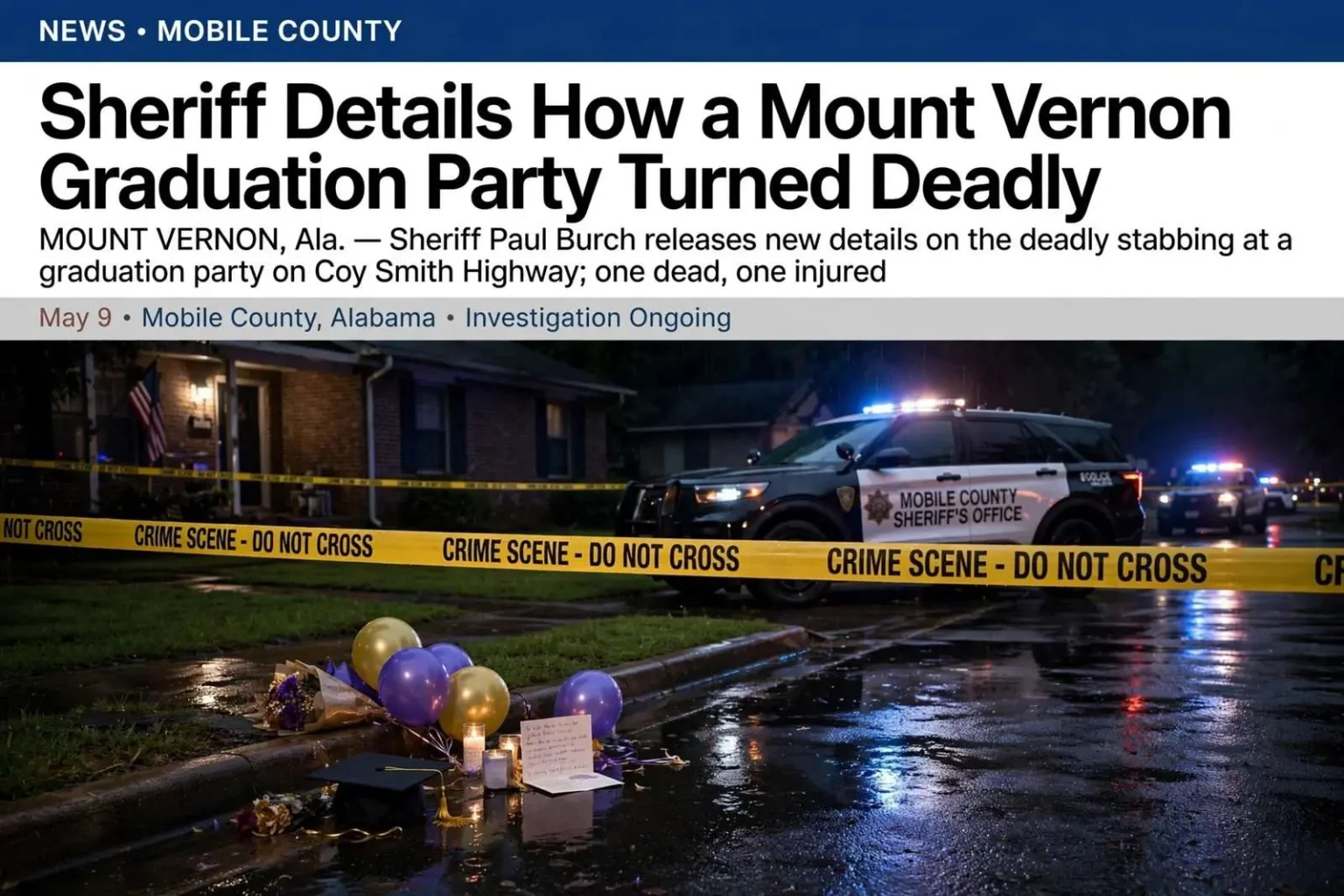
MOUNT VERNON, Ala. — Mobile County Sheriff Paul Burch has released new details about the chain of events that led to a deadly stabbing at a graduation party in Mount Vernon earlier this month, describing a gathering that spiraled from celebration to gunfire to a fatal knife attack in a matter of minutes. The account, drawn from court documents and interviews, offers the clearest picture yet of how the night unfolded.
Burch said more than 100 people showed up to the party on Coy Smith Highway on the night of May 9, though most of them had not been invited. The crowds that gather at graduation parties in small north Mobile County communities routinely exceed what hosts plan for, and word of the gathering had spread well beyond the family and friends at its core.
According to Burch, 20-year-old Caleb Reed and 20-year-old David Sullivan were longtime friends who got into what court documents describe as a “personal dispute” that escalated into a physical confrontation. The exact origin of that dispute remains unclear, and neither investigators nor prosecutors have laid out what started it.
“The defendant pulled out a gun, shot several rounds and the gun was taken from him by a mutual friend,” Burch said. “They were separated and went about their ways. A few minutes later they encounter each other again.”
Burch said Reed then produced a knife. Someone at the party attempted to intervene and was cut in the process but was unable to stop Reed, who went on to stab Sullivan four times. The intervention likely prevented further harm to others at the gathering, but the person who stepped in became one of the injured — the basis for the second charge Reed now faces.
Sullivan, who friends and family knew as “Man-Man,” died from his injuries. He was remembered by loved ones as loving, respectful and someone who could light up any room he entered.
The charges
Reed has been charged with murder and second-degree assault in connection with the incident. The murder charge covers the death of Sullivan; the second-degree assault charge stems from the injuries suffered by the partygoer who tried to intervene and was cut in the process.
Second-degree assault in Alabama covers attacks that cause serious physical injury or that are committed with a deadly weapon, and it is commonly charged alongside a more serious offense when one altercation injures more than one person. The charge means prosecutors are treating the wounded good Samaritan as a distinct victim, with the same standing in the case as Sullivan’s estate and family.
The gun Reed is accused of firing was recovered at the scene, taken from him by the mutual friend whose intervention broke up the first confrontation, according to the sheriff’s account. That sequence — a shooting stopped by a bystander, followed minutes later by a stabbing — is what investigators say makes the night so hard to reconstruct, since the crowd scattered between the two encounters and accounts of the second one vary.
Competing Accounts Court documents also lay out Reed’s version of events, which claims he was attacked by Sullivan multiple times and had retreated before the fatal encounter. Prosecutors dispute that account, and the exact origin of the dispute between the two men remains unclear. How a judge or jury weighs Reed’s claim of self-defense is likely to be the central question as the case moves toward trial, since both men were armed at different points in the night and the confrontation played out in stages.
The sequence matters under Alabama law. A claim of self-defense turns on whether a person reasonably believed force was necessary at the moment it was used, and a breakdown of the night — gunfire first, a separation, then a second encounter with a knife — gives both sides material to work with. Prosecutors will point to the separation and the choice to re-arm; the defense will point to what Reed says happened before and between those moments.
Burch said Sullivan was a close family member of the homeowner who hosted the party. While the homeowner could potentially face a charge related to hosting an unauthorized gathering, the sheriff suggested the family’s grief made further legal action unlikely.
“I’ll say this, my understanding he is a close relative of Sullivan and so there’s nothing; the house party thing is a misdemeanor,” Burch said. “There’s nothing law enforcement can do to him that’s worse than the suffering he’s going through right now.”
The sheriff’s remarks reflect a judgment call that prosecutors in such cases routinely face — whether charging a grieving family member serves any purpose the law can accomplish. Hosting an unauthorized gathering where alcohol or violence occurs can expose a host to misdemeanor liability, but the penalty available is modest compared with the loss the family has already suffered.
Reed Released on Bond
Jail records show Reed was released after posting a $425,000 bond. As a condition of his release, court records show he is required to wear an ankle monitor. His arraignment was scheduled for May 13.
The ankle monitor and the size of the bond reflect the seriousness with which the court is treating the case, along with the practical realities of pretrial release: Reed is 20 years old, charged with a killing that occurred in the middle of a large gathering, and the conditions are designed to keep him accounted for while the case is pending.
Bond in murder cases in Mobile County is set by a judge based on the severity of the offense, the defendant’s ties to the community, and any history of failure to appear, among other factors. Conditions such as electronic monitoring are frequently attached in cases involving violent allegations, and violating them can send a defendant back to jail while the case is pending.
The case remains under investigation, and additional details may emerge as it moves through the Mobile County court system. Investigators are still working to sort out accounts from the dozens of witnesses who were present when the confrontation turned fatal, and any of those accounts could shape the charges or the defense as the case develops.
A community shaken
Mount Vernon, a small town in the northern reaches of Mobile County, is the kind of community where a killing at a graduation party reverberates far beyond the families directly involved. With a population measured in the low thousands, the town’s residents are connected through its schools and churches, and the loss of a 20-year-old at a gathering meant to celebrate the end of a school year has been felt across the community.
Graduation season parties are a fixture of the spring in rural and small-town Alabama, and sheriffs’ deputies across the region are familiar with the pattern: large, loosely organized gatherings that grow by word of mouth until the crowd includes many people the host has never met. Events like the one on Coy Smith Highway strain the ability of a single household to manage a crowd, and when alcohol and old grievances are added, deputies say, the risk of something going wrong rises sharply.
The Mobile County Sheriff’s Office, which patrols the unincorporated and small-town areas of the county outside Mobile city limits, handles the investigation. Detectives spent the days after the killing interviewing witnesses, and Burch’s public accounting of the night — unusual in its detail — was aimed in part at closing off speculation in a community where versions of the story had already begun to spread.
What happens next
For the family of David Sullivan, the legal process is only beginning. Arraignment will formally bring the charges before Reed, and the months that follow will involve pretrial hearings, motions, and eventually a trial unless a plea agreement resolves the case. Prosecutors have not indicated how they intend to proceed on the competing accounts, and defense attorneys for Reed have not publicly detailed their position beyond what appears in court filings.
The man who was cut trying to intervene also faces a recovery of his own, and his injuries — suffered trying to stop the attack — have made him a central figure in the second-degree assault charge. Witnesses to that moment, like witnesses to the fatal encounter, may be called on to testify as the case moves forward.
Sheriff Burch’s office has asked anyone with additional information about the night to come forward, noting that even small details from the dozens of people at the party could help complete the record. In the meantime, the family and friends who gathered on Coy Smith Highway to celebrate a graduation are left to mourn a young man remembered for lighting up rooms — and a community is left to reckon with how quickly a celebration can turn into a funeral.