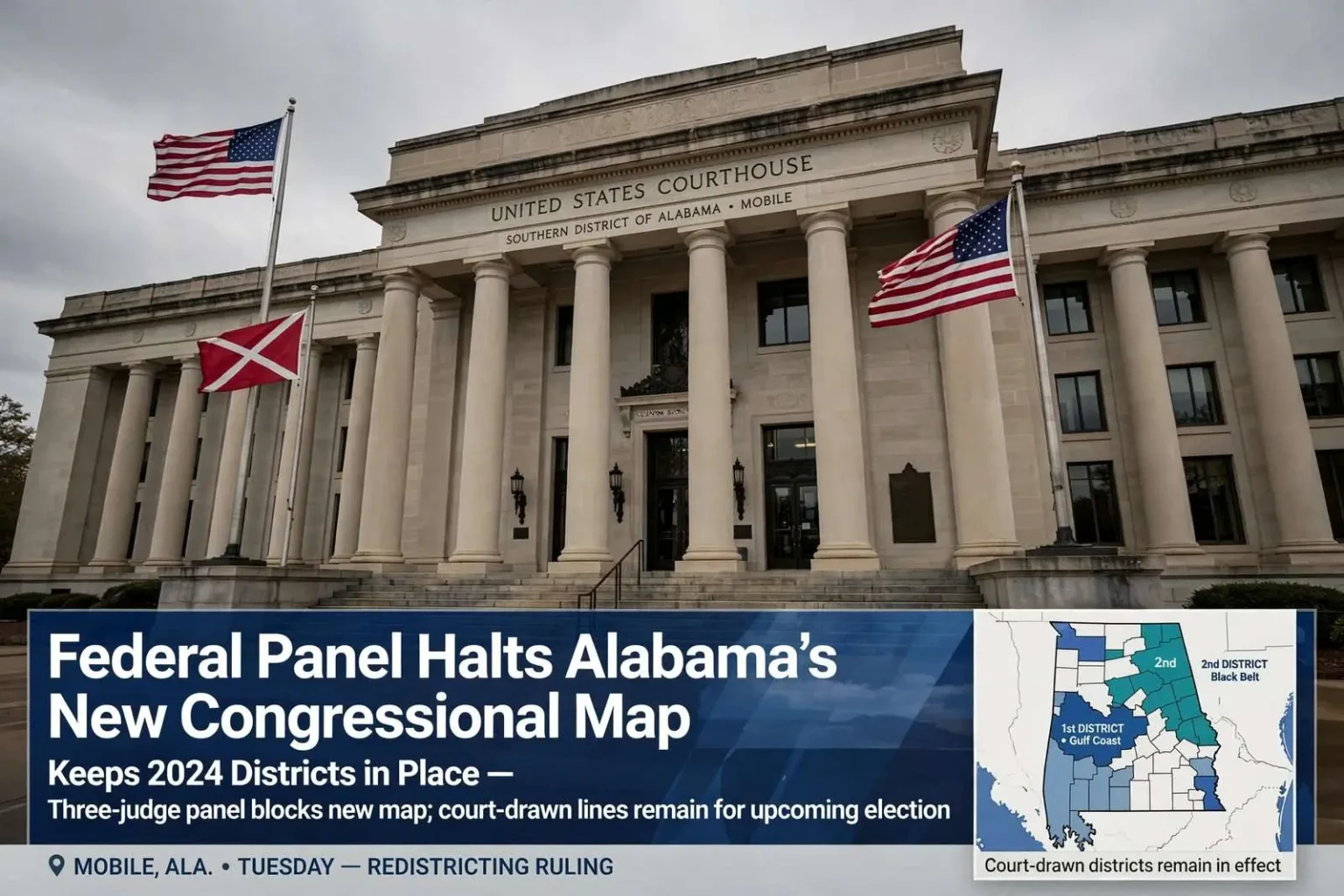
MOBILE, Ala. — A three-judge federal panel ruled Tuesday to block Alabama from switching to a newly proposed congressional map while litigation over the state’s district lines continues, ordering officials to keep using the court-drawn districts that were in place for the 2024 election.
The ruling is the latest turn in a redistricting fight that has stretched across multiple election cycles and repeatedly reached the U.S. Supreme Court. Alabama’s congressional map, with its single district — the 2nd — where Black voters have a realistic chance of electing their preferred candidate, has been the subject of litigation since the 2021 round of redistricting, when the Legislature drew maps that federal courts later found likely diluted Black voting strength in violation of the Voting Rights Act. The state’s Black voting-age population is roughly a quarter of the total, yet the 2021 map spread Black voters across districts in a way courts found unlawful, producing a series of court-ordered redraws and appeals.
Voting Rights Groups Sought the Injunction
The NAACP Legal Defense Fund and other organizations representing Black voters had asked the court to block the state’s proposed map, arguing it intentionally weakened Black voting power in Alabama. Republican leaders had hoped the new map would help the GOP reclaim a congressional seat currently held by Democratic Congressman Shomari Figures.
Figures won the 2nd District seat in the first election held under the court-ordered map, defeating his opponent in a contest that drew national attention as the culmination of the multiyear legal battle. The district as configured by the court stretches across the Black Belt of south-central Alabama and reaches down to include portions of Mobile County, uniting Black communities that the earlier maps had divided among the 1st, 2nd and 7th districts.
Figures issued a statement following the ruling. “I am pleased with the court’s decision, but this case is not over,” he said.
The judge’s order means that any election held while the litigation continues will use the boundaries under which Figures was first elected, preserving the status quo that voting rights plaintiffs fought years in court to obtain. Republican state leaders had argued the state should be free to implement its own map absent a final court judgment requiring otherwise.
State Plans Supreme Court Appeal
Alabama Attorney General Steve Marshall said the state will immediately appeal the ruling to the U.S. Supreme Court. Gov. Kay Ivey said she fully supports the appeal and believes Alabama should be permitted to move forward with its planned August special primary.
The timeline for a Supreme Court decision remains uncertain, though both sides say a ruling could come quickly given the upcoming election calendar. Election deadlines have a way of compressing judicial timelines: ballots must be printed, candidates certified and absentee voting opened well before election day, and federal courts typically fast-track redistricting cases that threaten to disrupt those milestones. The state’s appeal will ask the high court to say whether Alabama may implement its own map for the special election or must continue using the court-drawn districts until the litigation reaches a final conclusion.
The case is only the most recent chapter in a redistricting saga that has already visited the Supreme Court twice. In the first round, the justices declined to disturb the lower court’s finding that the 2021 map likely violated the Voting Rights Act, and after the Legislature passed a new map without a second majority-Black district, the court allowed a special master to draw the map used in the 2024 elections. Each round has sharpened the legal questions about how far courts may go in reshaping state-drawn maps and what the Voting Rights Act requires of states whose political geography spreads minority voters across districts.
Local Impact in Mobile County
In Mobile County, election officials spent Tuesday counting provisional ballots from the previous week’s primary before certifying final results to the Alabama Secretary of State’s office. Mobile County Probate Judge Mark Erwin said the ruling does not immediately change anything at the local level.
“At the moment this does not change what we do locally,” Erwin said. “We will certify all races on the ballot, including congressional results that were on the ballot last week. Whatever happens moving forward, we’ll be instructed, I’m sure, to let us know what we need to plan for, but for now it doesn’t affect us locally as far as the May 19th primary goes.”
Mobile County is Alabama’s largest county by voter registration outside Huntsville’s Madison County, and its probate judge serves as the county’s chief election official. The provisional ballot count that consumed Erwin’s office this week is the standard step after every primary: voters whose eligibility was questioned at the polls — registration issues, wrong precincts, missing identification — cast provisional ballots that are researched and counted or rejected before the county certifies its results to Montgomery.
What It Means for the AL-1 Race
The federal panel’s order means the 1st District, anchored by Mobile and Baldwin counties along the Gulf Coast, also remains unchanged for now. The 1st has been reliably conservative in recent decades, but the possibility that the state’s proposed map could rearrange the district lines was the backdrop for both parties’ planning in the special election cycle. Candidates who declared for the race did so under one set of boundaries, and any switch to a new map could change who lives in the district and, potentially, who can run in it.
For voters in Mobile County, the practical effect of Tuesday’s ruling is stability: the districts they voted in last week remain the districts they will vote in during the special primary, unless the Supreme Court intervenes. Election officials will proceed with certification, candidate qualifying and ballot preparation under the existing lines, and any change ordered from Washington would come with instructions about how to adjust the county’s election calendar.
The broader stakes reach beyond a single special election. The outcome of the appeal will help determine whether the court-drawn map that elected Alabama’s newest Black Democratic congressman becomes a permanent fixture of the state’s political landscape or a temporary arrangement during ongoing litigation. Civil rights groups argue the court-ordered districts finally gave Black voters in the Black Belt and Mobile the representation the Voting Rights Act was written to secure; state Republican leaders argue the courts have overstepped into map-drawing that belongs to the Legislature.
A Long Fight Not Yet Finished
Both sides describe the litigation as far from over, and the Supreme Court appeal ensures the fight over Alabama’s congressional lines will continue well after the next election. The court’s docket, the pace of briefing and the proximity of the August primary will all shape how quickly the justices act — and whether the map used in that primary is the last word.
For the officials running elections in the meantime, the instruction Erwin described will govern: certify the results, follow the map in place, and prepare for whatever the courts decide next. Voters in Mobile and across the 1st and 2nd districts will watch the Supreme Court’s docket as closely as any campaign, because in Alabama’s redistricting wars, the map itself is the prize.
Until the justices rule, the court-drawn districts stand, Shomari Figures remains the congressman from the 2nd, and the Gulf Coast’s 1st District keeps the boundaries its voters already know — the rare period of stability in a case that has produced anything but.
How Alabama Reached This Point
The background of the dispute explains why the panel acted. After the 2020 census, the Legislature redrew Alabama’s seven congressional districts and maintained the long-standing configuration in which only the 7th District, stretching from Birmingham through the Black Belt to Tuscaloosa, gave Black voters the ability to elect their candidate of choice. Black voters make up about a quarter of Alabama’s population, and plaintiffs argued the state’s geography — with Black communities concentrated in a crescent from Mobile up through Montgomery and the Black Belt to Huntsville — made a second such district achievable.
Federal courts agreed at every stage. A three-judge panel first found the 2021 map likely unlawful and gave the Legislature a chance to fix it; when lawmakers instead passed a map with a slimmed reconfigured 2nd District that still did not create a second majority-Black district, the courts rejected that fix as well. The special master’s map, used in the 2024 election, drew a new 2nd District running from Mobile County northeast through the Black Belt, and Shomari Figures — a Mobile native and former congressional staffer whose mother had long served in Mobile County government — won the new seat.
The state’s newly proposed map at issue in this week’s ruling would have replaced that court-drawn configuration, and the NAACP Legal Defense Fund and its co-plaintiffs argued the redesign was retaliation for the 2024 result and an intentional weakening of the district that Black voters had just used to elect Figures. The panel’s decision to keep the court-drawn lines in place preserves the districts that produced that outcome while the courts sort out the legality of the state’s proposal.
What Happens Next
The Supreme Court appeal now becomes the center of gravity for everyone involved. The attorney general’s office will file its appeal in the coming days, the plaintiffs will respond, and the justices will decide whether to take the case on an expedited basis in light of the election calendar. Whatever the court decides, counties across south Alabama — Mobile, Montgomery, and the Black Belt counties between them — will be watching for instructions that could reshape their congressional elections.
In the meantime, the ordinary machinery of elections continues. Mobile County’s certification of last week’s primary results goes forward, candidates in the special races continue campaigning under the existing lines, and the probate office’s ballot preparation proceeds on schedule. The federal panel’s order, for now, buys the Gulf Coast a measure of certainty it has rarely enjoyed during years of redistricting litigation.