University of South Alabama Mobile
South Alabama Honors Joel Erdmann’s 17-Year Legacy as Athletic Director Retires
The University of South Alabama gathered at Hancock Whitney Stadium to celebrate the career of retiring Athletic Director Dr. Joel Erdmann, who spent 17 years transforming Jaguar Athletics.
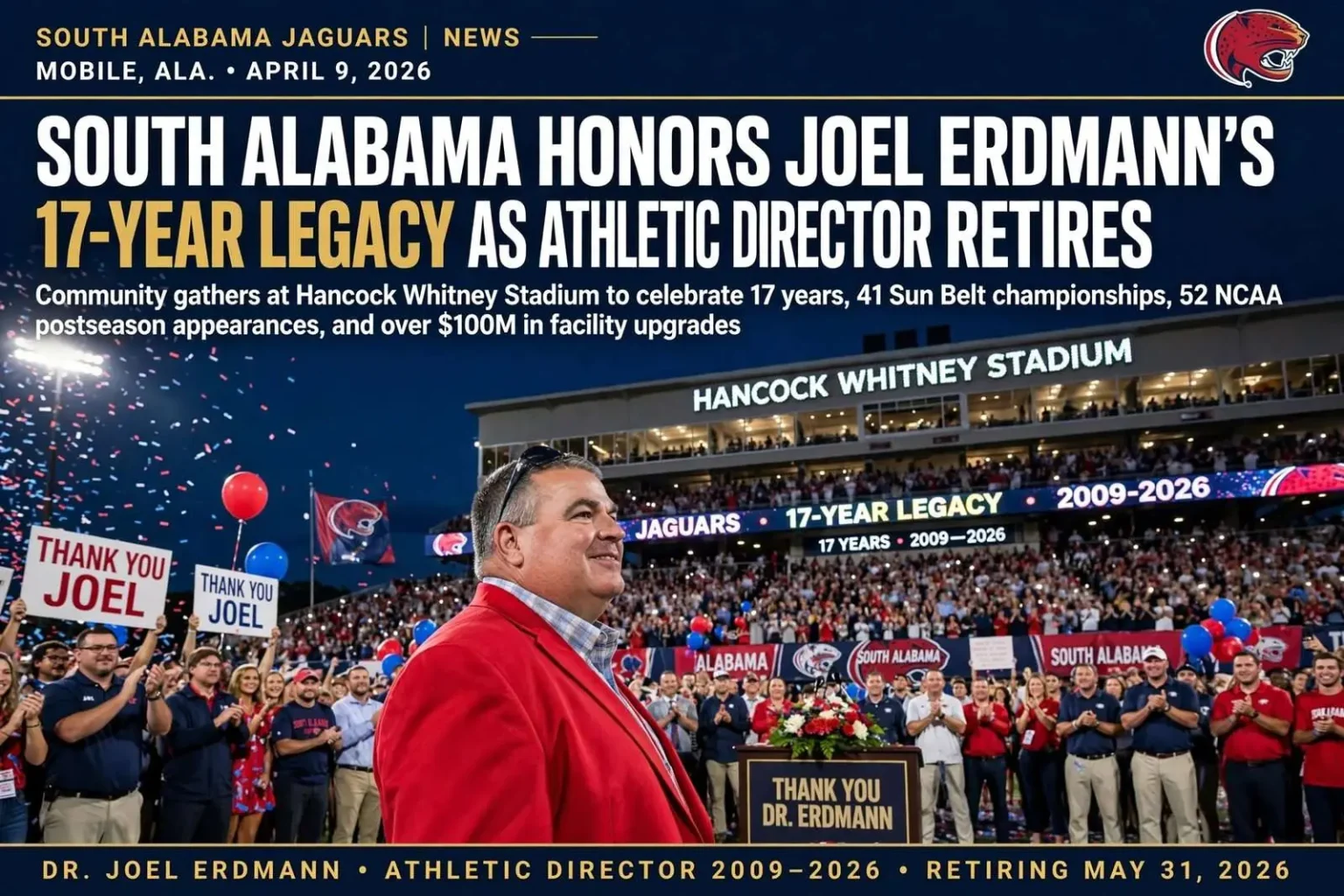
MOBILE, Ala. — The University of South Alabama community filled Hancock Whitney Stadium on Wednesday night to celebrate the career and legacy of retiring Athletic Director Dr. Joel Erdmann. Friends, coaches, former student-athletes and longtime supporters gathered to honor Erdmann, who announced his retirement in early April after 17 years leading the university’s athletic department.
The turnout said as much as any speech could. Stadium ceremonies are usually reserved for players and coaches, but Erdmann’s send-off drew the full range of people who had worked with him across nearly two decades — the evidence of a tenure that touched every program on campus, not just the ones that made headlines. Wednesdays in a college athletic department are ordinary workdays; filling the stadium on one takes a career’s worth of relationships.
A transformational era for Jaguar athletics
Erdmann oversaw one of the most significant periods of growth in South Alabama athletics history. During his tenure, the Jaguars won 41 Sun Belt Conference championships and made 52 NCAA postseason appearances across the university’s sports programs.
Those numbers place South Alabama’s run among the most consistently successful stretches for any program in the Sun Belt, the conference the university joined as it moved its athletics program into the top tier of college sports. Conference championships across 41 occasions — spread across sports rather than concentrated in one or two — reflect a department that invested broadly, and the 52 NCAA postseason trips show that success carrying onto the national stage year after year, not just within the league.
Beyond the win column, Erdmann played a central role in more than $100 million worth of athletic facility upgrades and new construction, including the building of Hancock Whitney Stadium and the Jaguar Training Center — two projects that reshaped the university’s athletic footprint.
The facilities were the visible half of the transformation. Hancock Whitney Stadium, built on the Mobile campus, ended the football program’s years of playing home games off campus and gave the university a true home-field venue of its own. The Jaguar Training Center put strength, sports medicine and athlete development infrastructure at the heart of the complex — the kind of behind-the-scenes facility that recruiting pitches are built on and that student-athletes use every day, in every sport, regardless of the season.
A career built from the ground up
Erdmann became South Alabama’s athletic director in 2009, just one month before the Jaguar football program kicked off its inaugural season. The timing placed him at the controls of a program in motion: the university had committed to building a football team from nothing, and its new athletic director had to hire staff, schedule games, manage logistics and build a culture simultaneously — while running every other sport on campus at the same time.
Launching a football program from scratch is among the tallest orders in college athletics. There is no roster, no tradition and no home venue at the start — only recruits willing to join something new and a fan base asked to believe in it. South Alabama’s program moved from those beginnings into full NCAA competition and conference membership within a handful of years, a pace that required steady leadership at the top, and Erdmann’s stewardship through those seasons became a defining part of his resume.
The job Erdmann stepped into in 2009 looked nothing like the department he left. At the start there was no on-campus football stadium, no training center, and a sport-by-sport operation with far fewer resources than its conference rivals. Seventeen years later, the department operates a modern stadium on campus, trains its athletes in a dedicated facility, and holds a trophy case built through championship runs across nearly every sport it sponsors. The distance between those two pictures is, in practical terms, the definition of the tenure the university celebrated Wednesday night.
Over the years that followed, he helped elevate the university’s athletic profile both on and off the field, while also placing a consistent emphasis on academic achievement among student-athletes across all Jaguar sports programs. Academic performance rarely generates the headlines that championships do, but it is the metric university presidents and faculty watch most closely, and sustained academic success across an entire athletic department is often cited internally as a director’s most durable legacy — the part of the job that outlasts any single coaching hire or building project.
Erdmann’s official retirement takes effect May 31, closing out nearly two decades at the helm of the department. The date gives the university a transition window that spans the end of the spring sports calendar, when postseason runs wrap up and the academic year closes, and positions the next administration to take over ahead of the summer recruiting and preparation cycle.
Seventeen years is a long tenure by the standards of modern college athletics, where conference realignment, coaching turnover and the pressures of the transfer era have shortened stays at the top of athletic departments across the country. To hold the post from the launch of a football program in 2009 through the building of an on-campus stadium — and to leave on his own schedule, announced months in advance — marks a career of unusual stability for both the university and the staff who worked under him.
New leadership takes over
University of South Alabama President Jo Bonner has appointed Deputy Athletic Director Dr. Daniel McCarthy to serve as the university’s interim athletic director as the search for a permanent successor moves forward.
Promoting from within during a search is a common and often stabilizing choice. McCarthy’s time as deputy athletic director means continuity in the department’s day-to-day operations — budget management, conference obligations, compliance and ongoing facility projects continue without an outsider’s learning curve — while the university takes whatever time the search requires to find the right permanent hire rather than rushing the decision. Interim leaders in this position typically also become the department’s institutional memory during the handoff, briefing candidates and easing the eventual transition.
The search itself will draw interest from across the college athletics landscape. A department with a decade-and-a-half run of conference titles, NCAA appearances and $100 million in new facilities is an attractive portfolio for any candidate, and South Alabama’s position in Mobile — a growing Gulf Coast city with a devoted local fan base — adds to the appeal. The university has not announced a timeline for naming a permanent athletic director.
Bonner’s appointment of an interim leader also keeps the department moving on initiatives already in progress. Athletic departments run on year-round schedules — recruiting calendars, budget cycles, conference meetings and facility work do not pause for a leadership search — and an experienced deputy in the chair ensures that contracts, staffing and planning continue while candidates are evaluated. The arrangement also gives coaches and staff a familiar point of contact during a period that could otherwise be disruptive.
Wednesday’s celebration offered current and former athletes, coaches and university leaders a chance to reflect on Erdmann’s impact and to send him into retirement with the same stadium crowd energy that has come to define Jaguar Athletics under his leadership.
Send-offs like this one also serve the people staying behind. For coaches, hearing two decades of achievements read out in one place is a reminder of the standard they inherit; for former student-athletes, it is a chance to see the administrator who signed them, funded their programs and championed their academic work honored in the stadium they played in. Athletic departments are typically measured in wins, but the crowd in the stands Wednesday came for the person who spent 17 years making the whole operation possible.
Retirements of long-tenured athletic directors tend to prompt the broader question of what an era actually leaves behind. In Erdmann’s case the answer is measurable: 41 conference championships, 52 NCAA postseason appearances, more than $100 million in facilities, and a football program that exists at all because of the work done in 2009. It is also cultural — a department that grew from a collection of programs fighting for recognition into a fixture of the Sun Belt and of life in Mobile.
The stadium crowd on Wednesday included people who were students when the football program played its first game and are now raising families in the stands of the stadium Erdmann helped build. That kind of arc — from launch to institution — is what 17 years in one chair looks like, and it is why the university chose a full stadium gathering rather than a quiet office reception to mark the end of it.
What comes next will be written by McCarthy and, eventually, by whoever takes the permanent chair. The standard, though, has been set: a department that competes for conference titles across its sports, graduates its student-athletes, and plays its home games in facilities it can call its own. Erdmann’s retirement closes a 17-year chapter, but the foundation it leaves behind — competitive, academic and physical alike — is the part of the legacy that the next era of Jaguar athletics will build on, starting with the May 31 handoff.