Alabama Special Primaries Draw Low Turnout as Incumbents, Establishment Picks Prevail
Alabama's special congressional primaries drew turnout of just 5.24% Tuesday, with incumbents and establishment-backed candidates prevailing in the 1st, 2nd, 6th and 7th districts.
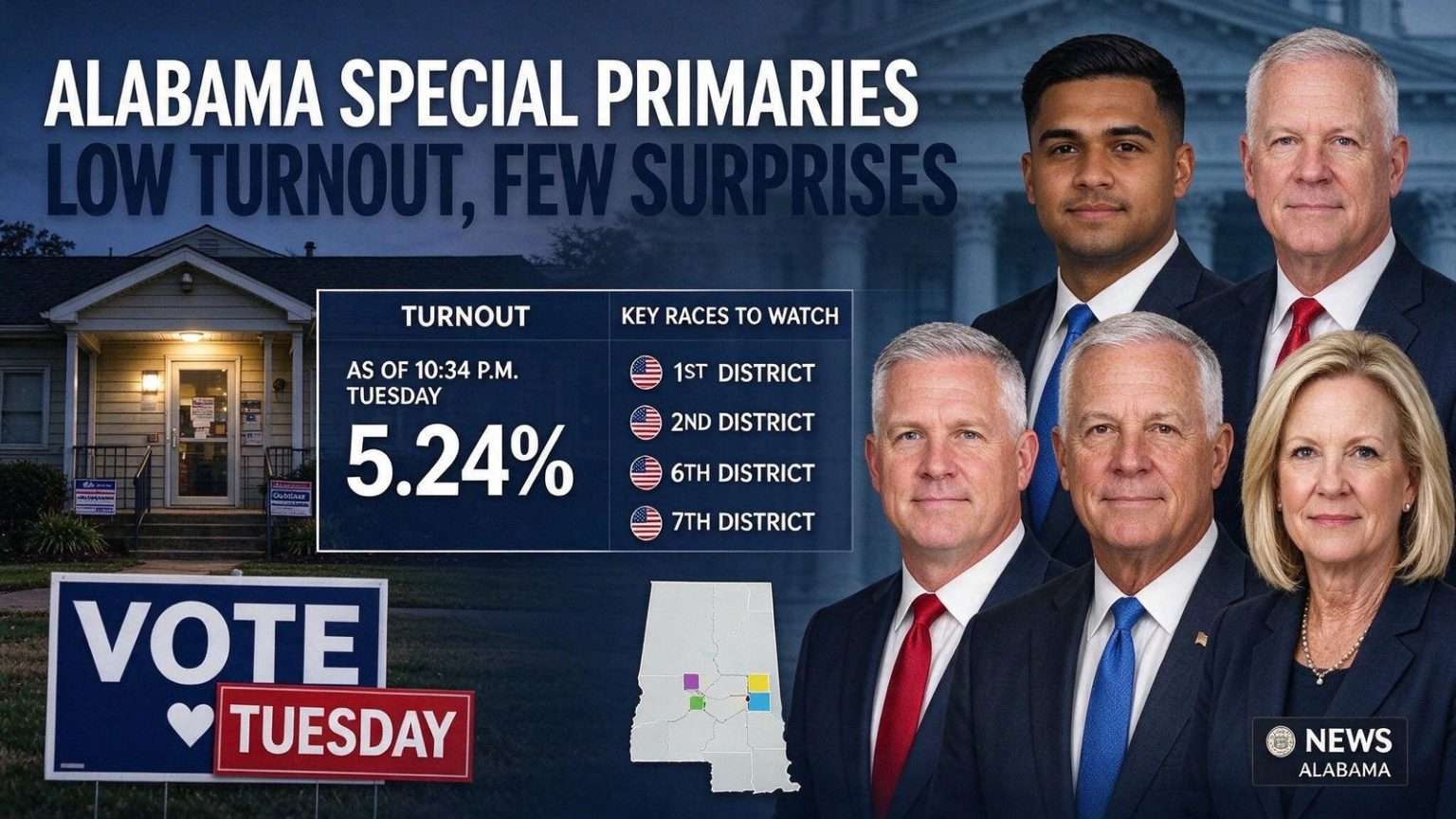
Tuesday’s special Alabama congressional primaries shared two defining traits: sparse turnout and few surprises. Voters in four of the state’s seven congressional districts — the 1st, 2nd, 6th and 7th — went to the polls under a restored congressional map, and largely sided with incumbents, familiar names or establishment-backed candidates.
The night unfolded as a formality in most districts and as a preview in one. While the 1st, 6th and 7th districts remain solidly aligned with one party or the other, the 2nd District rematch between a Republican state legislator and the sitting Democratic congressman is expected to draw national attention and spending heading into the Nov. 3 general election, one of a handful of races nationwide that could decide which party controls the U.S. House.
A record-low night at the polls
Turnout continued a downward trend seen throughout the year. As of 10:34 p.m. Tuesday, the Alabama Secretary of State’s office reported turnout of just 5.24%. That compares with roughly 23% turnout in the May 19 primaries and fewer than 11% in the June 16 runoff.
The steady erosion is familiar to observers of Alabama elections. Special elections, particularly ones held in late summer and settled largely by absentee and early ballots, rarely approach the participation levels of a regular primary, and this one carried none of the marquee statewide contests that typically pull voters to the polls. Political scientists have long noted that off-cycle elections in Alabama skew heavily toward the most reliable partisans, which tends to reward candidates with established party backing — exactly the pattern that played out Tuesday.
Why new primaries were needed
The special primaries were triggered by the U.S. Supreme Court’s ruling in Louisiana v. Callais, which significantly raised the bar for challenges to congressional district maps under Section 2 of the Voting Rights Act. That decision eventually paved the way for the court to overturn Allen v. Milligan, the 2023 case that had forced Alabama to redraw its congressional maps, and allowed the Legislature to reinstate a prior map. Because of that action, the results of the May 19 primaries in the affected districts were invalidated.
The legal back-and-forth stretched over more than two years. Allen v. Milligan, decided in 2023, had required the state to draw an additional district in which Black voters had the opportunity to elect their preferred candidate, leading to the map used in the 2024 elections. The later rulings unwound that requirement, and the Legislature responded by reinstating the earlier district boundaries — setting up the unusual circumstance of candidates running twice in one year for the same nomination under different maps.
The legislation setting up Tuesday’s primaries did not include a runoff provision, meaning candidates needed only a plurality of votes to win their party’s nomination rather than a majority. That change removed the possibility of a second round of voting, which would have pushed the calendar dangerously close to the general election, and it lowered the bar for any candidate who could consolidate a strong base of support in a crowded field.
In their post-election remarks, Republican winners largely emphasized national issues, with several accusing Democrats of embracing socialism. Democratic candidates, who had fewer contested primaries Tuesday, focused more on affordability concerns. The split previewed the two competing frameworks likely to define the fall campaign: nationalized cultural and economic arguments from the Republican side, and pocketbook appeals from Democrats hoping to connect congressional races to the cost of living in their districts.
1st Congressional District
Former U.S. Rep. Jerry Carl of Mobile won the Republican nomination over two other candidates, capturing about 75% of the vote in unofficial returns. The district covers Mobile, Baldwin and Escambia counties along with most of Covington County. Carl will face Democratic nominee Clyde Jones Jr. in the Nov. 3 general election.
Carl campaigned on his prior experience in Congress and said he hopes to rejoin the House Committee on Appropriations and the House Committee on Natural Resources. He represented the district from 2021 to 2025 before narrowly losing a 2024 Republican primary to U.S. Rep. Barry Moore, R-Enterprise, after redistricting shifted more of the Wiregrass into the district. Moore, now running for U.S. Senate, left the seat open.
The return bid got easier with the map restored to something closer to the configuration Carl originally won. The 1st District stretches across the state’s Gulf Coast corridor, from the port city of Mobile through the fast-growing suburbs of Baldwin County, and has favored Republicans in federal races. Carl’s committee ambitions matter to the district’s economic pillars: Appropriations influence touches the shipbuilding and defense work concentrated around Mobile, while Natural Resources jurisdiction reaches the coastal and fisheries issues that shape both counties’ economies.
For Carl, Tuesday’s result completed a round trip through Alabama’s turbulent redistricting cycle — unseated in a primary redrawn around him, then renominated two years later in a district remade largely in his favor. The general election contest with Jones Jr. gives the district a choice of nominees, though the seat’s partisan lean makes the Republican a heavy favorite on paper heading into November.
2nd Congressional District
State Rep. Rhett Marques, R-Enterprise, won the Republican nomination in the redrawn 2nd Congressional District, setting up a high-profile matchup against U.S. Rep. Shomari Figures, D-Mobile, in a race that could help determine control of the U.S. House.
Marques campaigned on his endorsement from President Donald Trump and his conservative voting record in the Alabama Legislature. Speaking to roughly 100 supporters in Enterprise on Tuesday night, Marques said of national Democrats: “Basically they are communists who are trying to control their party and they’re letting them, and that’s scary. Do you really want Alabama to look like New York and California?”
Figures, in a statement, said he had worked for the people of Alabama “because that is who we should be working for,” and argued that his opponent “would be just another rubber stamp on the same policies that are making life more expensive for the people right here in Alabama.”
The 2nd District is the exception to Alabama’s otherwise predictable congressional map. Redrawn in recent years to give it a more competitive partisan balance, it pairs communities in the Wiregrass and the Montgomery area with parts of southwest Alabama, and both parties treat it as winnable. That makes the Marques-Figures contest the one Alabama House race this fall with genuine national implications, and both campaigns can expect outside money and attention to follow.
The matchup also reprises a dynamic from the previous cycle, when the district’s new boundaries first put its communities into play. Figures won the seat under the redrawn map; Marques now runs under the restored one. Which map better reflects the district’s voters is precisely the question November will answer, and both candidates spent their primary nights framing the other as out of step with the district — Marques on ideology, Figures on economics.
6th Congressional District
U.S. Rep. Gary Palmer, R-Hoover, easily won renomination for a seventh term. He will face former Pelham City Council member Maurice Mercer, the Democratic nominee, in a district considered strongly Republican.
Palmer, first elected in 2014, campaigned on repealing the Affordable Care Act along with abortion restrictions and expanded gun access. Mercer, echoing other Democratic candidates this cycle, centered his campaign on affordability, including a call to raise the minimum wage.
The 6th District wraps around the Birmingham metro area’s southern suburbs — Hoover, Vestavia Hills, Pelham, Alabaster — and has been among the most Republican-leaning districts in the state since it was drawn. Palmer has built his congressional career on policy work rather than high-profile committee chairmanships, and a seventh term would extend a tenure that began when he won the seat in the 2014 cycle.
Mercer’s affordability message gives the general election a clear contrast even if the district’s partisanship limits its competitiveness. Democrats in Alabama have leaned into cost-of-living themes this cycle in districts where a victory is unlikely but a message campaign can build infrastructure for future cycles, and the former council member’s local-government background in Pelham anchors that pitch in the district’s own suburbs.
7th Congressional District
Former educator Ammie Akin won the Republican nomination. In a statement, Akin said she would work to strengthen agriculture and business opportunity in the district and would offer “a new vision for our district.”
Akin will face longtime U.S. Rep. Terri Sewell, D-Birmingham, who has represented the district since 2011. Although the new map altered the 7th District’s boundaries compared with the map used in 2024, the seat remains strongly Democratic.
The 7th District is Alabama’s only majority-Black district and its Democratic anchor, stretching from Birmingham through the Black Belt and into parts of west Alabama. Sewell has held the seat since 2011 and has built a national profile within her party, serving on the Ways and Means Committee and becoming a fixture in Alabama Democratic politics. The boundary adjustments made under the restored map shift some communities in and out of the district but do little to change its fundamental partisan character.
Akin’s background in education and her emphasis on agriculture speak to real constituencies within the district’s rural stretches, where farming remains an economic mainstay. Her campaign, however, begins against an incumbent with more than a decade of incumbency advantages in a district where Democratic nominees routinely clear general elections by wide margins.
What comes next
All four races now advance to the Nov. 3 general election.
The shape of the fall ballot is now set in all four districts, and the campaigns’ trajectories could hardly be more different. In the 1st, 6th and 7th, the general election is likely to be a low-drama affair decided by the districts’ underlying partisanship. In the 2nd, both parties and national committees will pour attention into a contest that sits among the small number of seats nationwide capable of shifting House control, and the restored map adds an unusual wrinkle: neither nominee won this nomination under the same boundaries that will decide the general election.
For voters, the practical takeaway from Tuesday is procedural as much as political. The special primaries invalidated the May results in the affected districts, so the nominations are now officially settled by Tuesday’s returns, and every registered voter in the 1st, 2nd, 6th and 7th districts will have a congressional contest on the November ballot regardless of whether they participated this week. County election offices will now shift from the special primary to general election preparation, including absentee ballot applications for voters who will be away from home on Nov. 3.
The turnout numbers, meanwhile, offer a preview of how little participation shaped the nominations. With fewer than one voter in twenty casting a ballot Tuesday, the nominees were chosen by a small fraction of each district’s electorate — a recurring feature of special elections in Alabama and nationwide. Whether the Nov. 3 general election, with the 2nd District race at stake, generates broader engagement will be the next measure of how Alabama’s restored congressional map performs.