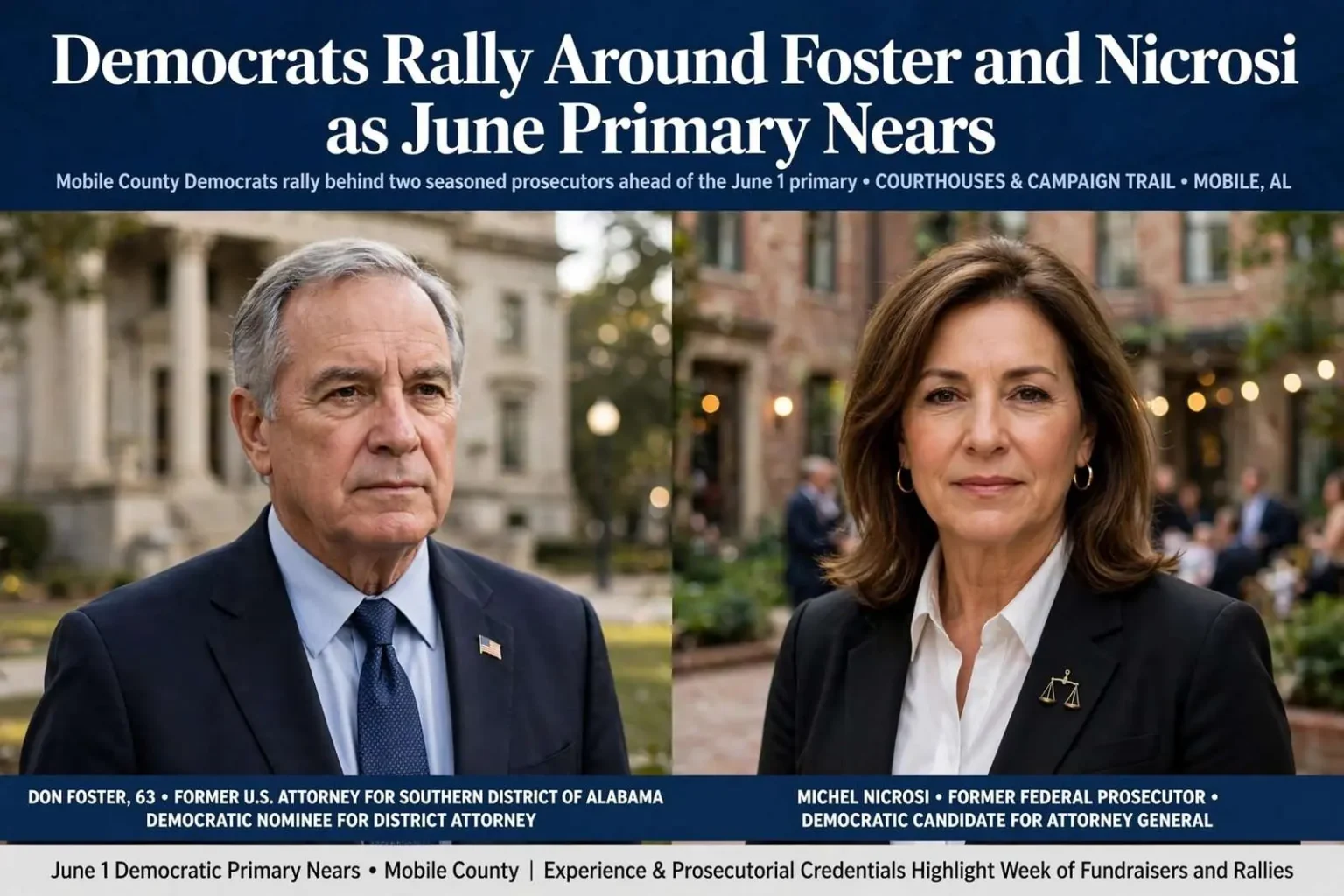
Mobile County Democrats spent the week putting money and momentum behind two candidates with prosecutorial resumes: Don Foster, their nominee for district attorney, and Michel Nicrosi, a former federal prosecutor seeking the party’s nomination for attorney general. With the June 1 primary bearing down and November already looming, the county party is leaning hard on its most bankable commodity — candidates with courtroom credentials — in a year when nearly everything else about the political landscape works against it.
Foster makes his pitch
Foster told members of the Mobile County Democratic Executive Committee on Thursday that he would stack his experience as a former U.S. Attorney against that of either prospective Republican nominee. Foster, 63, served six years as U.S. Attorney for the Southern District of Alabama during the administration of President Bill Clinton. He will face either assistant Mobile County District Attorney Ashley Rich or Mark Erwin, the former Mobile County GOP chairman and Saraland municipal judge, in the general election in November.
Foster’s argument to the committee was essentially the resume itself. The U.S. Attorney’s office for the Southern District of Alabama, based in Mobile, handles federal prosecutions across the southern tier of the state — public corruption, drug trafficking, fraud and the full range of federal crime — and leading that office is experience no other candidate in the race can claim. For a party trying to hold an office it has owned for decades, a former federal prosecutor is the profile the mathematics of the race calls for.
He is more than 20 years the senior of whichever Republican emerges from the June 1 primary, and he is not running away from it. Foster said he is at a stage in his career where public service holds great appeal, and that he would like to work with law enforcement again. It is an unapologetic framing, and it matches the office he is seeking: a district attorney’s job rewards judgment accumulated over decades.
The stakes could hardly be clearer. The seat is open because District Attorney John Tyson Jr., a Democrat who has held the office since 1994, decided not to seek re-election. It is one of the last non-judicial countywide offices in Mobile County still in Democratic hands, and holding it will require Foster to win a substantial share of voters who will otherwise be marking Republican ballots in November.
That is the tactical reality hanging over the whole campaign. Mobile County has drifted steadily toward the Republican Party in federal and state races, even as Democrats have kept a foothold in local government. A countywide Democratic nominee for district attorney cannot win with the Democratic base alone; he must persuade a meaningful slice of the Republican-leaning electorate — the same voters who will find Rich or Erwin on their ballots — that experience in the prosecutor’s office trumps partisan habit. Tyson demonstrated over sixteen years that such coalitions are possible. Foster’s task is to prove they are still possible without Tyson’s name on the ticket.
A courtyard full of criminal lawyers
Across town Thursday afternoon, roughly 40 to 50 supporters of Nicrosi gathered in the courtyard at the downtown Mobile office of criminal defense lawyer Dennis Knizley for a fundraiser. Attendees, according to Knizley, represented law enforcement, the medical community, former federal and state prosecutors and the civil bar — “but mostly the criminal bar.” “A $250 contribution was requested on the invitation, and the donation basket had plenty of envelopes in it,” Knizley reported. “I do not know how much was raised. A similar function was held at the Brutkiewicz law firm the previous evening.”
Two fundraisers in two nights, both hosted by prominent members of the Mobile bar, is a meaningful show of hometown support for a candidate running statewide. In statewide races, campaigns live and die by whether they can raise money beyond their home county, and what Nicrosi’s back-to-back events demonstrate is the kind of networked legal community that can seed a campaign early. The crowd’s composition mattered as much as its size: when law enforcement figures, physicians, former prosecutors and defense lawyers show up to the same courtyard, a candidate is collecting credibility from every part of the criminal justice ecosystem at once.
The attorney general’s race
Nicrosi, formerly an assistant U.S. Attorney in Mobile who once headed the criminal section of the federal prosecutor’s office here, faces Montgomery lawyer James Anderson and former state party executive director Giles Perkins in the June 1 Democratic primary for attorney general. Her local base is a genuine asset in a three-way race. Mobile County is one of the larger sources of Democratic primary votes in the state, and a candidate who can consolidate it while the other two split votes elsewhere has a plausible path to a runoff.
The geometry of a three-way primary rewards exactly the strategy Nicrosi appears to be pursuing. A candidate does not need a statewide majority to reach a runoff — she needs a home region she wins overwhelmingly while opponents divide the rest. Mobile County’s Democratic electorate is among the largest single pools of primary votes in Alabama, which is why statewide candidates of both parties campaign here heavily, and why a Mobile prosecutor running for attorney general starts with a structural advantage that her Montgomery-based rivals must spend time and money to neutralize.
Her prosecutorial background also gives the campaign a theme that writes itself. The attorney general’s office is the state’s chief legal enforcement post, and a candidate who once ran the criminal section of the federal prosecutor’s office in Mobile can speak about the job from the inside — supervising complex investigations, working with federal and local agencies, and trying the kind of cases that make headlines. In a primary field where the rivals come from private practice and party administration, that enforcement resume is the clearest dividing line.
The Republican side of the attorney general’s race is its own contest, with incumbent Troy King defending the office he was appointed to and later won. That dynamic matters to Democrats in a practical way: an incumbent with a primary fight of his own must spend resources and take positions during the spring, while the Democratic field gets free time to introduce itself to voters. Whoever emerges from the Republican primary will carry the advantages of incumbency or of an establishment-backed challenge — but the Democratic nominee will enter the fall with a fully formed campaign and months of organization behind her.
The shape of a hard year
Alabama Democrats came into 2010 defending a legislature they had controlled for more than a century and facing a national climate turning sharply against their party. In Mobile County, that meant recruiting candidates late, as they did with Foster, and leaning on the professional networks — lawyers, doctors, law enforcement — that still have reason to answer the phone.
The week’s two events, read together, sketch the party’s whole strategy for the year. Statewide, the party still holds both chambers of the legislature — majorities of astonishing vintage, given that Democrats have run the legislature continuously for well over a hundred years. But the 2010 midterm environment is hostile to the party in power in Washington, and Alabama Democrats know that the national wind will be blowing against them in November regardless of anything they do locally.
Recruiting late has costs, and Foster’s candidacy illustrates both sides of the bargain. On one hand, the party did not field a district attorney candidate until Tyson’s retirement made the opening unmistakable, which means Foster enters the race needing to introduce himself, build an organization and raise money on a compressed calendar. On the other hand, waiting let the party recruit the strongest available name, and a candidate with a long career behind him can compress the introduction quickly.
That is where the professional networks come in. The groups that filled Knizley’s courtyard and the executive committee’s Thursday meeting — the bar, the medical community, law enforcement — are the durable infrastructure of Alabama Democratic politics in regions where the party’s registration has thinned. These networks supply the early money, the host lists, the endorsements that signal viability, and the volunteers who make a county operation function. They cannot stop a national tide, but they can hold specific offices — and that is precisely the kind of limited, achievable objective a hard year demands.
Whether that is enough will be settled first on June 1 and then in November.
The June 1 primary will settle both questions the county Democrats are working on this week: whether Nicrosi can convert her hometown legal base into a runoff spot in the attorney general’s field, and whether Foster, unopposed for the nomination, has built the foundation he will need for the harder general election in November. The primary calendar gives them a short runway, and both campaigns spent the week using it the way compressed campaigns must — with events designed to do three jobs at once: raise money, rally the network, and generate the visible signs of momentum that later donors and endorsers look for.
There is also a shared logic in the party’s choice of candidates. Both Foster and Nicrosi are selling the same product — prosecutorial experience — in a year when trust in rhetoric is low and voters are sizing up candidates by what they have actually done. District attorney and attorney general are enforcement jobs, and the party that once dominated Mobile County government is betting that, in these two races at least, credentials can still outrun the political current. The courthouse networks that attended this week’s events are the proof of concept: if the lawyers and law enforcement figures who know the candidates’ work are willing to host, give and volunteer, the argument writes itself for everyone else.
What happens in Mobile County on June 1 and in November will say a good deal about how much of the old Democratic coalition in south Alabama remains reachable — and whether experience, in the end, still sells at the ballot box.