Amtrak Mardi Gras Train Hits Stuck Trailer at Grand Bay Crossing, Locomotive Partially Derails
An Amtrak Mardi Gras Service train struck a stuck trailer at a Grand Bay crossing, derailing the locomotive and injuring crew members.
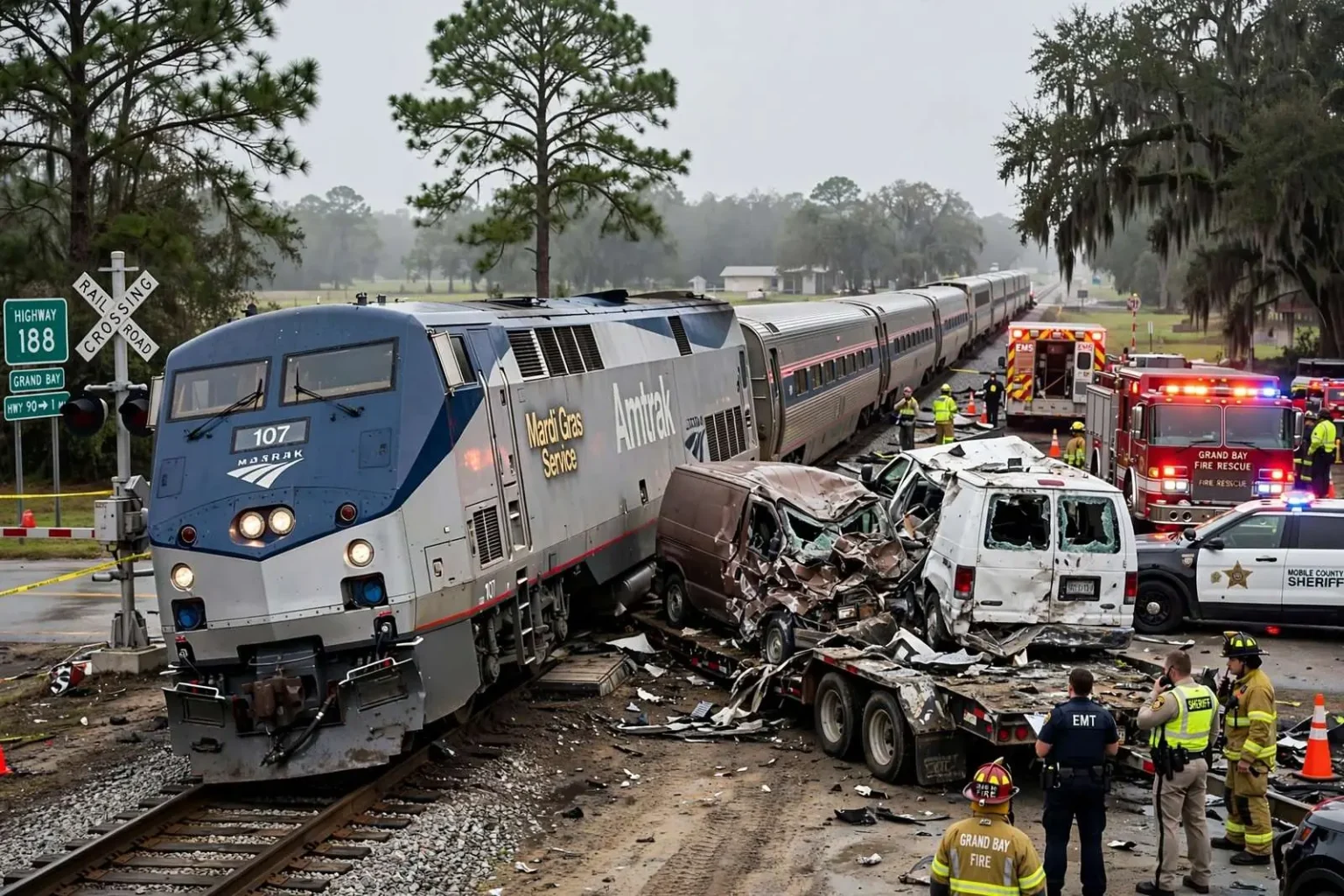
An Amtrak Mardi Gras Service train struck a trailer that had become stuck on the tracks in Grand Bay on Sunday morning, leaving the locomotive partially derailed and several crew members injured, according to emergency personnel at the scene. The collision happened at about 7:20 a.m. as the train departed Mobile en route to New Orleans, cutting short a run that ordinarily carries riders across the Gulf Coast on one of the region’s busiest travel weekends.
The train had only recently left the Port City when it came upon the obstacle. A trailer hauling two vans had gotten stuck minutes earlier while crossing the tracks on Highway 188, just off Highway 90, in the Mobile County community of Grand Bay. The crossing sits in a stretch of rural roadway where trains and slow-moving farm and recreational vehicles share the same narrow footprint, and it proved unforgiving on Sunday.
The driver of the stuck rig called 911 immediately, dispatchers said, and tried unsuccessfully to have the trailer towed clear before the train arrived. Emergency calls about a vehicle fouling the tracks set off a race against a schedule that emergency crews could not win. Within minutes, the oncoming equipment met the trailer at the crossing.
The impact was enough to derail the front wheels of the locomotive, according to Amtrak and emergency personnel. The engine left the rails but remained upright, and the rest of the train held the track. Reports from the scene showed the locomotive stopped across the crossing as crews from multiple agencies converged on the area.
Crew Members Hurt; Passengers Uninjured
First responders said several people were hurt in the impact, though the injuries were not believed to be serious. Amtrak confirmed the injured were crew members, who were treated at the scene. Details on their conditions were not released, but authorities indicated none of the injuries appeared life-threatening.
None of the 48 passengers aboard the train were hurt. The passenger count, provided by the railroad, underscored how much of the shock of the collision was absorbed by the lead equipment rather than the cars behind it. Passengers were kept informed as crews assessed the scene and worked out how to move them onward.
Crews spent the morning working to clear both the highway crossing and the rail line. The work involved inspecting the locomotive, removing the destroyed trailer and its cargo from the right of way, and checking the track structure before any train could pass. Investigators from the railroad were expected to document the scene as part of the standard review that follows a crossing collision.
Passengers Bused Onward
Amtrak said riders aboard the stranded train were given snack packs and water while crews worked. The railroad’s crews distributed the provisions as the morning stretched on and it became clear the train would not continue south. For families and travelers heading to New Orleans for the holiday week, the delay turned a routine trip into an unplanned morning on a stalled train in south Mobile County.
Later that morning, the railroad returned the train to Mobile, where passengers transferred to alternate transportation to continue their trip to New Orleans. The decision to bring the train back north reflected the damage to the lead locomotive and the need to keep the line clear while the crossing was worked. Amtrak moved to get riders going again as quickly as the logistics allowed.
The Highway 188 crossing has since reopened to vehicle traffic. Rail operations through the corridor resumed after the track was inspected and cleared, and the crews who had spent the morning on the scene were released by early afternoon.
A Growing Gulf Coast Rail Service
The Mardi Gras Service is Amtrak’s return to the Gulf Coast corridor between Mobile and New Orleans, a route that had gone without passenger service since Hurricane Katrina damaged the line in 2005. The reinstated service connects Mobile with stations in Pascagoula, Biloxi, Gulfport and Bay St. Louis before terminating in New Orleans, giving coastal Mississippi and south Alabama a direct passenger rail link that residents had sought for nearly two decades.
Ridership on the restored route has been strongest around holidays and special events, when travelers use the train to avoid congestion on Interstate 10 and the street closures that accompany Carnival in both cities. A collision that stops the train on a Sunday morning in peak season therefore affects not just those aboard, but the schedule and equipment rotations for the rest of the day.
The service has also become part of the Mardi Gras experience itself, marketed as a way for revelers to travel between the Carnival capitals without worrying about parking, parades or impaired drivers. Mobile’s continuing claim as the original home of Mardi Gras in America, with celebrations dating to 1703, has made the city’s rebuilt Amtrak terminal a natural starting point for the trip west.
Crossing Safety in Focus
Grade crossing collisions remain one of the most persistent hazards on the nation’s rail network, and safety organizations have long urged drivers never to attempt to cross when a vehicle might hang up on the rails. Low-clearance trailers, in particular, can ground out on the crossing surface and leave a driver trapped on the track with seconds to spare.
Safety guidance from railroads and Operation Lifesaver is consistent in situations like the one on Highway 188: if a vehicle stalls or hangs up on a crossing, occupants should get out and move away from the tracks immediately, and call the emergency number posted at the crossing so railroads can be alerted directly. Sunday’s collision in Grand Bay is likely to renew local attention to signage, warning devices and clearance at crossings along Highway 90 and its connecting roads.
Rail safety experts note that most crossing collisions occur in daylight and good weather, in familiar settings close to home, when drivers who cross the tracks every day grow comfortable with the routine. Modern warning devices have reduced incidents at many crossings, but the fundamental rule remains the same: any time a vehicle cannot clear the rails completely, the crossing should not be attempted.
For crews on the Mardi Gras Service, Sunday’s crash was a demonstration of how quickly an ordinary run can change. The corridor’s trains cross dozens of public and private grade crossings on every trip between Mobile and New Orleans, from industrial spur connections near the port to rural farm roads like Highway 188, and each one depends on drivers treating the tracks with the same seriousness the railroad does.
For the Grand Bay community, the response drew on resources from across south Mobile County. Fire and rescue units, sheriff’s deputies and railroad personnel all played a role in securing the site, treating the injured crew members and managing the small crowd of onlookers that gathers at any major incident along Highway 90. No homes or businesses were evacuated, and the incident remained confined to the crossing itself.
Grand Bay is an unincorporated community of a few thousand residents along the Mississippi line, strung out along Highway 90 and the rail line that parallels it. Highway 188 branches south from the highway toward Bayou La Batre and Coden, carrying a steady mix of commuter traffic, commercial fishing traffic and trailers moving boats and equipment to the coast. The rail line through the community carries the freight and passenger trains of the Gulf Coast corridor, and crossings like the one at Highway 188 are an everyday part of life there.
The two vans being hauled by the trailer were destroyed in the collision. Their owner, like the driver of the rig, escaped injury, according to emergency personnel. The wreck of the trailer blocked the crossing for hours while heavy equipment was brought in to lift and remove the debris from the tracks.
The trailer’s load of two vans, apparently being transported along the Highway 188 route toward the coast, made the rig long and heavy enough that a standard tow could not free it in time. Once a vehicle hangs on a crossing, the few minutes between the 911 call and the arrival of a train are rarely enough, which is why safety campaigns stress evacuation over rescue.
What Happens Next
Collisions between trains and highway vehicles are investigated by the railroad and federal safety regulators, with findings that can lead to changes in warning devices, speed restrictions or crossing geometry. Amtrak has not said how long the damaged locomotive will be out of service or whether any equipment substitutions will affect upcoming departures of the Mardi Gras Service.
For now, the railroad urges passengers to check service alerts before traveling, and drivers along the Highway 188 and Highway 90 corridors to approach every crossing with caution. The passengers from Sunday’s train completed their journeys to New Orleans by alternate transportation, and the crew members injured in the crash were expected to recover.
Local officials will likely revisit the crossing in the weeks ahead, as communities along the corridor have done after previous incidents. For the residents of Grand Bay, Sunday’s crash was a reminder that the return of passenger rail to the Gulf Coast brings with it a renewed need for caution at every grade crossing along the route.