
With Shootings Mounting, Mobile Leaders Question the ‘Safest City by 2020’ Goal
After four shootings in 24 hours, Mobile leaders including CJ Small and Sandy Stimpson question the safest-city-by-2020 pledge.
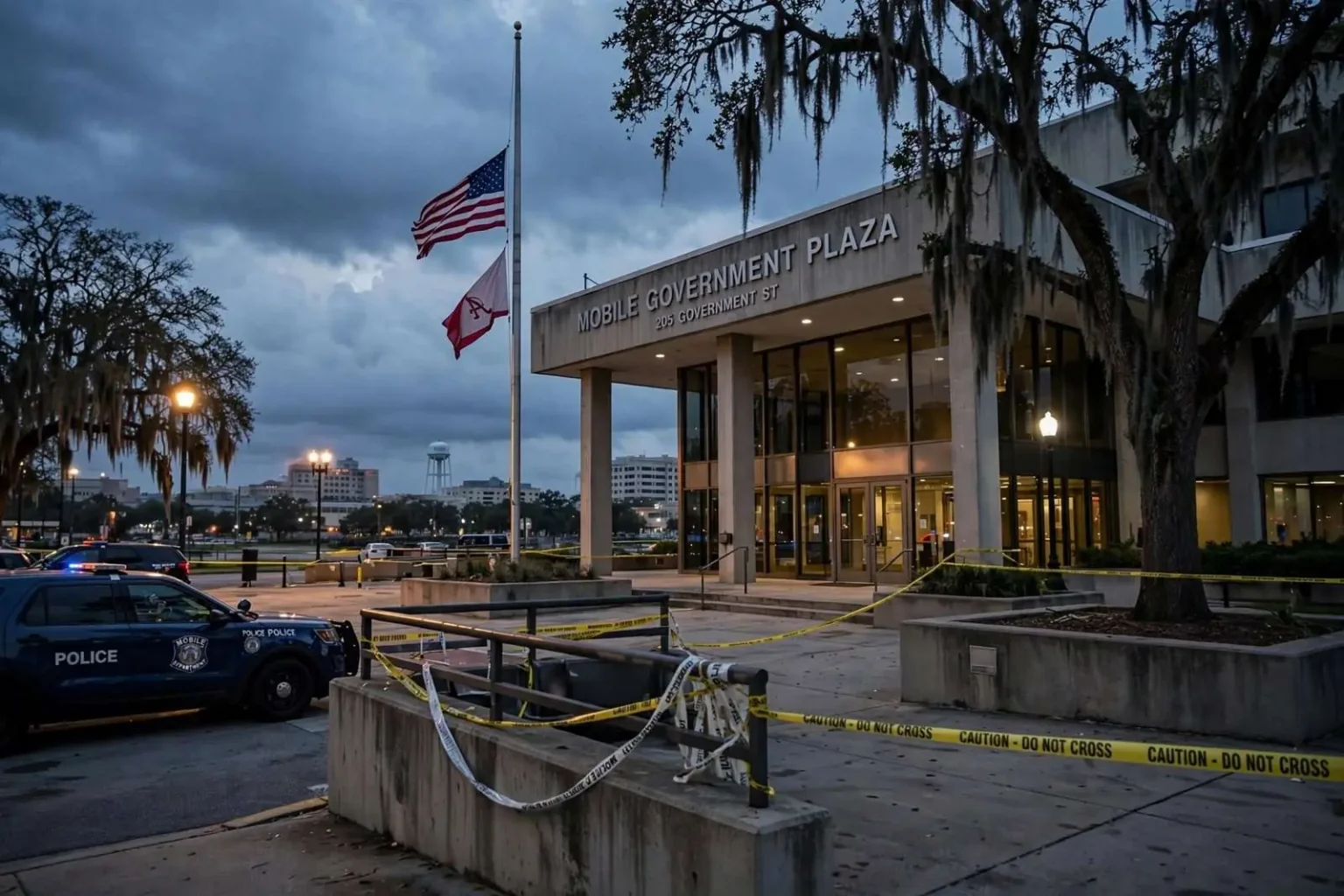
MOBILE, Ala. — A stretch of gun violence in Mobile — four shootings in less than 24 hours — has city leaders openly questioning whether Mayor Sandy Stimpson’s signature pledge to make Mobile “the safest city in America” by 2020 can be kept. With less than seven months left until that self-imposed deadline, concerns about the pace of violent incidents surfaced during Tuesday’s Mobile City Council meeting. The pledge has been a defining theme of Stimpson’s administration since he first took office, invoked in campaign materials and repeated in city communications as the standard against which his public safety record would be measured.
The latest cluster of shootings did more than add to the year’s tally. It prompted an unusually frank exchange in the council chamber, where members who routinely vote alongside the mayor’s administration said out loud what many residents have been saying in neighborhood meetings and on social media: the goal posts are approaching faster than the violence is receding. Mobile, like many mid-sized Southern cities, has grappled with concentrations of violent crime that shift from one part of the city to another, straining police resources and testing community patience.
City leaders have historically pointed to the Police Department’s enforcement operations, violence intervention efforts and partnerships with neighborhood groups as evidence of progress. But the past several days of gunfire made it difficult to frame the trend positively, and the council meeting became a venue for members to voice the frustration their constituents have been expressing for months.
Councilmember: ‘It’s Just Going to Get Worse’
Councilman CJ Small told colleagues he did not see the goal being met at the current rate. “Our mayor campaigned on having the safest, friendliest city by 2020 — I just don’t see it,” Small said. “If we don’t crack down or do something, it’s just going to get worse. I hate to say it, but it’s not just the east side of Mobile, it’s now on the west side of Mobile. It’s a bad statement on our city.”
Small’s comments carried weight because of what they signaled about the geography of the problem. District 3, which he represents, sits on Mobile’s western side, an area long regarded by many residents as insulated from the gun violence more often associated with older neighborhoods closer to downtown and the city’s eastern districts. When gunfire reaches the western stretches of the city, he suggested, no neighborhood can consider itself removed from the problem.
His remarks also underscored the political arithmetic facing the administration. A pledge made on the campaign trail becomes a scoreboard item in the council chamber, and with the deadline months away, council members who might otherwise defer to the mayor on public safety strategy were unwilling to let the timeline pass without comment. The exchange was not a budget fight or a procedural dispute; it was a public statement of doubt about whether a marquee promise could be kept.
Stimpson and Public Safety Director Respond
Stimpson, speaking that evening at a Mobile United community forum, acknowledged the toll the violence is taking on residents’ sense of security. “How can you not think of crime when every night on the news you’re reading something that you’d prefer was happening in some other city than where you’re living,” the mayor said.
The forum setting mattered. Mobile United convenes civic leaders, business figures and residents for community conversations, and it is precisely the kind of venue where a mayor cannot fall back on talking points prepared for a press conference. Stimpson’s acknowledgment — that the nightly drumbeat of violence weighs on how people feel about their own city — aligned his public posture with the concerns council members had voiced only hours earlier.
Public Safety Director James Barber, whom Stimpson quoted as saying police “can’t arrest our way out of this problem,” conceded the timeline may slip but said the objective itself remains. “Maybe it will take longer than the mayor anticipated, but we’re certainly going to continue to try,” Barber said.
Barber, a former Mobile police chief who moved into the public safety director’s role overseeing the department, has been the administration’s point person on crime strategy. His admission that the deadline could pass without the goal being met was notable for its directness. Rather than defending the 2020 date, he reframed the question around persistence: the target may be missed, but the pursuit of it will not be abandoned.
Enforcement Alone Won’t Close the Gap
The director’s framing reflects a broader shift in how American cities approach violent crime. Departments across the country have come to recognize that arrests and prosecution, while necessary, address the symptoms of gun violence rather than its roots. Modern strategies layer community outreach, conflict mediation, job and youth programming, and cooperation with federal partners on top of traditional patrol work, on the theory that a small number of disputes drive a disproportionate share of shootings and that intervention before a retaliatory shot is fired is worth more than an arrest after one.
Mobile has pursued versions of that approach in recent years, and Barber’s quoted remark — that the police “can’t arrest our way out of this problem” — was an acknowledgment that the department’s clearance numbers and arrest statistics, however they trend, will not by themselves deliver a city that feels safe. The harder work, he suggested, happens in neighborhoods, churches, schools and homes, in the relationships that determine whether a disagreement ends in an argument or an ambulance.
A Citywide Effort, Not Just a Police One
Small, for his part, argued that reaching the goal will require a citywide effort rather than enforcement alone, calling Mobile “a jewel, a treasure” worth protecting for visitors and residents alike. His framing cast the safety pledge as something larger than a police metric: a statement about how Mobile presents itself to the world and how neighbors treat one another.
That view finds support in the way cities that have made measurable progress on violent crime tend to describe their success. Rankings like the ones implied by a “safest city in America” pledge are typically built on FBI crime reporting, comparing rates of violent offenses per capita across metropolitan areas. Moving those numbers requires years of sustained reduction, not a single good quarter, and the cities that manage it usually pair enforcement with economic investment, youth programming and neighborhood-level engagement that no police department can deliver on its own.
For Mobile, the conversation comes at a moment when the city’s self-image is riding high in other respects. The city has invested in its downtown waterfront, attracted new development and marketed itself as a growing Gulf Coast destination. A “jewel” is how many civic leaders like to describe the port city, and the councilman’s remark was a reminder that persistent gun violence is the loudest counterargument to that narrative — one heard every night on the local news.
What Comes Next
No vote was scheduled as a result of Tuesday’s discussion, and no new strategy was announced at the meeting or the forum. What changed, in effect, was the tone: council members said publicly that they doubt the deadline, and the administration said publicly that it may indeed pass unmet. For residents, that candor may matter more than the pledge itself, which now appears likely to be redefined as a direction rather than a destination.
The coming months will test whether that honest reassessment produces results. The Police Department will continue its operations, the council will continue to press for accountability, and community organizations will continue the work that officials describe as inseparable from any enforcement strategy. Seven months is not long, but city leaders on both sides of the exchange agreed on at least one thing: the effort to make Mobile safer will continue past 2020, whatever the calendar says about the promise.
Business and civic leaders have a stake in the outcome as well. Tourism, recruiting and retail investment all track closely with a city’s reputation for safety, and Mobile’s ability to market itself alongside faster-growing Sun Belt peers depends in part on reassuring visitors and employers that the city’s crime problem is being confronted, not minimized. Every national list that ranks cities by violence gets circulated widely, fairly or not, and civic leaders know it. Tuesday’s exchange ensured that no one at city hall can claim the issue has gone unnoticed.
For now, the most concrete takeaway for residents is the one officials repeated in both settings — that reducing violence is a shared job. Those who witness crime are encouraged to report it, neighborhood groups remain central to the city’s prevention efforts, and the dialogue between the council and the administration, strained as Tuesday’s exchange was, keeps the goal in view even as the deadline slips out of reach.


