Two Meals at The Blind Mule, and Both of Them Were the Last
Stale smoke, a gumbo with no taste and red beans that defied description sent our critic out the door of a downtown Mobile music bar with no intention of returning.
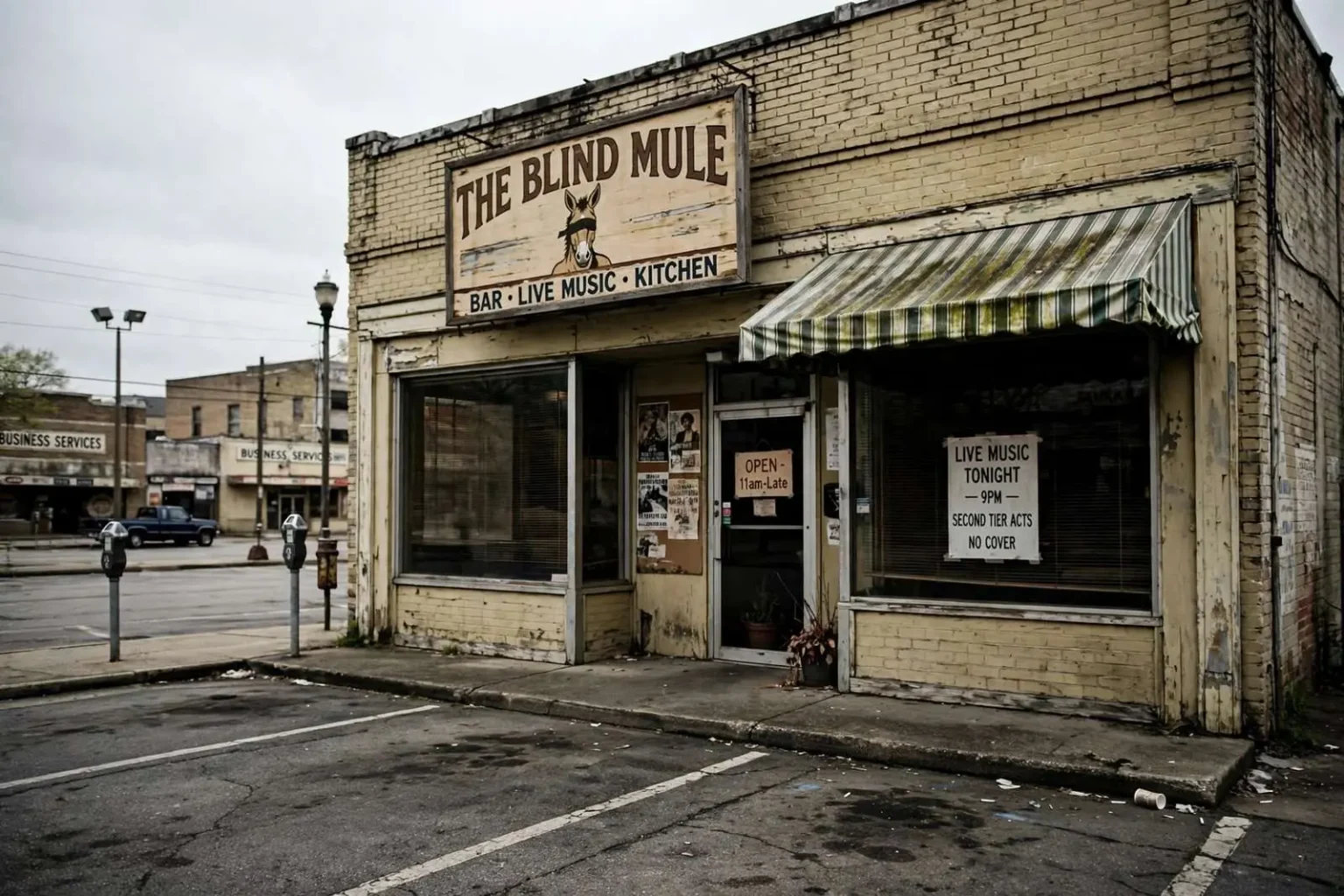
“I had two dining experiences there,” our anonymous dining correspondent wrote of The Blind Mule, “my first and my last, both within the same hour on the same day.” It is the kind of line a reviewer saves. The visit that produced it took place in the spring of 2008, at a restaurant and bar whose name he found more interesting than anything that arrived on the table. A bad review is never the plan when a critic walks through a door. What made this one worth writing was the accumulation of small disappointments — a parking lot, a smell, an empty room, a gumbo that photographed well and tasted of nothing — that turned an ordinary lunch into a small comedy of errors.
The Blind Mule sat in Mobile’s downtown, one of the bars and eateries that cluster near the business district and depend on the lunch trade for a large share of their business. Establishments with names like that trade on personality, and in a college town adjacent to a port city, a catchy name and a stage for live music can carry a bar a long way. The question our correspondent set out to answer was whether the kitchen could stand on its own. The answer, he would conclude, was that the kitchen was never really the point.
Warning signs, ignored
Our critic arrived with great hopes, and lost the first of them in the parking lot, where the exterior of the building did not encourage confidence. Unwilling to be deterred by appearances, he went in anyway — and was met at the door by what he described as the smell of very heavy and stale cigarette smoke residue, the ghost of the previous night still hanging in the room. In 2008, Alabama’s bars were still places where smoking indoors was permitted under state law, and a smoky room the night before was unremarkable; a smoky room the day after, in a restaurant, at noon, was something else. The smell that lingers into the next day is the smell that has soaked into the drapes, the ceiling tiles and the booths, and no amount of morning cleaning retrieves it.
Still undeterred, he found a table in the empty dining room. The emptiness, he noted afterward, should have been a clue. A downtown restaurant at the heart of the lunch hour, with tables to spare and not a single other diner, is telling its own story. Regular customers are the voting public of the restaurant business, and an empty dining room means the regulars have rendered a verdict. Our correspondent pressed on regardless, which is either a critic’s highest virtue or his most reliable flaw.
The gumbo that looked better than it tasted
He ordered a cup of gumbo as an appetizer, part of a running survey of the region’s gumbos he had been conducting for weeks. Gumbo is serious business on the Gulf Coast, where Creole and Cajun traditions meet the local catch, and a coastal Alabama restaurant stands or falls on its version. Visually, it was a triumph: dark, with a good consistency, plenty of meat and crab claws floating in it. It really looked good. The dark roux, the floating crab claws, the color of the broth — everything about the bowl announced that someone in the kitchen understood what gumbo is supposed to look like.
“The appearance of the gumbo was its best feature,” he wrote. It had no distinct taste. In fact, he said, it had hardly any taste at all. A gumbo that looks the part and tastes of nothing suggests a roux that went through the motions — color achieved, flavor never developed — and a broth that was built for presentation rather than the pot. The failure is almost stranger than an ugly, delicious gumbo, because it takes effort to make something look right and no effort at all to leave it bland.
He will keep trying gumbo at new places, but for a really good one he intends to go back to The French Loaf. Mule gumbo he would not order again. The comparison was telling: The French Loaf, a small lunch spot with a devoted following, was the standard against which the correspondent measured the region’s gumbos, and The Blind Mule’s version had not come close.
A question about crawfish
For an entrée he settled on the jambalaya, advertised with crawfish and smoked Conecuh sausage — a promising combination, particularly after a recent bad experience with jambalaya on the Causeway. Conecuh sausage, the smoked sausage made in Conecuh County, Alabama, is a point of genuine local pride, and its appearance on a menu alongside crawfish promises a dish rooted in the region. On paper, the kitchen had done everything right: a Louisiana classic, local sausage, Gulf crawfish.
But he asks one question before ordering any crawfish dish, and he asked it here: is the crawfish domestic or imported? He was told, to his surprise, that it was imported — and this a day after a local newspaper had run a feature titled “An Abundance of Mudbugs.” The timing made the answer harder to take. A newspaper celebrating a bountiful local crawfish season one day, and a local restaurant serving imported crawfish the next, is the kind of coincidence that a food writer cannot leave alone.
Our critic does not knowingly eat imported crawfish, a position with real force in a coastal county where crawfish and shrimp are pulled from nearby waters by people who cannot compete with foreign prices. The imported product — frequently farm-raised and sold at a fraction of the cost of the domestic catch — has pressed hard on the Gulf Coast seafood economy for years, squeezing the fishermen, docks and processors that anchor communities from Bayou La Batre to the Causeway. When a restaurant in a port city serves imported crawfish while local boats are landing the real thing, the choice is not just a matter of taste; it is a vote with the menu. A diner who declines imported seafood is exercising one of the few levers available to protect a domestic industry that cannot survive on sympathy alone.
He ordered the red beans and rice instead.
The red beans
What arrived, in a wide-rimmed bowl with garlic bread, was dominated by white rice, with a smattering of beans and a few bites of sausage thrown in. Red beans and rice is a humble dish, and humility is part of its appeal: beans simmered long with seasoning meat until the pot thickens, ladled over rice, finished with whatever heat the kitchen likes. What the bowl should never be is a mound of white rice with the beans treated as a garnish. The proportions, as they arrived, suggested a kitchen stretching a pot to cover more plates than it should.
The taste, he wrote, was unlike any red beans and rice he had ever eaten — somewhat sweet and somewhat spicy at once, which he acknowledged may not make sense, and simply not good. He ate all of the Alabama smoked Conecuh sausage and left most of the rice and beans in the bowl. The sausage, at least, did its job; the product made in Conecuh County has carried many a mediocre dish, and it carried this one as far as it could.
The young server asked how he had liked it. When he told her, she said, “Oh, I’m sorry,” and disappeared. He waited for someone from the kitchen to come out and ask what had gone wrong. No one did. That silence matters more than the apology. A kitchen that wants to know why a diner left a bowl untouched will send someone to the table; a kitchen that does not care has told the diner everything he needs to know. In fairness to the server, she was placed in an impossible position — carrying bad news she did not cause — but the absence of any follow-up from the back of the house was the final entry in a day’s catalogue of warnings.
A bar that serves food
Our critic’s conclusion was less a verdict on the cooking than a diagnosis of the establishment. The kitchen opens at 11 a.m. and stays open very late, but from all appearances, he judged, The Blind Mule is far more interested in adult beverages and live music than in food. There is nothing wrong with being a bar. A bar that is honest about being a bar can be a fine thing, particularly in a downtown where the evening crowd wants music, a pour and a late kitchen. The problem is presenting a full menu to a lunchtime dining room while the kitchen functions as an afterthought to the stage.
He suspected that several trips to the bar would be essential to giving the kitchen a positive rating. The line was a joke with a serious edge: at certain establishments, the food improves in direct proportion to the number of drinks that precede it, and the reviewer who arrives sober is reviewing a different restaurant than the one the regulars know.
The upcoming acts advertised on the wall — which he graded as second or third tier — were not enough to bring him back, not with last night’s smoke still in the air and this afternoon’s cooking still on his mind. The music calendar, in the end, could not overcome what the food had already said. Venues live and die on their entertainment lineups, but a lunch customer is won by what comes out of the kitchen, and The Blind Mule had offered him nothing to come back for.
Our restaurant critic dined at his own expense, remained anonymous to the staff, and reviewed only restaurants he visits in the ordinary course of life. That method is what gives a review like this its weight: no comped meals, no advance warning, no special treatment. The Blind Mule served an ordinary customer on an ordinary afternoon, and that customer never came back.
The Blind Mule’s name, our correspondent allowed, remained the best thing about the place — memorable, a little odd and far more interesting than anything that reached his table that day. In a city with no shortage of straightforward restaurant names, a place called The Blind Mule at least made you curious. Curiosity, as it turned out, was all it had to offer him. The parking lot raised doubts, the stale smoke confirmed them, the empty dining room reinforced them, and the kitchen — with a bland gumbo, imported crawfish in the jambalaya and a bowl of red beans and rice that was mostly rice — settled the question entirely.
His closing verdict doubled as advice to anyone who might follow him through the door: go for the music and the drinks if that is what you are after, order the Conecuh sausage if it appears anywhere on the plate, and set your expectations for the food accordingly. The two dining experiences he had there — his first and his last, within the same hour on the same day — were, in the end, one experience, and one was enough.