Loxley Landowner Wins Split Vote to Open Wedding Venue on Rural Property
Baldwin County zoning commissioners narrowly approved a Loxley woman's plan to host weddings on her 15-acre property after a 4-3 tie-breaking vote.
A Loxley property owner has cleared a major hurdle in her plan to turn a stretch of family land into a wedding and reception venue, after the Baldwin County Planning and Zoning Commission narrowly approved her request in a split vote. The decision, reached only after the panel’s chairman cast a rare tie-breaking vote, shows how closely Baldwin County’s zoning board weighs requests to shift rural land toward commercial use — and how finely divided such requests can leave it.
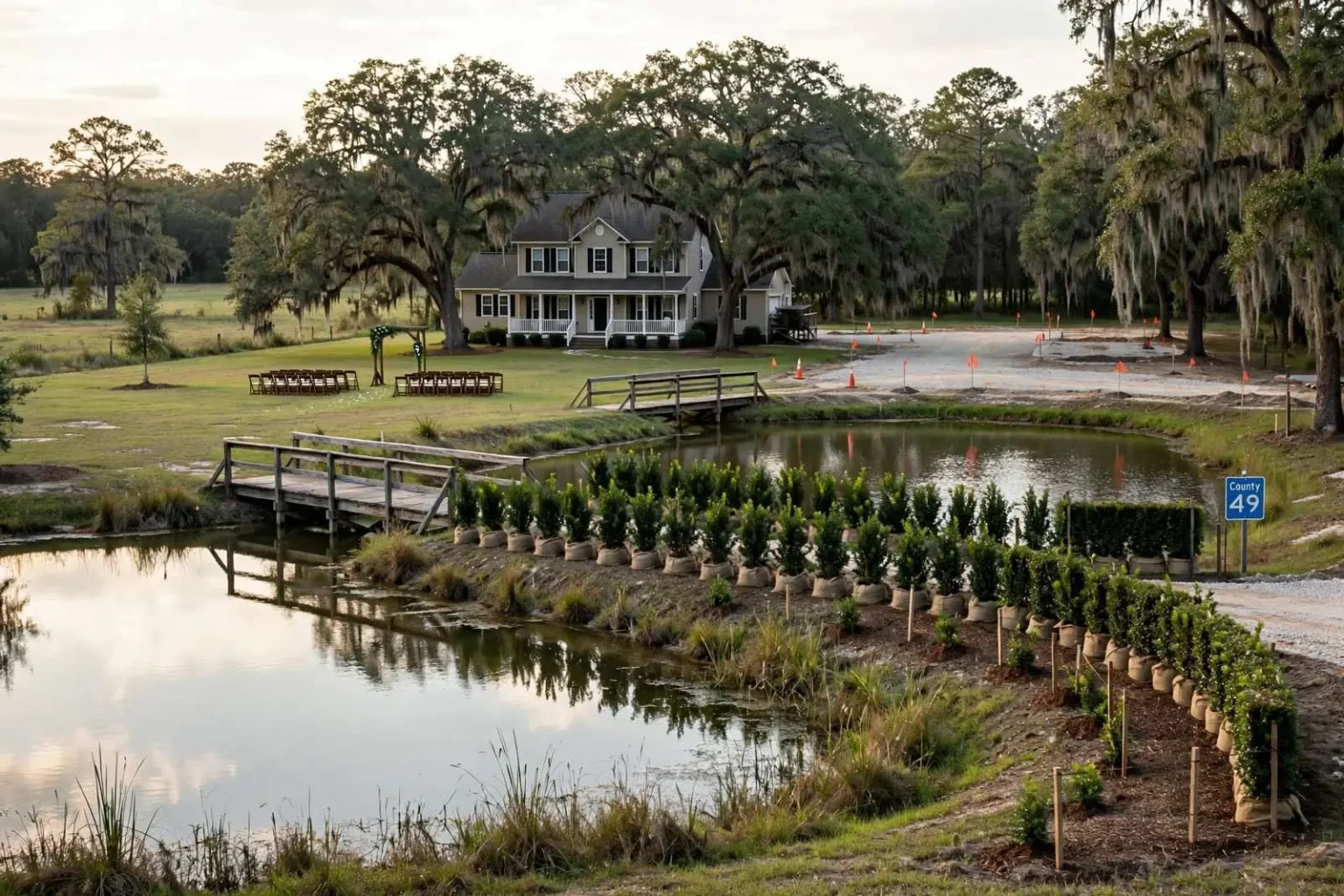
Robin Gregorius sought a conditional use permit to build the venue on her 15-acre property in the 25000 block of County Road 49, land that includes her two-story home, three ponds, two bridges and a wooded buffer. The property’s natural features — water on three sides of the grounds, tree lines screening the edges, a home anchoring the center — are exactly what wedding parties look for in a venue, and Gregorius envisioned hosting ceremonies and receptions among the oaks and ponds her family’s land already provided.
A commission divided
The commission voted 4-3 in her favor, with the chairman stepping in to break a tie among the six regular voting members. Commissioners Dale Marston, Art Hosey and Cassie Boatwright voted to approve the request, while Dewane Hayes, Kevin Murphy and Michael Kaiser voted against it. Because the panel deadlocked at three votes apiece, Chairman Sam Davis, who only casts a vote to break ties, sided with approval, allowing Gregorius to move forward.
The chairman’s vote is reserved for exactly these moments, and its use signaled how genuinely split the panel was. A 4-3 outcome on a conditional use permit is a narrow mandate — enough to approve the request under the commission’s rules, but also a signal that the concerns raised during the process were heard and shared by half the board. Conditional use permits occupy a middle ground in zoning law: the underlying request is not allowed by right, but a governing body may permit it when the applicant meets conditions designed to protect the surrounding area.
Gregorius, who also runs Country Gables Assisted Living in Grand Bay, said she wasn’t confident going into the meeting that the commission would side with her. “I felt that what I had shown them was really deserving for use on my property,” she said afterward. “If I hadn’t gotten it, I would have been so disappointed that they didn’t see the need for another option in Baldwin County.”
Her experience operating an assisted living facility in Grand Bay gave her a track record managing a business that hosts people, manages traffic and operates near neighbors — experience she argued translated directly to running a venue responsibly. The argument apparently resonated with the commission’s majority, even as the vote’s narrowness showed the persuasion had limits.
The neighbors’ concerns
Not everyone in the area supported the plan. Some neighbors raised concerns during the process about the potential for increased traffic and noise from wedding events held near their homes, worries that are common when rural residential land shifts toward hosting commercial gatherings. County Road 49 is a rural road not built for event-scale traffic, and residents along it feared weekend processions of cars and amplified music carrying across the pastures and into their yards.
Those objections mirror the ones heard in zoning hearings across Baldwin County, where the county’s rapid growth has pushed event venues, campgrounds and other commercial recreation into areas zoned for rural residential use. Planning commissioners are asked to weigh a property owner’s right to use land productively against neighbors’ expectation of quiet country roads — a balance with no formula, decided case by case.
The conditions attached
To address those concerns, the commission attached several conditions to the approval. Parking will not be allowed along County Road 49 itself, meaning any vehicle overflow will need to stay on Gregorius’ property. The rule protects the road’s travel lanes and shoulders — and the driveways and sight lines along it — from the crush of cars a Saturday evening wedding can produce, keeping arrivals and departures on the applicant’s own 15 acres.
Guests will not be permitted to stay overnight at the venue, ruling out the kind of extended-stay events some wedding venues offer elsewhere. The restriction keeps the property in the events business rather than the lodging business, preventing the conditional use from quietly expanding into something closer to a resort or bed-and-breakfast without the commission seeing the request again.
The commission also required Gregorius to install a hedge buffer along the property line, intended to screen the venue from neighboring homes and soften noise from outdoor events. A living buffer does the work a fence cannot: it absorbs sound, blocks sight lines to the festivities and grows more effective with every season — a condition aimed directly at the neighbors’ noise complaints and at the visual change a venue brings to a rural road.
Moving toward opening
Gregorius said she intends to honor both the letter and the spirit of those conditions as she moves toward opening. “It’s not going to be loud and obnoxious by any means, and it’s just going to be for a few hours here and there,” she said, adding that she has not yet settled on a firm timeline for when the venue will begin hosting its first events.
The conditions will now govern how the venue operates for as long as the approval stands. Conditional use permits can typically be revisited if the holder violates their terms, which gives neighbors a remedy if traffic spills onto County Road 49 or events run late into the night — and gives Gregorius a standing reason to keep the operation as restrained as she has promised it will be.
Between the approval and the first wedding, practical work remains: the hedge buffer must be planted, parking areas laid out on the property, and the grounds prepared for ceremony traffic. Weddings in Baldwin County are seasonal business, concentrated in spring and fall, so the venue’s first bookings will depend on how quickly the site can be readied for its first season.
Part of a countywide trend
The approval adds another option to a growing list of rural wedding and event venues across Baldwin County, where landowners have increasingly sought to convert agricultural or residential acreage into spaces for weddings, receptions and similar gatherings. The county’s scenery — live oaks, pastures, ponds and proximity to the beaches — makes it a natural market for destination-style weddings, and property owners looking at sprawling acreage have seen events as a way to make land pay without subdividing it.
Each request navigates the same tension between property rights and neighbors’ quality-of-life concerns that played out in Gregorius’ case, and the outcomes vary with the site, the applicant and the objections raised. The split vote in Loxley illustrates the pattern: commissioners willing to approve a well-conditioned venue, and equally willing to attach the parking rules, overnight bans and buffers that keep the surrounding rural character intact.
For County Road 49, the result is a new neighbor of a particular kind — one that appears on weekends, draws crowds for a few hours and, if its operator keeps her promises, leaves little trace by Monday morning. For Baldwin County’s venue map, the 4-3 vote added one more entry to a list that keeps growing as the county grows around it.
How Baldwin County’s zoning process works
The hearing that produced the 4-3 vote followed the path any conditional use request takes in unincorporated Baldwin County. Property owners file with the Planning and Zoning Department, which reviews the site, drafts recommended conditions and schedules the request for a public hearing before the commission. Neighbors within the surrounding area receive notice, and anyone who objects — or supports — can address the commissioners directly before the vote.
The commission’s structure shapes its outcomes. Six regular members vote on most questions, with the chairman participating only to break ties, a rule that makes a 3-3 deadlock possible and gives the chairman’s vote real weight when it happens. In the Gregorius case, that meant the decision ultimately rested on one person after three members saw the conditions as sufficient and three saw the risks to the rural road as too high.
Conditional use approvals also differ from rezonings in an important way: the land’s zoning stays the same, and the permit attaches to the specific use under specific conditions. If the use ceases or the conditions are violated, the approval can lapse or be revoked, and the property returns to whatever the underlying zoning allows. That structure is designed to let unusual uses — a venue, a church, a campground — exist without rewriting the county’s zoning map every time.
What a wedding venue means for a rural road
The traffic question sits at the center of most venue disputes because event traffic arrives in pulses unlike anything a rural road normally carries. A Saturday ceremony means dozens of vehicles arriving within the same hour, parking for the duration, and leaving together after the reception — a pattern that can overwhelm a road built for farms and scattered residences. The commission’s no-parking condition on County Road 49 was written for exactly that pulse, forcing all of it onto Gregorius’ own acreage.
Noise follows the same logic. Outdoor ceremonies and receptions carry across open land in the evening hours, and the hedge buffer requirement acknowledged that distance alone — 15 acres is a large property, but neighbors still border it — would not quiet the concern. Screening vegetation along the line softens both the sound and the sight of an event in progress, and it gives the neighbors along the property edge a living barrier between their homes and the festivities.
The overnight ban addresses a third concern that surfaces in venue requests: the drift from a few-hours event toward continuous operation. Weekend-long wedding weekends, guests staying in onsite cabins, midweek events — each expands the venue’s footprint in the neighborhood. By prohibiting overnight stays, the commission capped the use at what the surrounding area can absorb.
Gregorius, for her part, described an operation consistent with all three conditions: events of a few hours, held here and there, without amplified chaos. If the venue opens as she describes it, the conditions and the operator’s intentions will align — and the commission’s narrow, conditioned approval will have done what the process is designed to do, which is let a rural landowner put her family’s property to productive new use while holding the line for the neighbors who opposed it.