Orange Beach and Baldwin County School Officials Clashed Over the Numbers Behind a Breakaway School System
Weeks before a September 2014 referendum, Orange Beach and Baldwin County school officials remained split over enrollment counts and funding projections for a proposed city-run school system.
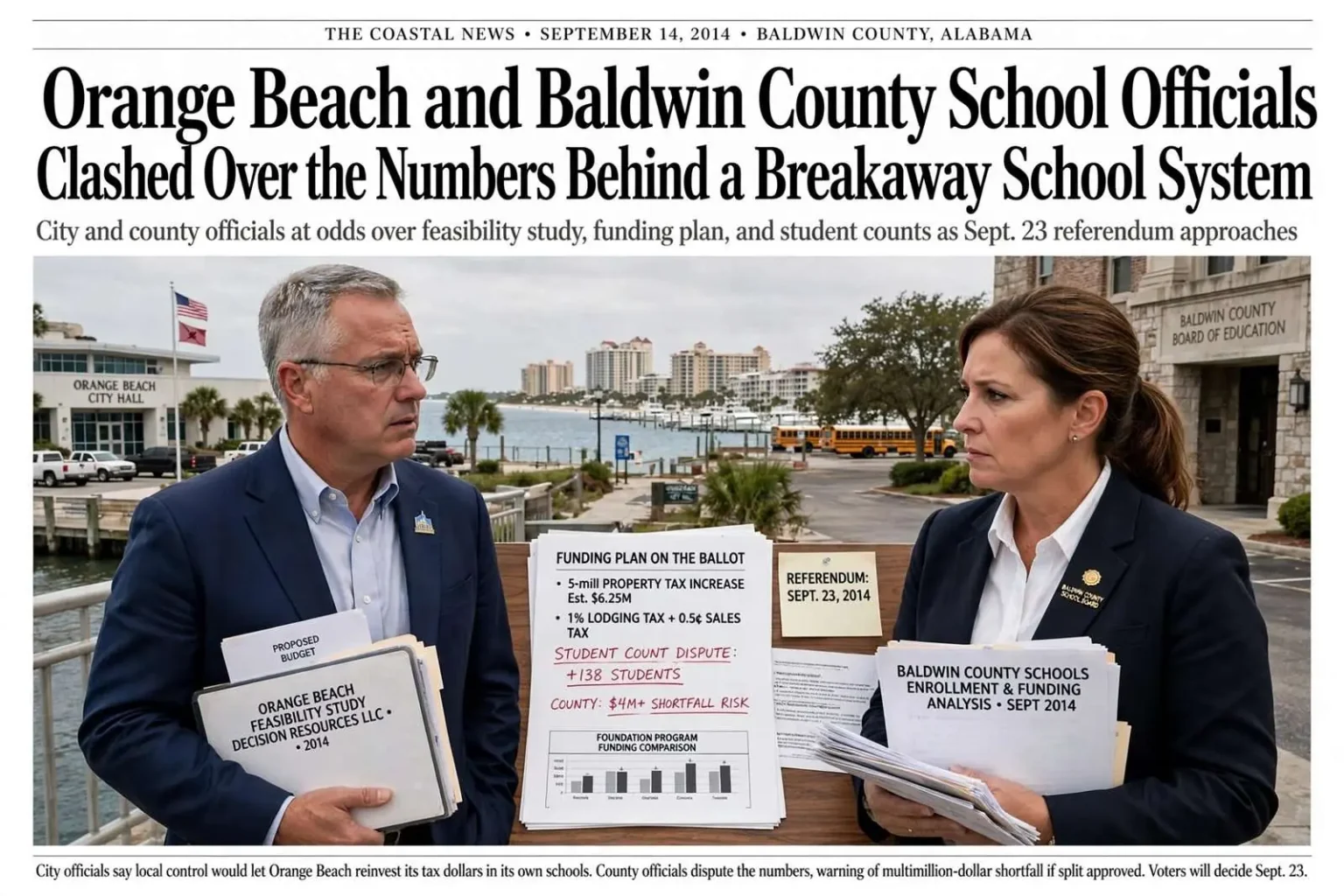
With a referendum just weeks away, Orange Beach city leaders and the Baldwin County school board remained sharply divided in September 2014 over the numbers behind a proposed breakaway school system. City voters were set to decide on Sept. 23 whether Orange Beach should form an independent school system, a vote that would settle one of the most consequential questions the young resort city had ever put on its ballot.
Approval would trigger a 5-mill property tax increase to fund the split from the Baldwin County public school system, and the City Council indicated it would also implement a one-percent lodging tax increase and a half-cent sales tax increase, together expected to generate an estimated $6.25 million. The layered funding plan reflected the city’s unusual economy: a community of condominium towers, restaurants and vacation rentals whose guests — not just its property owners — would share the cost of a new system through taxes paid on lodging and purchases.
The push followed a wave of separation movements across south Baldwin County, where the fast-growing beach cities had long argued that their booming property tax base sent far more money to the county system than came back to their community schools. Gulf Shores was pursuing its own split at the same time, and leaders in both cities argued that local control would let them direct their residents’ tax dollars to their own classrooms.
A feasibility study at the center of the debate
The council based its decision to move forward on a city-funded feasibility study by Birmingham-based consultant Ira Harvey and his firm, Decision Resources LLC. The city paid $37,500 for the study and an additional $12,500 to the accounting firm Carr, Riggs & Ingram LLC to establish a potential working budget for the system. Harvey, a veteran school finance consultant who had advised districts across Alabama, concluded that an independent Orange Beach system would be financially viable.
The county school board disputed the study, arguing it rested on flawed funding assumptions that would leave an independent system with a shortfall of more than $4 million. The disagreements centered on what the board called an inflated student count, contributions to Alabama’s Foundation Program, and assumed funding through a special privilege license tax as well as federal Title I money.
Each disputed element carried real dollars. The Foundation Program — the state’s core school funding formula — distributes money based on enrollment and local capacity, so a city’s student count directly determines what it pays in and receives out. Title I funds flow to schools based on poverty levels, and a tourist city’s claim on them was itself a point of contention. And a privilege license tax, unlike a property tax, would depend on businesses and workers rather than land values, making its future revenue harder to guarantee.
A school board member urges caution
School board member Angie Swiger, who represented Orange Beach and Gulf Shores along with other areas of south Baldwin County, reiterated the county’s position in a letter to the editor, urging voters to “think twice about supporting” the tax measure.
“To be clear, my motivation is not in opposition to a separate system if that is the direction Orange Beach voters wish to move,” she wrote. “Rather, it is to insure that the relevant and accurate facts are placed before the voters prior to the time they are asked to cast this critical vote.”
Swiger’s carefully worded letter mirrored the board’s broader strategy in the closing weeks: rather than argue that separation was wrong in principle, county officials framed their case as a challenge to the arithmetic — a claim that the city’s numbers did not survive contact with actual enrollment figures and state funding rules. For board members, the concern was twofold: what a split would mean for the students leaving, and what the loss of tax base would mean for the students staying behind in one of Alabama’s largest and fastest-growing county systems.
The city fires back
The city issued a formal response to the school board’s rebuttal, with points discussed by Mayor Tony Kennon and Jeremiah Mosley, an attorney with the city’s lobbying firm.
“The County does not want Orange Beach to separate. This much is clear,” the city’s news release stated in part. “After Orange Beach separates, the County may face similar attempts by other cities in Baldwin County, cities that are just as concerned over the condition of the County system as we are.”
The statement made explicit what both sides understood: the dispute was about more than one city. Baldwin County’s system spans a geography among the largest east of the Mississippi River, serving communities as different as Bay Minette, Foley, Fairhope and the beach cities. A successful separation by Orange Beach — following Gulf Shores — would reshape the county board’s finances and could embolden other municipalities to calculate their own exits.
The city said it simply wanted to “educate our citizens on the truth” ahead of the vote, casting itself as the party responding to facts rather than producing them.
The fight over the student count
At the heart of the dispute was enrollment. The county contended that Harvey had ignored actual enrollment data and inflated student totals by 138 students, a difference it said would improperly shift roughly $1 million in countywide taxes toward Orange Beach. In the funding formula that governs Alabama schools, 138 students is not a rounding error; it is the difference between a system that can staff its classrooms and one the county insisted would run a multi-million-dollar deficit.
The city countered that Harvey based his projections on the student count the county board itself had provided and that he had included private-school and homeschool students living within the city because an Orange Beach system would be legally required to admit them. That point cut to the core of how a split actually works: when a new city system is created, state law obligates it to educate every resident child, not just those currently enrolled in county schools. A count based only on today’s county enrollment, the city argued, would understate the new system’s true obligations — and its true revenue needs.
The competing claims left voters to sort through dueling budget projections in the run-up to the referendum — a high-stakes decision about whether one of Baldwin County’s coastal cities would chart its own course in public education. Each side had its study, its accountant and its elected champions; what neither could resolve before the vote was the question every referendum of this kind eventually turns on — whose assumptions about students, taxes and state formulas would prove closer to the truth once the classroom doors actually opened.
What separation would take
Forming a school system is not a project a city can improvise after a vote passes. An independent district must acquire or build campuses, hire a superintendent and staff, purchase buses, negotiate the division of existing assets with the county board and stand up the payroll, nutrition and transportation operations a county system quietly provides behind the scenes. The Sept. 23 vote, if successful, would begin years of transition work before an Orange Beach system ever opened its own doors — work that the city’s feasibility study tried to price out in advance.
The revenue side of the plan leaned on the city’s distinctive tax base. Orange Beach’s lodging and sales taxes draw heavily on the millions of visitors who pass through the Gulf Coast’s resort corridor each year, meaning that a substantial share of any new education funding would come from tourists rather than residents. City officials pointed to that dynamic as a sign the plan asked little of local homeowners; county officials countered that tourism revenue is volatile, and that a school system’s obligations — salaries, debt service, classroom construction — arrive on time whether or not the summer season does.
The 5-mill property tax proposed to accompany the split would fall only on property owners within Orange Beach city limits. A mill is one-tenth of a cent of tax on every dollar of assessed property value, and in a city of multimillion-dollar beachfront homes and condominiums even a modest millage produces significant revenue. It also deepens the equity argument both sides were making: the city said its residents were already paying countywide taxes for schools far away; the county responded that the same taxes support the system every Baldwin child is entitled to share.
A county watching closely
For the Baldwin County school board, the stakes extended well beyond one beach town. The system had spent years building and rebuilding schools to keep pace with one of the fastest-growing enrollments in Alabama, funded in large part by property taxes from the very cities now talking about leaving. Officials warned that a domino of municipal separations would leave the remainder of the county — including communities with far less taxable value per student — bearing a larger share of the system’s costs with a thinner base to draw from.
The September 2014 clash over numbers, in that sense, was the public portion of a larger negotiation over how growth would be paid for in one of the South’s boom counties. Every new rooftop in Foley or Daphne and every new condominium in Orange Beach adds both students and tax value to the ledger, and the fight over the breakaway was ultimately a fight over which government ledger those figures would land in. Voters would render their judgment on Sept. 23; the arguments over enrollment counts, state formulas and million-dollar shifts in tax revenue were the terms in which that judgment was being asked.