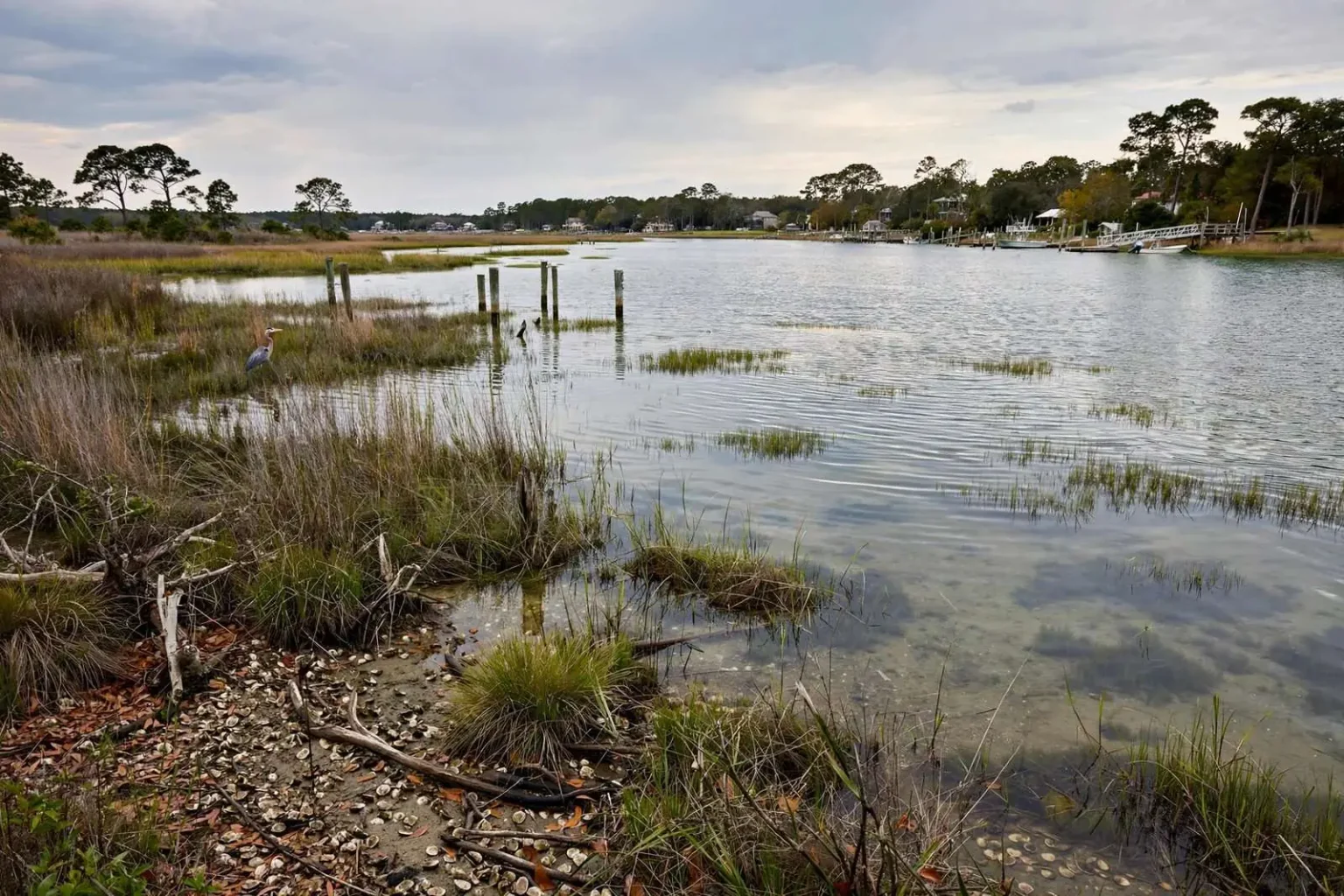
Aerial view of a coastal lagoon near Gulf Shores, AlabamaLittle Lagoon, an eight-mile coastal waterway in Gulf Shores, is the focus of ongoing preservation efforts.

Residents concerned about the long-term health of Little Lagoon will get an update this week on a package of environmental proposals aimed at protecting the eight-mile coastal waterway in Gulf Shores.

The Little Lagoon Preservation Society has invited the city’s environmental and grant coordinator, Daniel Bond, to speak at its quarterly membership meeting Thursday, October 16, at 5:30 p.m. at the Gulf Shores Adult Activity Center. Bond is expected to walk through a set of recommendations the nonprofit previously submitted to City Administrator Steve Griffin.

According to the group’s vice president, the request covers several fronts. Chief among them is a push for Little Lagoon to earn an Outstanding Alabama Water designation, a state classification that would bring additional protections against pollution and unregulated development along the shoreline.

The society is also asking the city to develop an incentive-based plan to phase out septic tanks ringing the lagoon in favor of connections to the public sewer system. Failing or aging septic systems have long been cited by area residents and environmental advocates as a source of bacterial contamination in the shallow lagoon, which is a popular spot for swimming, fishing and boating.

On the development side, the group wants the city to limit new commercial marinas around the lagoon, or at minimum require environmental impact studies before any new marina applications move forward. The proposal would also restrict future commercial and multifamily construction along the lagoon’s edge to parcels already zoned for that kind of use, effectively capping the intensity of shoreline development going forward.

Fisheries management is another piece of the request. The society wants the city to coordinate with Alabama Marine Resources on managing fishing, crabbing and shrimping activity in the lagoon to keep fish and shellfish populations at sustainable levels. Members have also raised concerns about seawalls, which can accelerate erosion on neighboring properties and disrupt natural shoreline processes, and the group intends to discuss ways to discourage their use around the lagoon.

After Bond’s presentation, the meeting will include a status report on construction progress at the Little Lagoon Pass bridge, along with results from a recent Coastal Cleanup effort based at Mo’s Landing on the lagoon.

The Little Lagoon Preservation Society has advocated for the waterway for 23 years and holds its meetings open to the public. Residents interested in the lagoon’s water quality, upcoming construction projects or the group’s advocacy work can find more information and contact details through the organization’s website.

See also  Coastal Arts Center Wraps an 'Epic' Summer of Kids' Camps

The Gulf of Mexico borders Alabama’s southern edge and defines much of the state’s coastal identity. Alabama’s Gulf coastline, centered on Dauphin Island, Gulf Shores, and Orange Beach, supports a tourism industry built around beaches, charter fishing, and marine recreation, while offshore waters host shipping lanes and energy interests.

The Gulf’s warm, shallow shelf and exposure to hurricanes make weather and disaster preparedness recurring concerns for communities from Mobile to Baldwin County. The marine environment also underpins commercial seafood harvests that have sustained Gulf Coast families for generations, tying the region’s economy and culture closely to the water.

Alabama is a state in the southeastern United States bordered by Tennessee, Georgia, Florida, the Gulf of Mexico, and Mississippi. Often called the Heart of Dixie, it spans Appalachian foothills in the north and flat coastal plains in the south. Its largest cities include Birmingham, Montgomery, Huntsville, and Mobile.

Alabama’s history encompasses Indigenous roots, Spanish and French colonial settlement, a cotton-plantation economy, the Civil War and Reconstruction, and the Civil Rights Movement of the 1950s and 1960s, followed by a shift toward manufacturing, aerospace, and technology. Local news across the state frequently reflects this mix of tradition and change.

The natural environment is central to life on the Gulf Coast, where barrier islands, bays, rivers, and wetlands support fisheries, recreation, and storm protection. Coastal Alabama faces challenges common to low-lying regions, including hurricane exposure, erosion, and the management of fragile ecosystems.

The Mobile-Tensaw Delta, one of the largest river deltas in the country, is a particularly significant natural asset. Conservation efforts, fisheries regulation, and shoreline restoration are frequent points of collaboration among state agencies, federal bodies like the Army Corps of Engineers, and environmental groups.

How the region plans for growth while protecting its natural assets is a recurring theme in local reporting. The tension between development pressure and ecological stewardship plays out in zoning fights, infrastructure projects, and disaster-recovery decisions that shape the coast for generations.

Behavioral-health care on the Gulf Coast is provided by a mix of community mental-health organizations, hospital systems, and private practitioners. Community centers play an especially important role in serving patients who might otherwise lack access to care, often coordinating with courts, jails, and social services.

Demand for these services has grown alongside heightened public awareness of mental illness and the lasting effects of disasters such as hurricanes. Workforce shortages of psychiatrists and other clinicians are a persistent challenge nationwide, and they shape how providers allocate limited staff time between direct patient care and the administrative and legal obligations that accompany treatment.

See also  Courthouse Politics Heat Up in Mobile and Baldwin Judicial Races

The intersection of mental health and the justice system is a national concern as well as a local one. Communities across the country have debated how best to divert people in crisis away from jails and toward treatment, a conversation that informs how courts, clinicians, and advocates approach commitment hearings and related proceedings.

The economy of the Mobile region is diversified across shipping and logistics, aerospace and shipbuilding, healthcare, tourism, and manufacturing. The Port of Mobile is one of the nation’s busiest seaports and a cornerstone of the local and state economy.

Major employers in aviation and defense contribute to a skilled workforce, while economic-development organizations aim to attract investment and jobs through incentives and infrastructure improvements. Small businesses, from restaurants to professional services, form the backbone of neighborhood commerce.

The health of the regional economy is a frequent subject of public discussion and reporting. Workforce development, recruitment of industry, and the fortunes of local retailers all feed into a broader picture of how the Gulf Coast competes and adapts in a changing national economy.

Charitable and nonprofit organizations form a vital safety net across South Alabama, addressing needs from hunger and homelessness to disaster relief and holiday assistance. Groups such as The Salvation Army operate local corps that provide shelter, food, and seasonal programs funded largely by community donations.

The generosity of Gulf Coast residents, often mobilized after hurricanes and economic hardship, underscores how tightly knit many of these communities are. Local philanthropy also relies on volunteers and corporate partners, and the progress of fundraising efforts is a recurring subject of regional news because it reflects the community’s capacity to care for its most vulnerable members.

Holiday campaigns in particular reveal the scale of need and the reach of volunteer networks. The rhythm of annual giving, from food drives to toy distributions, is woven into the regional calendar and into the coverage that keeps residents informed about how to help and where support is most needed.

Healthcare in the Mobile area is anchored by several hospital systems and provider networks that serve patients across southwest Alabama, the Gulf Coast, and into parts of Mississippi and Florida. Large employers in the sector include regional health systems operating hospitals, clinics, and specialty centers, alongside university-affiliated providers.

See also  Inside Look: Airbus Unveils Its $600 Million Mobile Assembly Plant

Access to care, the financial health of nonprofit hospitals, and the integration of behavioral and physical health are ongoing priorities. As in many parts of the country, local healthcare institutions navigate workforce shortages, changing reimbursement models, and the particular demands of serving both dense urban neighborhoods and far-flung rural communities.

The ties between healthcare and the local economy are strong. Hospitals are among the region’s largest employers, and decisions about service lines, expansion, or closure reverberate through surrounding neighborhoods, making health-system news a staple of regional journalism.

Mobile is the county seat of Mobile County in southwest Alabama and the state’s only saltwater port. Situated where the Mobile River meets Mobile Bay near the northern Gulf of Mexico, the city has long served as a commercial and cultural gateway between Alabama and the wider Gulf Coast. Founded in 1702 as Fort Louis de la Louisiane and ruled in turn by France, Britain, and Spain before joining the United States in 1813, Mobile carries a layered heritage distinct from the rest of the state.

Today Mobile anchors a metropolitan area spanning Mobile County and neighboring Baldwin County, and it remains a center for shipping, aerospace, healthcare, and higher education in the region. Its downtown and waterfront have seen sustained revitalization, while historic neighborhoods preserve architecture from its colonial and antebellum past. The city’s identity is shaped as much by its working port and industrial base as by its festivals and food culture, making it a frequent focal point for news about growth and change in southern Alabama.

Baldwin County sits directly east of Mobile County across Mobile Bay and is the largest county in Alabama by land area. It encompasses the Eastern Shore communities of Daphne, Fairhope, Spanish Fort, and Foley and stretches south to the beaches of Gulf Shores and Orange Beach along the Gulf of Mexico.