Avoiding a possible Bayway toll could cost drivers more time, test shows
A timed test of alternate routes across Mobile Bay found the Africatown Bridge quickest at 31 minutes, as drivers weigh a possible $6 Bayway toll.
MOBILE, Ala. — With a $6 toll possibly coming to the Bayway, drivers are already looking at alternate routes across Mobile Bay — but a timed test suggests the toll may still be the faster option. Mapping apps estimate it takes about 24 minutes to reach Baldwin County via the Bayway, 25 minutes through downtown to the Causeway and 28 minutes using the Africatown Bridge to the Causeway. On paper, the three crossings are close enough that the choice looks like a coin flip, which is exactly why a real-world drive was worth running before commuters commit to a new routine.
To check those numbers, a local news crew drove each route with matching start and end points over two days at similar times. The exercise was simple: start from the same location in Mobile, finish at the same point in Baldwin County, and compare the clock and the experience route by route. The differences that emerged between the app estimates and the actual drives say a lot about how the Bayway, the downtown tunnels, and the Causeway really behave in afternoon traffic.
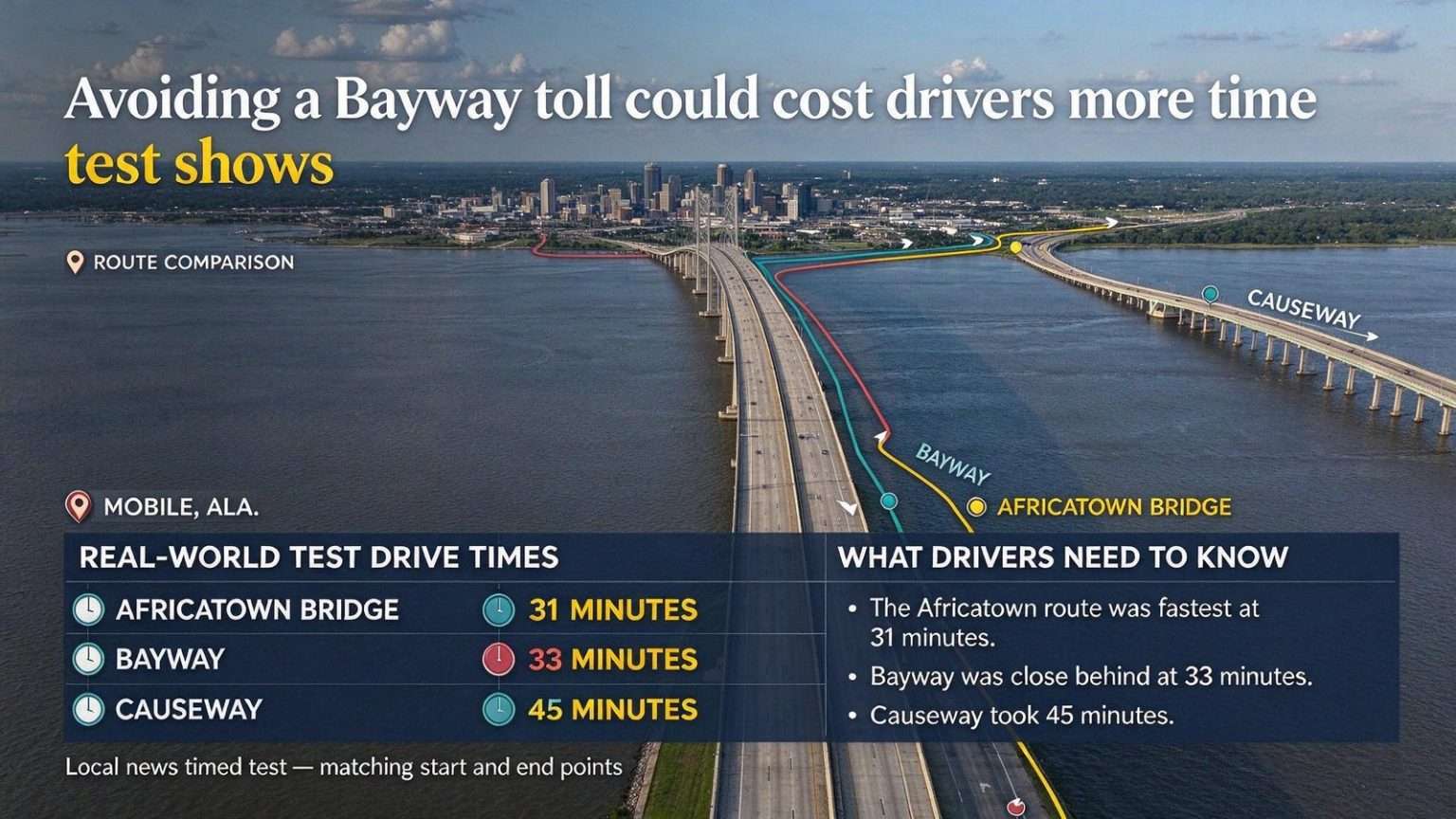
The Bayway route left at 3:30 p.m. and reached Baldwin County at 4:03 p.m., slowed by a traffic jam near the Wallace Tunnel and again on the Bayway bridge. The Wallace Tunnel bottleneck is a fixture of Mobile afternoon travel, where lanes compress as traffic funnels toward the tunnel approach, and the merge onto the Bayway bridge adds a second slowdown before the long rise over the Mobile Ship Channel. Even with both delays, the crossing came in at 33 minutes, close to the mapping estimate of 24 plus the reality of a mid-afternoon peak.
The Causeway route, leaving at 4:30 p.m., arrived at 5:15 p.m. after backups on Government Street. Getting through downtown to the Causeway proved to be the slow part of the trip, with signal timing and congestion on Government Street eating the time that the open, unhurried stretch of the Causeway itself gave back. The scenic route along the bay’s northern shore has no tolls and no tunnel, but the drive demonstrated that the approach to it, not the causeway road itself, is where the minutes disappear.
The Africatown Bridge route, leaving at 3:45 p.m., arrived at 4:16 p.m., with the only delay near where the Bankhead Tunnel lets out onto the Causeway. The northern loop avoids the downtown core and the Wallace Tunnel entirely, running up to the Africatown-Cochran Bridge and across to the Causeway’s western end. Of the three drives, it was the cleanest: one slow spot near the Bankhead Tunnel’s exit, then an unobstructed run the rest of the way.
All told, the Africatown Bridge was quickest at 31 minutes, the Bayway second at 33 minutes and the Causeway last at 45 minutes. Two minutes separated the fastest and the tolled route, a margin small enough to vanish on any given day depending on tunnel traffic, bridge draws, or a wreck on the bridge span. But the test suggests that drivers willing to reroute through Africatown can cross the bay without paying the toll and without giving up meaningful time, while the direct downtown-to-Causeway drive is the one option that consistently underperforms.
What the Toll Debate Is About
The possible $6 toll is tied to the long-running effort to rebuild the I-10 Mobile River Bridge and Bayway, a project designed to replace the aging crossing with a higher span and wider roadway. The proposal has been one of the most contested infrastructure debates on the Gulf Coast for years, with supporters arguing that a new crossing is the only realistic answer to a corridor that carries far more traffic than its 1960s-era design intended, and opponents contending that a daily toll would fall hardest on working commuters who cross the bay every day.
For those commuters, the arithmetic is straightforward. A $6 one-way toll, paid twice a day by someone living on one side of the bay and working on the other, adds up to roughly $250 a month, a figure that dwarfs the two minutes the test found between the Bayway and the free Africatown route. That math explains why so many drivers say they will simply exit the interstate and take the bridges north, and why traffic planners worry about where those vehicles will go instead.
The test could not account for how many drivers will shift off the Bayway once a toll takes effect, which could lengthen the alternate routes further. Traffic diversion is the great unknown in every tolling debate: modeling can predict it, but only actual driver behavior proves it. If a meaningful share of the Bayway’s daily volume moves to the Africatown Bridge and the Causeway, the 31-minute free route in this test could stretch well past the tolled option, erasing the savings that make diversion attractive in the first place.
Know Your Three Crossings
Each route has its own personality, and understanding them helps explain the test results. The Bayway, the elevated interstate crossing south of downtown, is the fastest on open road but is hostage to the Wallace Tunnel approach and to any incident on the bridge itself, where there is nowhere to exit once committed. The Cochrane-Africatown Bridge route trades a few extra miles for a ride that bypasses downtown entirely, and its bottleneck is largely inherited from whatever traffic the Bankhead Tunnel pushes onto the Causeway’s western end.
The Causeway itself is the region’s oldest crossing, a low, two-lane road that runs along the northern edge of Mobile Bay. It is beloved for scenery, seafood restaurants, and sunsets, and loathed at rush hour because every light and every merge downtown sits between most Mobile drivers and its western entrance. As the test showed, the Causeway’s 45-minute real-world time had less to do with the causeway road than with the trip across downtown to reach it.
Timing matters as much as route. The three test drives were launched at slightly different times, 3:30, 3:45, and 4:30 p.m., and each crossed during the build-up to Mobile’s afternoon peak. A driver leaving an hour later would face a different picture entirely, with the tunnels and downtown intersections congested but the Bayway’s own span often flowing freely after the bridge work clears. Conversely, a pre-dawn crossing makes the routes nearly identical, which is why the toll question matters most to the commuters who travel at the worst hours of the day.
What This Means for Daily Drivers
For now, drivers planning ahead have a practical takeaway: the Africatown Bridge route is a legitimate everyday alternative, not just an emergency detour. The 31-minute test time was competitive with the Bayway even before any toll exists, and it used roads that handle local traffic comfortably. Drivers who need to reach the Causeway’s eastern end or the Daphne area may find the northern loop saves both time and toll money, while those bound for Spanish Fort or destinations along the eastern shore corridor may still prefer the interstate’s direct line.
The bigger question, whether the region builds the new crossing and how it is paid for, remains unresolved, and the timed drives will not settle it. What they do show is that Mobile Bay’s crossing network has more capacity than most drivers use, and that the difference between routes is measured in minutes, not miles. Until the toll question is decided, the clock, not the toll, is likely to be what changes commuter habits.
The two-minute gap between the Africatown route and the Bayway deserves context as well. Timing tests are snapshots, not guarantees, and any single afternoon carries its own accidents, weather, and drawbridge delays. The Africatown route’s advantage also depends on the driver’s start point; someone coming from west Mobile would face a longer trek to the northern bridge than someone starting downtown, which could flip the comparison. The test’s value is in showing that the routes are close enough that no driver should assume the Bayway is automatically the only sensible crossing.
There is also the question of what happens to the Causeway communities if diversion grows. The road’s restaurants and businesses depend on visibility and access, and a surge of diverted commuter traffic would change the character of a route that currently mixes local driving, fishing trips, and leisurely dining. Planners in Spanish Fort and Daphne have watched the toll debate closely for that reason, since their communities sit at the eastern end of both free alternatives and would absorb much of any new volume.
For now, the region waits on decisions about the bridge project’s financing, and drivers wait on the toll question that has hung over every crossing conversation for years. In the meantime, the test gave Mobile commuters something concrete: three real drive times, run back to back, on the routes they will actually be choosing between. The Africatown Bridge won the day, the Bayway stayed close behind, and the Causeway proved that the shortest line on the map is not always the quickest way home across the bay.