Old Press Building Emerges as Temporary Home for Mobile County Probate Court
In 2004, Mobile County officials eyed a former newspaper building on Government Street as temporary quarters for Probate Court while the old courthouse was razed and the annex expanded upward.
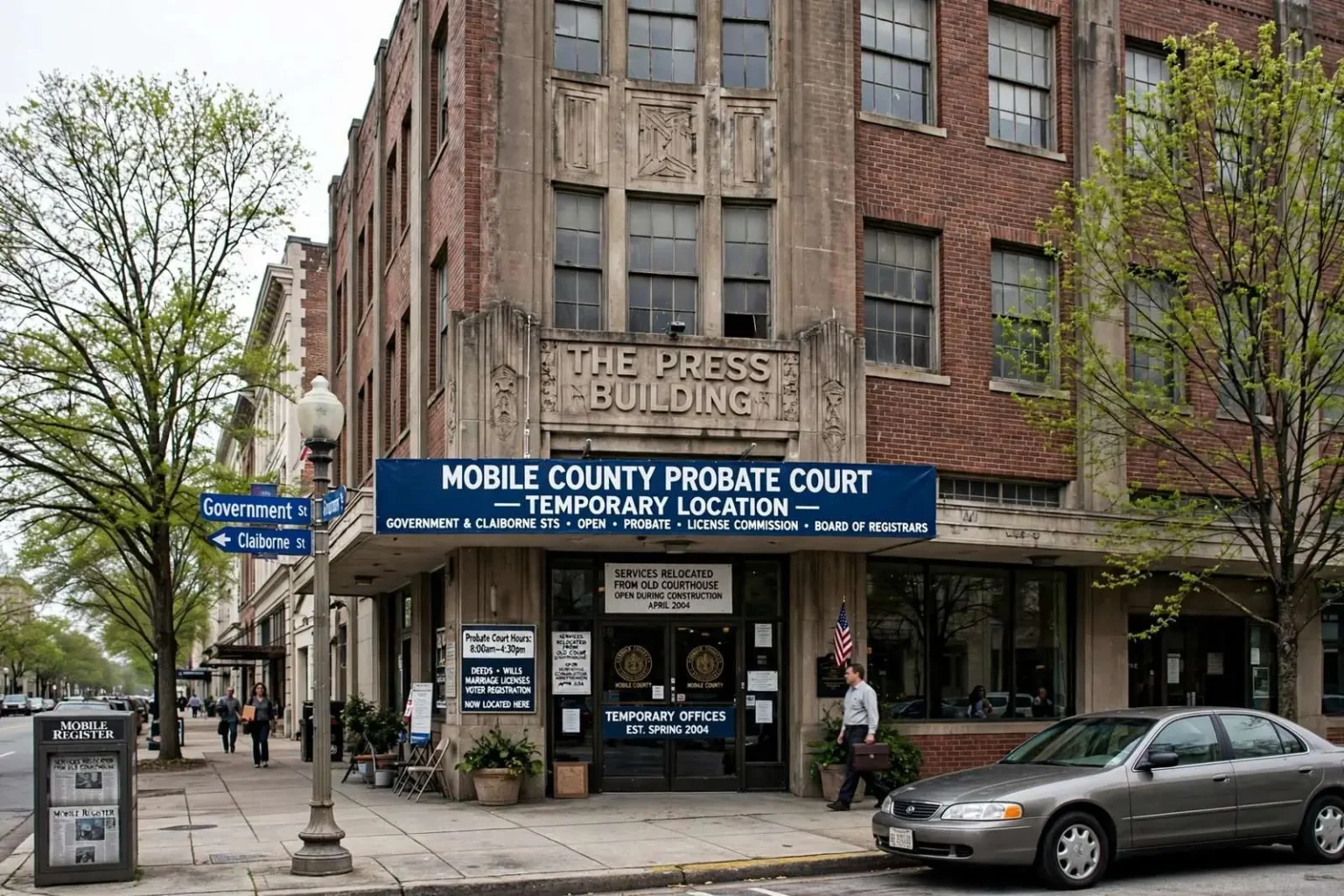
The old newspaper building at Government and Claiborne streets emerged in the spring of 2004 as the frontrunner to house Mobile County Probate Court operations on a temporary basis, while county officials worked out a permanent home for the court atop the newer courthouse annex. The plan under discussion was ambitious and, in its way, a small act of civic surgery. The old courthouse bounded by Royal, Church and Government streets — a building then roughly 50 years old — was to be demolished. In its place would rise a downtown green space with a Mardi Gras theme, paid for with a mix of public and private money. The Hearin-Chandler Foundation was expected to play a prominent role in funding the park.
For the people who worked in the old courthouse and the thousands of Mobile County residents who passed through its doors each year, the plan meant something far more immediate: a move. Probate Court is not an abstract institution. It is the office where wills are probated, estates are settled, adoptions are finalized, marriage licenses are issued and conservatorships are established for family members who can no longer manage their own affairs. A temporary relocation touches nearly every family in the county eventually, whether at the death of a parent, the birth of a child or the filing of a deed.
County leaders spent the spring of 2004 weighing how to keep those services running without interruption while the largest piece of the reshuffling — the demolition of the old courthouse and the vertical expansion of the annex — played out. The answer they were converging on was a lease, and the building they liked best had spent most of its life printing the morning paper.
Why tear it down?
The arithmetic drove the decision. Removing asbestos from the old courthouse, officials said, could cost as much as $20 million — roughly the same price tag as adding three floors to the newer annex next door. Faced with spending the same money either to rehabilitate an aging building or to build fresh vertical space, the county leaned toward the latter.
The comparison was not an idle one. Buildings erected in the middle of the last century commonly contained asbestos in floor tile, pipe insulation, ceiling spray and joint compound, and abating it in a structure the size of a full courthouse block is a disruptive, painstaking job. Workers must seal off sections of the building, strip the material under negative air pressure, and haul it away under strict disposal rules before any renovation can even begin. The dollar figure only captures part of the burden; the months of displacement during abatement would have mirrored the displacement a demolition would require anyway.
The annex, by contrast, had been designed from the outset to accommodate a vertical expansion, which made the option practical. Its structure and foundations anticipated additional floors, so the county would be building on engineering that already existed rather than fighting the compromises of a 1950s-era courthouse. A bridge would connect the expanded annex to the larger Government Plaza to the west, knitting the county’s downtown operations together and allowing employees, jurors and members of the public to move between buildings without stepping outside.
That kind of connection mattered in a district where county government was already concentrated. Government Plaza had brought city and county offices under one roof in a single modern complex, and every additional function pulled into the annex-and-plaza campus reduced the scattering of public offices across downtown that residents had long complained about.
The orphan offices
The old courthouse was not sitting empty. It housed Probate Court along with a satellite office of the License Commission, the Board of Equalization and the Board of Registrars, among other functions — the kind of everyday government offices residents visit to record a deed, register to vote, contest a property assessment or renew a tag.
Each of those offices carried its own rhythms and deadlines. The Board of Registrars handled voter registration under state and federal law, with attendance lists and precinct files that could not simply sit in a box during construction. The Board of Equalization heard property owners’ appeals of their assessments, a process that runs on a calendar tied to the tax year and cannot be suspended because a building is coming down. The License Commission’s satellite operation issued automobile tags and business licenses to a steady stream of customers who expected to park nearby, transact their business and leave in minutes.
All of those operations would have to go somewhere while construction proceeded, and the county understood that scattering them across random available offices would confuse exactly the residents the offices existed to serve. Keeping the displaced functions together, or at least clustered near their old location, would preserve whatever familiarity the public had built up with the courthouse block.
County officials estimated the leased space would be occupied for roughly three years, and the county expected to take about 55,000 square feet in the old newspaper building. Smaller county functions would move along with Probate Court into the leased quarters, concentrating the displaced offices in a single location within easy walking distance of the courthouse site. For probate litigants, estate attorneys and title examiners, that concentration was the difference between an inconvenience and a genuine disruption.
The newspaper building was not the only property in the running. Several buildings along Government Street were under consideration besides the former newspaper offices, including two old television station buildings — one at Government and Joachim, another at Government and Conception. Each candidate brought tradeoffs in square footage, parking, layout and lease terms, and county staff spent the spring comparing them. But the former newspaper building’s size and proximity kept it at the top of the list as May wore on.
A building with a history
The old newspaper building carried its own local story. It had been given to the Center for the Living Arts by the newspaper’s parent company, and the arts organization was its owner at the time county officials began eyeing it as swing space. The gift had been part of a wave of downtown reinvestment, in which large corporate properties changed hands as their original users consolidated or moved on.
That a downtown property could pass from a newsroom to an arts nonprofit and then be considered for county courtrooms says something about how downtown Mobile’s inventory of large old buildings was being recycled in the early 2000s. The same era saw former department stores become offices and lofts, former warehouses become restaurants and condos, and former institutional buildings change hands among nonprofits and government agencies. Large floor plates and solid construction made these structures adaptable in ways newer strip commercial buildings were not.
For the Center for the Living Arts, a lease to the county offered a way to put a large holding to productive use while its own plans for the property were sorted out. Arts organizations frequently operate with irregular cash flow, and income from a government tenant can underwrite programming in the meantime. Whether the arrangement would interfere with the nonprofit’s long-term ambitions for the building was among the details county officials were still working through.
No firm timeline
Officials cautioned that no construction schedule had been set for the annex addition. Once work began, they said, it could take three or four years to complete — a horizon that, added to the planning and leasing stages, put the whole project years out.
That uncertainty was itself part of the story. Large public building projects in Mobile have a long history of arriving late and costing more than the first estimate, and county officials in 2004 were careful not to promise a completion date they might not meet. Every phase carried its own variables: asbestos surveys and demolition permits before the old courthouse could come down, design and bidding for the annex floors, and the coordination of a Mardi Gras-themed park that depended in part on private fundraising rather than county money alone.
The three-year lease estimate had to be read in that light. If construction slipped, the county would need the swing space longer, and a lease structured for three years would have to be extended. Leases of that kind typically carry renewal provisions, but each extension is another negotiation and another expense, and officials knew they would be asked to justify the rent if the timeline drifted.
Funding was its own open question. The park plan relied on a mix of public and private money, with the Hearin-Chandler Foundation expected to play a prominent role. Foundations of that kind in Mobile have underwritten parks, waterfront improvements and cultural institutions across the city, and their involvement often signals confidence in a project — but their commitments come with their own timetables, and public agencies cannot spend grant money before it is pledged.
The broader picture
The proposal fit into a larger effort, then well underway, to reshape downtown Mobile’s civic core. Government Plaza had already consolidated a great deal of city and county activity into a single modern complex, and other projects of the era — from waterfront work to the early phases of the city’s Tricentennial-era revival — were changing how the district looked and functioned. Mobile celebrated its 300th birthday in 2002, and the anniversary had left the city with both momentum and a list of unfinished ambitions downtown.
Turning the site of a demolished courthouse into a Mardi Gras-themed park would have added public open space to a district that had comparatively little of it, and would have reinforced the identity Mobile has long claimed as the birthplace of American Mardi Gras. The city’s carnival tradition dates to the first years of the 18th century and organized mystic societies since the 1830s, and downtown streets fill each winter with parade routes and celebration. A park nodding to that heritage would sit at the center of a walkable civic district close to the parade corridors.
A green space on the courthouse block would also have addressed a practical complaint long raised about the area: surface parking and institutional buildings dominated much of the district, and shade, benches and open lawn were scarce. Planners of the period argued that downtown retention — keeping offices, residents and visitors in the core after five o’clock — depended on exactly such amenities.
Not everyone would have mourned the old courthouse, but buildings that house half a century of public life accumulate their own constituency. Deeds recorded there, juries impaneled there, and wills probated there gave the structure a place in family histories across the county that no architectural review could measure.
For the residents who used those offices, though, the practical question was simpler: where would they go to probate a will or register to vote while all this was going on? In May 2004, the answer being penciled in was a former newsroom on Government Street.