
Life Sentence for Mobile Man in Cross-State Cyberstalking Murder of Pensacola Woman
A federal judge sentenced a Mobile man to life in prison for cyberstalking and murdering a Pensacola woman after she ended their relationship, prosecutors said.
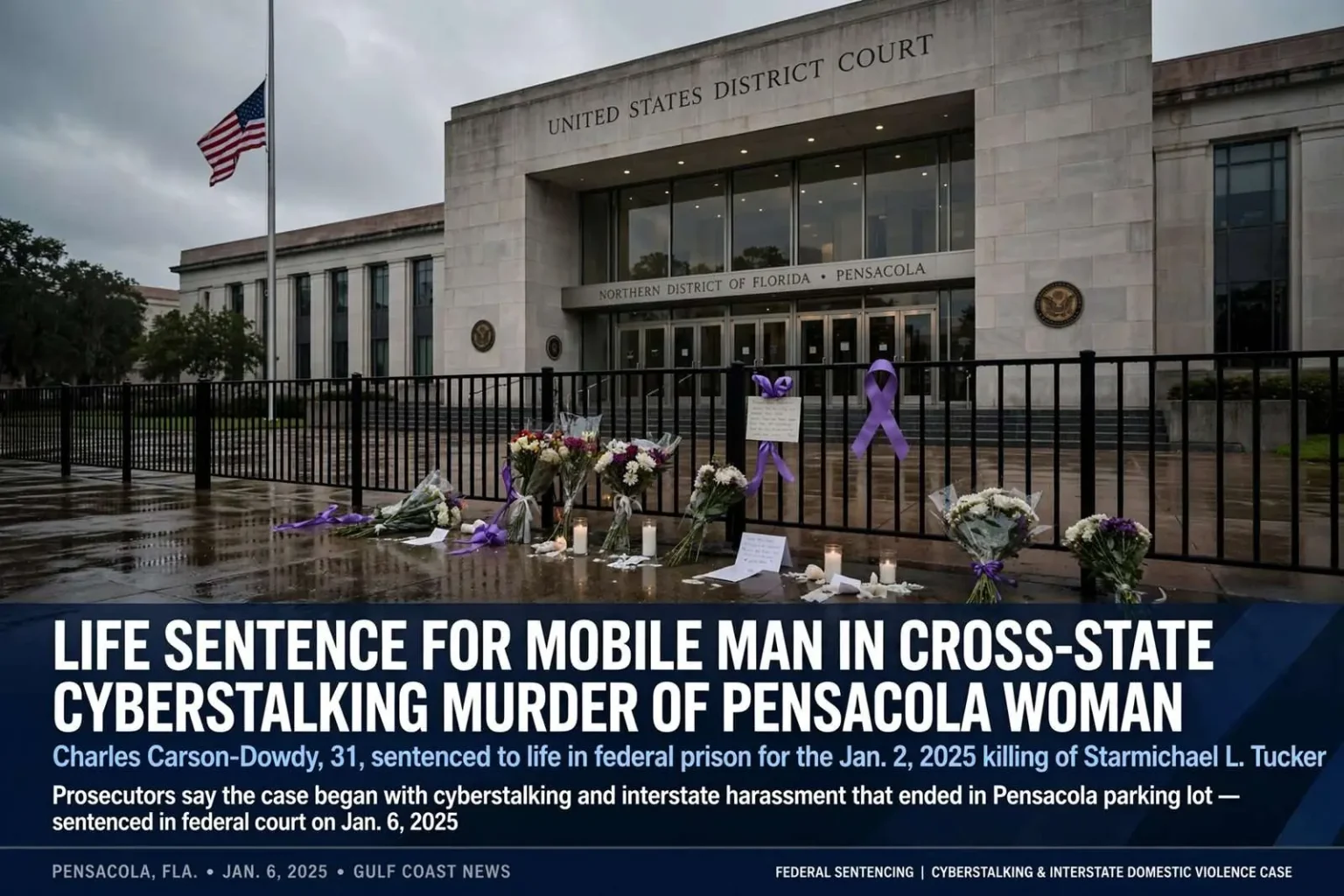
A 31-year-old Mobile man will spend the rest of his life in federal prison for the killing of a Pensacola woman — a case prosecutors said began with cyberstalking, crossed state lines and ended in a parking lot outside the victim’s apartment.
Charles Carson-Dowdy was sentenced in federal court to life imprisonment on convictions for cyberstalking, interstate domestic violence, murder through the use of a firearm, and possession of a firearm by a convicted felon in connection with the death of Starmichael L. Tucker in Pensacola in early 2025. The sentence closes one of the more closely watched federal cases involving cross-Gulf Coast violence in recent memory.
A Relationship That Turned Deadly
According to court documents, Carson-Dowdy and Tucker began dating around October 2024. Prosecutors said that during the relationship, he used cellular phones, the internet and a ridesharing service “to engage in a course of conduct with the intent to harass and intimidate” Tucker. The pattern of harassment escalated over the weeks that followed, with prosecutors contending it ultimately crossed from online threats into a plan to confront her in person.
In late December 2024, Tucker flew to California to visit family for the holidays. As she flew back to Florida on Jan. 1, 2025, the two exchanged a series of escalating text messages in which Tucker tried to end the relationship. Prosecutors said those messages — produced during discovery — were central to establishing the cyberstalking charge and the timeline leading up to the killing.
Prosecutors said Carson-Dowdy then hailed an Uber from Mobile to Tucker’s Pensacola residence to confront her — bringing a Taurus handgun and an extra loaded magazine despite being a convicted felon prohibited from possessing firearms or ammunition. The rideshare records were a key piece of evidence for the interstate domestic violence count, allowing prosecutors to track Carson-Dowdy’s movements from one state to another in the hours before the killing.
The Attack
Court documents say Carson-Dowdy entered Tucker’s home without her permission and waited inside. Around 8 p.m. on Jan. 2, 2025, as Tucker left her apartment, Carson-Dowdy followed her outside and shot her in the back, causing her to collapse in the parking lot. He then approached where she lay wounded and shot her about 10 more times at close range, prosecutors said.
He then got into Tucker’s vehicle and deliberately drove over her body, reversed and drove over her a second time, then drove forward and ran over her a third time before fleeing the complex in her vehicle. Tucker died from her injuries. The pattern — multiple close-range shots followed by use of the victim’s own car to further strike her — was central to the prosecution’s argument that the killing was deliberate and premeditated rather than the product of any sudden confrontation.
The Capture and Investigation
Law enforcement later located Carson-Dowdy in Tucker’s vehicle in Spanish Fort, Alabama, and took him into custody. The handgun used in the killing was found inside the car. The fact that the suspect was located so quickly across the bay, in Tucker’s own vehicle, helped prosecutors build a clean evidentiary chain from the shooting scene to the arrest in Spanish Fort.
The case was investigated jointly by the Bureau of Alcohol, Tobacco, Firearms and Explosives, the Escambia County Sheriff’s Office, the State Attorney’s Office and the Spanish Fort Police Department — a multi-agency effort that tracked the crime from a Florida apartment complex to a traffic stop on Alabama’s Eastern Shore. Each agency played a different role, from processing the Pensacola crime scene to canvassing for witnesses to tracking the victim’s phone and vehicle.
Federal prosecutors ultimately took the case because of the interstate nature of the conduct — the Uber ride from Mobile to Pensacola, the use of a firearm by a convicted felon, and the cyberstalking that crossed state lines. Federal charges often carry longer sentences than equivalent state charges and allowed prosecutors to seek the life sentence that was ultimately imposed.
Tucker’s family addressed the court at sentencing, describing the loss and asking for the maximum punishment available. The life sentence guarantees Carson-Dowdy will never be released from federal custody.
How Federal Charges Differ From State Charges
Federal charges often carry longer sentences than equivalent state charges because they are governed by the federal sentencing guidelines, which can stack additional time on top of the base offense level for use of a firearm. The murder-through-use-of-a-firearm count alone typically adds years to the underlying sentence, and a prior felony conviction disqualifies the defendant from claiming legal possession of any firearm. Life sentences in cases like Carson-Dowdy’s are not unusual when those enhancements combine with the underlying violence.
What It Means for the Families
Tucker’s family addressed the court at sentencing, asking for the maximum punishment and describing the loss of their daughter. Federal prosecutors said the life sentence reflects the seriousness of the conduct and the need to send a clear message that cross-state cyberstalking and gun violence will be prosecuted aggressively. For the broader Gulf Coast community, the case is a reminder that domestic violence does not stop at the state line, and that coordinated federal-state partnerships can produce accountability even when cases cross multiple jurisdictions.
How Domestic Violence Cases Are Tracked Across State Lines
Cases like Carson-Dowdy’s are not unusual in the federal system. The interstate domestic violence statute allows federal prosecutors to charge defendants who cross state lines to commit acts of violence, and the cyberstalking statute reaches conduct that begins online but ends in real-world harm. Together those tools give federal investigators the ability to pursue cases that might otherwise be split across multiple state courts, and they often produce sentences that are significantly longer than what state courts could impose.
How Survivor Advocacy Groups Have Responded
Domestic violence survivor advocacy organizations across the Gulf Coast said the Carson-Dowdy sentencing sends a clear message that cyberstalking and interstate firearm violence will not be treated lightly. Local crisis hotlines reported increased call volume in the days after the verdict, which advocates said is a common pattern following high-profile cases. The U.S. Attorney’s Office for the Northern District of Florida has worked closely with those organizations on outreach efforts in Pensacola, including public service announcements about how to report escalating online harassment before it turns violent.
How Local Law Enforcement Says It Responds to Similar Cases
Local law enforcement agencies across the Gulf Coast say they treat cyberstalking complaints seriously and have built relationships with federal partners to pursue cases that cross state lines. The Pensacola Police Department, Escambia County Sheriff’s Office and Spanish Fort Police Department all have investigators trained to recognize the patterns that lead to violence, and the multi-agency effort that led to Carson-Dowdy’s conviction has become a model for how similar cases should be handled in the future. Survivor advocates hope the visibility of the case encourages other victims to come forward earlier, before patterns of harassment escalate into violence.
Looking Ahead at Other Cases
Federal prosecutors have made clear that they intend to continue pursuing cross-state domestic violence and cyberstalking cases aggressively, both in Florida and across the Gulf Coast. The Carson-Dowdy case is likely to be cited in future charging decisions and in advocacy for additional resources dedicated to those kinds of cases. For survivors, advocates say, the most important takeaway is that reporting concerns early — even when they seem like online harassment rather than physical violence — can make the difference between intervention and tragedy.
What Survivor Advocates Want the Public to Know
Advocates say the most important thing for the public to understand is that escalation patterns like the ones in the Carson-Dowdy case are common, and that early intervention can save lives. Anyone experiencing escalating online harassment, repeated unwanted contact, or threats from a former partner is encouraged to contact local law enforcement, the National Domestic Violence Hotline, or a local advocacy organization. Reporting concerns early creates a record that can be used later if the conduct continues or escalates, and it puts would-be offenders on notice that their behavior is being watched.
How the Case Will Be Cited in Training
Federal law enforcement agencies that handle domestic violence and cyberstalking cases often incorporate recent convictions into their training programs. The Carson-Dowdy case is likely to be cited in future training sessions as an example of how coordinated multi-agency investigations can successfully prosecute cases that cross state lines, and how early reporting by victims and their families can help build the kind of evidence that supports federal charges and substantial sentences.
Why the Sentence Matters for the Broader Community
Life sentences for cyberstalking that escalates into murder send a strong deterrent signal, federal prosecutors have argued. They say the message is that the federal system will pursue those cases aggressively when state-level charges may not fully capture the interstate nature of the conduct or the prior-felony enhancements available under federal firearms law. Survivor advocacy groups have echoed that message, and several have said they expect the Carson-Dowdy case to become a reference point for future investigations and prosecutions along the Gulf Coast and beyond.


