Spanish Fort High Students Stage Peaceful Demonstration After Racist Rap Circulates
Spanish Fort High students held a peaceful demonstration against an explicit, racist rap made by a classmate that circulated widely online.
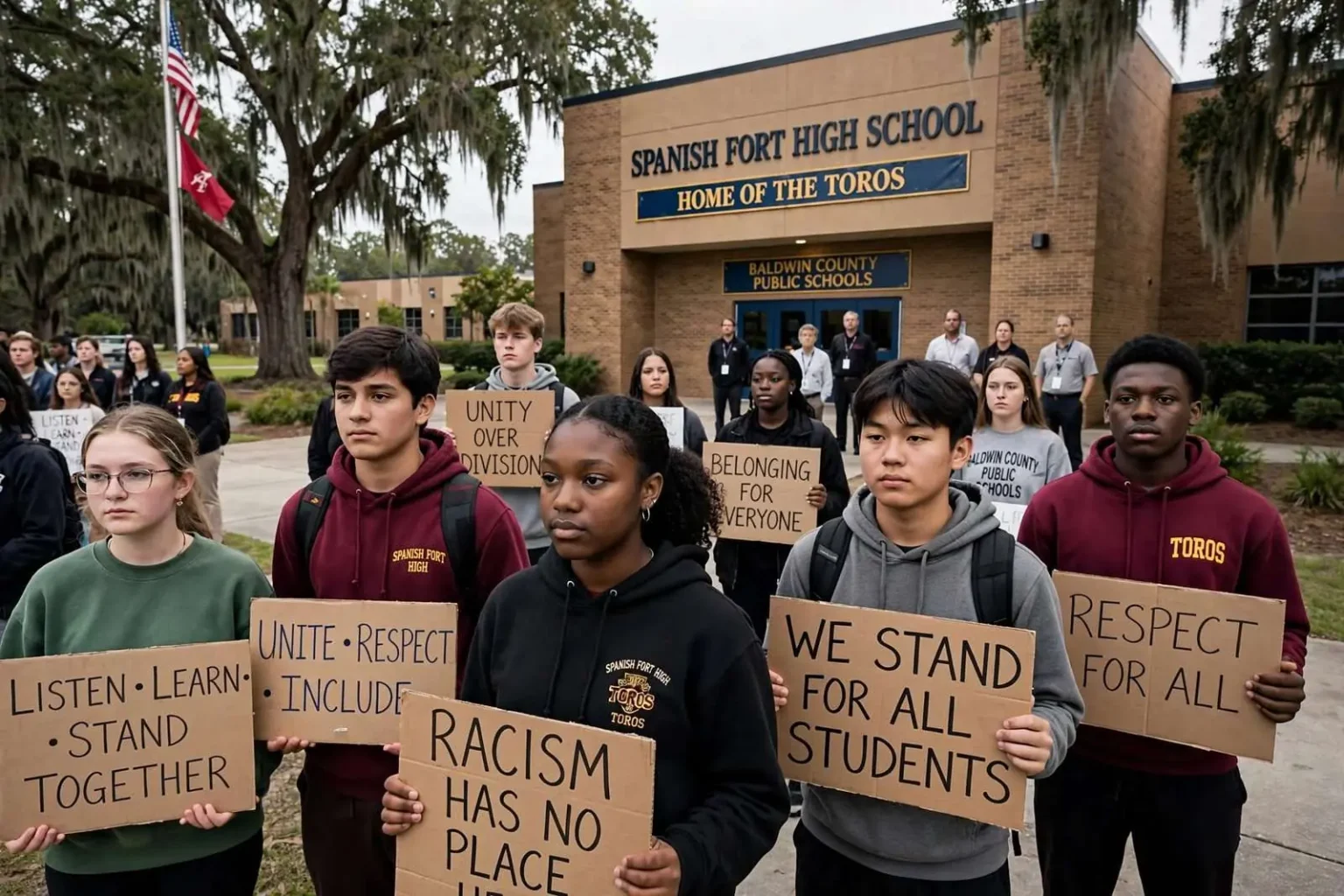
Students at Spanish Fort High School staged a peaceful demonstration after a racist rap recording circulated among the school community, turning a disturbing incident into a public statement about the values students expect their school to uphold. The demonstration drew attention to questions of racism, student expression, and school climate in one of Baldwin County’s fastest-growing communities. Students who took part described their goal in general terms as making clear that racism has no place at their school, and the decision to demonstrate peacefully rather than disrupt classes shaped how the event was received by administrators and the broader community.
Spanish Fort sits on the eastern shore of Mobile Bay, just across the bay from Mobile, and its high school serves students from a suburban city that has grown rapidly over the past two decades. The school is part of the Baldwin County Public Schools system, one of the largest districts in Alabama, spanning a county that stretches from Mobile Bay to the Florida line. In a school community of that scale, incidents involving racist content travel quickly among students through social media and group chats, and the circulation of a racist rap recording touched off conversations that extended well beyond the students who first encountered it.
The demonstration itself followed a pattern familiar from school communities across the country when racist incidents surface. Rather than walk out or skip class, students assembled in a manner that communicated their message while remaining within the bounds of peaceful assembly. The discipline of the event mattered. Administrators and teachers watched a student body express genuine anger and hurt without vandalism, confrontation, or disruption to the school day, and the peaceful character of the protest became part of the story in its own right, demonstrating the civic maturity of the students involved even as it highlighted the seriousness of what prompted them to act.
How the School Community Responded
Incidents involving racist content place school leaders in a difficult position. Administrators must address the specific conduct involved, follow district policy and applicable law, communicate with families, and reassure the students most affected, all while managing the churn of rumors and screenshots that circulate online. In Baldwin County, school system officials have generally handled such matters by investigating the source of the content, applying the student code of conduct where appropriate, and issuing statements condemning racism without necessarily publicizing the discipline of individual students, which privacy rules generally prevent them from discussing.
The students who organized the demonstration in Spanish Fort pushed the conversation beyond discipline alone. Their message centered on school climate: the feeling of belonging that students of color experience day to day, the way racist content spreads among peers, and the responsibility adults in the building have to address both. Peaceful demonstrations of this kind typically call for more than punishment after the fact. They ask schools to teach honestly about the history behind racist language, to make reporting mechanisms clear and trusted, and to follow through visibly when incidents occur, so that students believe raising concerns leads to action.
Teachers and staff play a central role in how such moments resolve. A demonstration that occurs during the school day puts adults in the position of deciding how to respond to students exercising First Amendment-protected expression in a setting where schools may regulate time, place, and manner but may not suppress the message itself. In communities like Spanish Fort, educators often use these moments as teaching opportunities, opening classroom discussions about the history of racist speech, the civil rights movement’s legacy in Alabama, and the difference between peaceful protest and disruption. How those conversations go can shape whether an incident becomes a turning point or a wound that quietly festers.
The Setting: Spanish Fort and Baldwin County
Understanding the demonstration requires understanding the community where it happened. Spanish Fort grew from a small town into a major suburb of the Mobile metropolitan area in the span of a generation, with new neighborhoods, retail centers, and schools built to serve families drawn to Baldwin County’s growth. The city’s name recalls its role in the American Civil War, when the Battle of Spanish Fort in the spring of 1865 was among the last major actions of the conflict. The community now presents itself as a family-oriented suburb, and its high school serves as a gathering point for that identity, filling its stadium on Friday nights and its gymnasiums through the winter.
Baldwin County as a whole has become one of Alabama’s fastest-growing counties, and its school system has grown with it, building new campuses and expanding existing ones to keep pace. Growth of that kind brings together families from many backgrounds, including families relocating from other states and long-established local families, and it creates the demographic mixing that can make questions of race and belonging more visible than they were in a smaller, more homogeneous community. Schools sit at the center of that experience, because they are the institutions where the community’s children spend their days and where its values are most publicly tested.
Incidents involving racist content are not unique to any one school or region, and school systems across Alabama and the country have confronted similar episodes in recent years, often amplified by the speed of social media. What varies is the response. In some communities, racist incidents pass with little acknowledgment; in others, students and families insist on a public reckoning. The decision by Spanish Fort students to demonstrate peacefully placed their school in the second category, and it reflected a student generation that has grown up documenting injustice, sharing it instantly, and expecting institutions to respond.
Student Voice and the Limits of School Authority
The legal backdrop to student demonstrations in public schools is well established. Since the landmark Supreme Court decision in Tinker v. Des Moines in 1969, students in public schools have not surrendered their First Amendment rights at the schoolhouse gate, and schools may restrict student speech only when it materially and substantially disrupts the educational environment. Peaceful demonstrations that do not disrupt classes or endanger anyone fall on the protected side of that line, and administrators who suppress them risk transforming a student protest into a larger controversy about rights and authority.
That framework shaped the options available to school leaders in Spanish Fort. A demonstration held on school grounds before or after class, or during non-instructional time, could be accommodated without conceding order, and doing so often de-escalates the situation. Administrators who meet with student organizers, listen to their concerns, and explain the district’s response to the underlying incident generally find that the demonstration serves as a release valve rather than an escalation. The alternative, treating peaceful student expression as a discipline problem, tends to widen the gap between students and the institution they are addressing.
Parents and families on both sides of the incident watched closely as it unfolded. Families of students targeted by racist content look for assurance that the school takes their children’s safety and dignity seriously, and families of students accused of creating or sharing the content expect due process and proportionate consequences. A peaceful demonstration compresses those tensions into a single visible moment, and how school leaders communicate in the days that follow, with clear statements about values and process, often determines whether the community comes through the episode with confidence in its school or with divisions that outlast the news cycle.
What happens in the weeks after such an incident matters as much as the demonstration itself. School communities that emerge stronger from episodes of this kind tend to combine concrete follow-through with honest conversation. That can mean anti-bias training for staff and students, revised reporting procedures, student-led clubs that build cross-cultural relationships, classroom discussions tied to the curriculum, and visible consequences when the code of conduct is violated. None of these steps happens automatically, and each depends on administrators, teachers, students, and families treating the demonstration not as an inconvenience to be managed but as a message to be answered.
For the students of Spanish Fort High, the demonstration offered a lesson in civic participation that no classroom exercise fully replicates. Organizing a peaceful protest requires coordination, communication with school officials, discipline among participants, and clarity about the message being sent. Students who take part learn how public opinion forms, how institutions respond to pressure, and how much restraint mature protest requires. Those lessons reflect the very purposes public education is supposed to serve, preparing young people to engage with their communities and to hold them accountable through lawful, constructive means.
The broader Baldwin County community also had a stake in how the episode was handled. Employers considering the area, families deciding where to move, and neighbors who send their children to the city’s schools all draw conclusions from the way a community responds when racism surfaces. A school that addresses a racist incident directly, and students who protest it peacefully, together tell a story about local values that reaches beyond the schoolhouse. Communities along the Eastern Shore of Mobile Bay have invested heavily in their schools as the foundation of their growth, and protecting the climate inside those schools is part of protecting everything built around them.
Racism, Social Media, and the Modern School Day
The speed with which the racist rap spread among students illustrates the changed environment schools operate in. A recording that once might have passed among a handful of classmates now moves through group messages and social platforms within hours, reaching students who never would have encountered it and inviting commentary, mockery, or defense in public view. By the time adults in the building become aware of such content, the student community has often already reacted to it, and administrators are responding not to a private incident but to a public event within the school’s social world.
Social media also changes the calculus for students deciding whether to speak up. A racist incident documented and shared online can be challenged publicly by the same channels, and demonstrations organized through group chats can assemble in a day. Students in Spanish Fort used the tools available to them to move from private anger to public statement quickly. School leaders who understand this dynamic respond faster than they might have a generation ago, because the window between an incident and a community-wide reaction has collapsed, and silence is read by students as indifference.
At the same time, the permanence of digital content raises the stakes for everyone involved. Content shared online does not disappear when a school’s investigation concludes, and students implicated in racist incidents carry the record with them. Educators and parents have grappled with how to teach young people that a few seconds of content can follow them for years, and how to balance accountability with the reality that teenagers make serious mistakes they may outgrow. These questions hang over every school that confronts an incident like the one in Spanish Fort, and there are no simple answers that satisfy all the families involved.
The peaceful demonstration at Spanish Fort High School ultimately stood as a statement about what students expect from their school and from one another. It transformed a racist recording, intended or used to demean, into a community conversation about respect and belonging, and it did so through means that honored the rights and dignity of everyone involved. The test that follows is whether the commitments expressed during the demonstration take root in the daily life of the school. For the students who organized it, the answer to that test is not in their hands alone, but their willingness to stand up peacefully made clear that they intend to keep watching, and to keep expecting better.