City Answers Annexation Suit Within Hours: ‘That’s Why You Have an Election’
Mobile's attorneys sought summary judgment the same day a lawsuit challenged the Sept. 18 annexation vote, arguing the four areas reflect real neighborhoods and that courts should not second-guess an elected council.
Attorneys for the city of Mobile moved immediately against a lawsuit challenging its Sept. 18 west Mobile annexation election, filing for summary judgment on the same day the suit was brought and arguing that the challenge had no merit.
The suit, filed earlier that Tuesday by three residents of the proposed annexation areas, contended that the city had divided the territory “arbitrarily and capriciously,” identifying pro-annexation voters and drawing a map that guaranteed capture of the tax-rich Schillinger Road corridor while encircling nearby areas that would eventually have no choice but to join the city.
The speed of the city’s response was the story within the story. Annexation suits in Mobile County had a history of stretching toward the Election Day they sought to block, and the city’s legal team wanted no part of a schedule that left the question hanging. By filing for summary judgment within hours, the city asked the court to end the challenge before it could delay or disturb the vote set for the following week.
At stake was the future of roughly 4,000 residents in four distinct areas of west Mobile, and a tax question with a price tag in the tens of millions of dollars.
The city’s legal standard
City Attorney Larry Wettermark said the question before the court was narrow. The legal test, he said, was whether the annexation proposal was “fairly debatable.” If it was — if it was not clearly unreasonable — a court would not substitute its own judgment for that of an elected body, in this case a City Council that had declared the annexation to be in the “public good.”
“There have been any number of annexation court challenges and the courts have established two things: one is the doctrine of judicial restraint, that the court will not substitute its judgment for that of an elected body unless the matter is so unreasonable that it is not fairly debatable,” Wettermark said. “If it is fairly debatable, that’s the end of the game. You respect the decision and the court has no business coming in and interfering with this election.”
The “fairly debatable” standard, drawn from decades of annexation litigation across the country, gives municipalities wide room to design annexations and leaves courts to intervene only in cases of clear unreasonableness. Wettermark’s point was that the plaintiffs’ argument — whatever its political merits — aimed at a target the law had effectively closed off. The city’s contention was that the boundaries were a legislative judgment, not a question for the judiciary to redraw.
The city’s motion for summary judgment included an affidavit from Jones and extensive supporting documentation, Wettermark said. Summary judgment, if granted, would end the case without trial, and with the election a week away, the timing was the point: the city wanted the lawsuit resolved or the election held, not both put on hold.
Four neighborhoods, four decisions
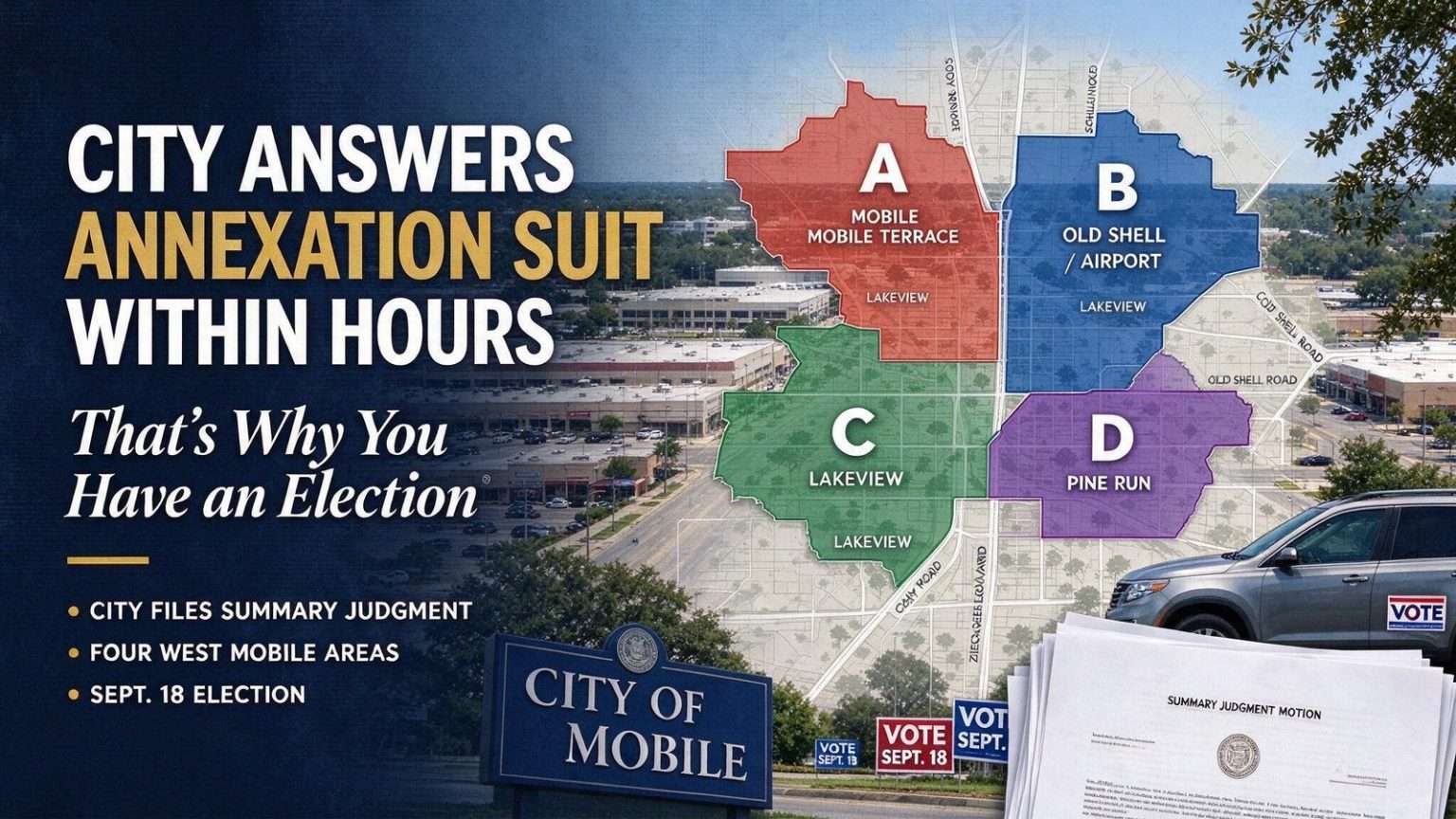
Mayor Sam Jones rejected the claim that the areas had been carved for political advantage, describing them instead as coherent, established communities. In addition to the commercial strip along Schillinger Road, the city said, Area A was primarily the Mobile Terrace community; Area B was generally the territory between Old Shell Road and Airport Boulevard; Area C was the Lakeview neighborhood; and Area D was principally Pine Run.
“First of all this (the lawsuit) appears to be an attempt to keep the people in each community from voting to make its own decision,” Jones said. “I don’t see any basis for it other than that, an effort to prevent their right of voting and making the decision on their own behalf. If every one of the areas A through D makes its own decision, no one is cut out or brought in against its will. There is no gerrymandering. It’s letting neighborhoods vote for themselves.”
Four distinct neighborhoods, he said, were each being given the chance to decide their future “without voters in other neighborhoods influencing the outcome of their decision.”
The four-area structure was the heart of the city’s defense. By breaking the annexation into separate, self-contained neighborhoods, the city could argue that each had its own identity and its own choice, and that no resident was being annexed by someone else’s majority. The plaintiffs read the same map the opposite way: as a gerrymander in which the boundaries followed anticipated votes rather than community lines.
West Mobile’s annexation politics had been building for years. The unincorporated stretches along Schillinger Road and the surrounding corridors sat inside the city’s police jurisdiction, receiving city services and city policing while paying county taxes, and successive administrations had looked at the growing tax base there as the natural next step in the city’s expansion. Residents, meanwhile, were split between those who wanted the city services and city representation and those who preferred lower tax rates and county government.
The lawsuit’s three plaintiffs spoke for the latter camp, and their complaint named the prize directly: the Schillinger Road commercial corridor, with its retail strips and sales tax base, was the annexation’s real objective, and the surrounding residential areas were there for cover, or so the suit argued.
Predicting the vote
The lawsuit asserted that the city knew Areas B and C would likely vote no and had included them only to “cloak” the election with a “robe of legitimacy.” Jones dismissed the reasoning.
“They (the plaintiffs) make all sorts of assumptions about how people are going to vote,” the mayor said. “That’s why you have an election: to see how people vote and let them make their choice.”
He disputed as flatly untrue any suggestion that the city had campaigned less vigorously in some areas than others. “We have put forth an equal effort in each of the four areas. We’ve worked all four areas and we are continuing to work them. We want all four of them to be part of the city. If they say yes or no, it’s up to the voters there, not us. We want them to have the right to vote.”
The mayor’s framing turned the plaintiffs’ argument inside out. Where the suit saw manipulation, Jones saw enfranchisement — residents who would get a vote they would never have if annexation died in court. The “that’s why you have an election” line became the administration’s answer to nearly every objection raised in the suit’s final week: predictions about votes, the mayor argued, were the plaintiffs’ business, not the city’s, and the ballot was the place to test them.
What was at stake
The four areas lay in a corridor between Cody Road and a line just west of Schillinger Road, from Hitt Road north to Ziegler Boulevard, and together held roughly 4,000 residents and nearly 1,900 voters.
Annexation of Area A alone would boost city sales tax collections by more than $10 million a year, almost entirely from the Schillinger Road businesses attached to the largely residential Mobile Terrace.
The numbers explain the intensity on both sides. A $10 million annual addition to city sales tax receipts — recurring, year after year, from a single corridor — was transformative money in municipal budget terms, and it flowed from a stretch of commercial property that had grown up on county roads with county services. Opponents in the residential areas asked what, exactly, they were voting to give away: city property tax on top of county tax, in exchange for services many felt they already received from the city’s police jurisdiction.
The case had been assigned to Mobile County Circuit Judge Rick Stout, and no hearing had yet been set — leaving both sides with a single week before voters were scheduled to go to the polls.
That week compressed everything. The plaintiffs needed a hearing and a ruling before Sept. 18; the city needed the opposite. The summary judgment motion filed the same day as the suit put the choice before Judge Stout in the starkest available form, and the election calendar ran regardless.
However the court ruled, the west Mobile annexation fight had become a referendum on how Mobile grows: one parcel, one corridor, one neighborhood at a time — and who gets to decide.
The long history of west Mobile annexation
The Sept. 18 election did not arrive out of nowhere. Mobile’s westward expansion had been debated at City Hall for decades, with waves of annexation pulling subdivisions along Airport Boulevard, Cottage Hill Road and Old Shell Road into the city as growth pushed past the interstate. Each round followed the same pattern: the city offered services, residents weighed taxes, and the map of the city crept further west.
The Schillinger Road corridor sat at the current edge of that expansion. Long a rural crossroads in the unincorporated county, the area had filled in with retail and residential growth that made it one of the busiest commercial strips outside the city limits, and that growth was the engine behind the annexation push — and behind the resistance to it.
Police jurisdiction rules meant city officers already patrolled much of the corridor, and city planning and building codes already shaped what could be built there. Annexation would formalize the relationship and add the tax base to the city’s ledger; a vote against would leave the area’s fiscal future with the county, whose commission had no power to stop the city from returning with another map.
That dynamic — the city can try again, the county cannot refuse — is what gave the plaintiffs’ “encirclement” argument its force with annexation skeptics across west Mobile, and it is why the outcome of the four separate votes was watched well beyond the corridor itself.
What happens next
With the suit pending and the election calendar fixed, the practical questions multiplied. If Judge Stout declined to act before Sept. 18, the votes would be counted while the challenge remained alive, and a close outcome in any area could leave the result in legal limbo. If he granted the city’s motion, the election would proceed on schedule with the court fight over; if he denied it, the plaintiffs would press toward trial on their gerrymandering claims.
City officials projected confidence in public, pointing to the case law Wettermark cited and to the affidavit the mayor had supplied in support of the city’s motion. The plaintiffs’ counsel argued the opposite, insisting that the boundaries’ arithmetic — pro-annexation voters here, resistant neighborhoods there — was a factual question a court should weigh, not wave away.
Either way, the week before the vote belonged to the campaigners. Civic associations in Mobile Terrace, Lakeview and Pine Run scheduled last forums; annexation supporters and opponents blanketed the corridors with signs; and the city’s message stayed on script: every neighborhood gets its own vote, and no one is annexed against its will.
The larger stakes were municipal. Mobile’s budget, its bond ratings and its long-term plans for western infrastructure all leaned on the assumption that the growing corridors outside its lines would eventually be brought inside them. The four ballots set for Sept. 18 were the next step in that assumption — and the lawsuit was the first real test of whether the city’s method of taking it would survive a courtroom challenge.