Alabama Appeals Court Reverses Ruling That Would Have Reinstated Fired Mobile Officer
The Alabama Court of Civil Appeals has sided with the city of Mobile in a two-year fight over a fired police officer's due process claims, reversing a lower court order that would have reinstated him with back pay.
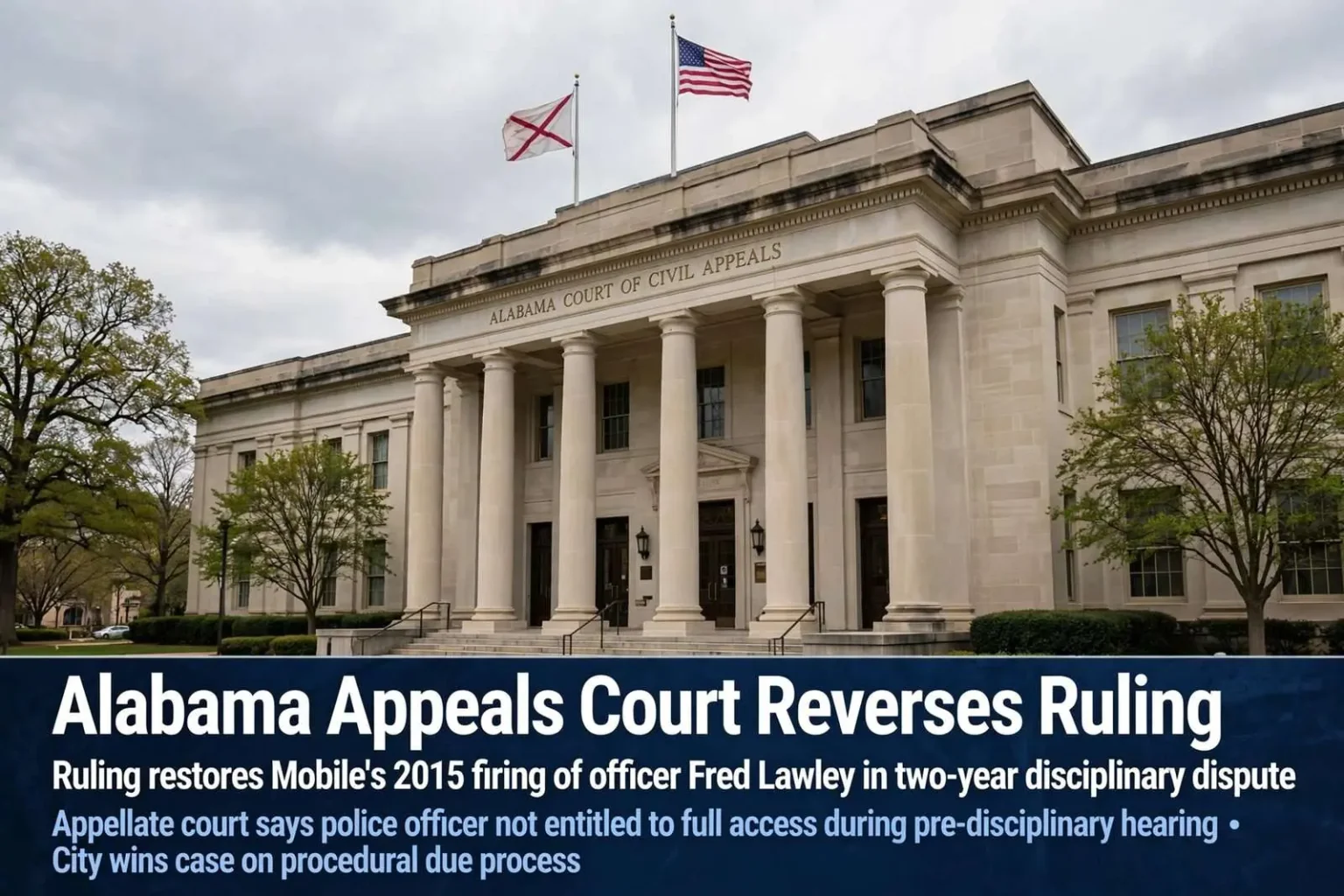
A two-year legal battle over the firing of a Mobile police officer has taken a decisive turn in the city’s favor, after the Alabama Court of Civil Appeals reversed a lower court ruling that had ordered the officer reinstated with back pay. The March decision restores the city’s original discipline and hands Mobile a victory in a case that turned on a question every public employer in Alabama faces: how much access an employee must be given to the evidence against him during the pre-disciplinary process.
The case centers on former Mobile Police Department officer Fred Lawley, who was fired in 2015 after an internal trial board determined he had committed four “major violations” while on duty. Investigators alleged Lawley removed $2,050 in cash from a safe at a convenience store while responding to a burglary call, and that he was later deceptive about the incident during a polygraph examination administered as part of the department’s internal review. The allegations combined a serious integrity offense with a separate finding of dishonesty during the investigation itself — the two grounds departments weigh most heavily in officer terminations.
A Mobile County grand jury subsequently indicted Lawley on a charge of theft of property, though that criminal case has proceeded on a separate track and has not been a factor in the employment dispute that followed. Criminal charges and employment discipline run on parallel paths in Alabama public employment: the personnel board decides whether the employee’s conduct justifies firing under the merit system rules, while the criminal case proceeds independently with its own standard of proof and its own timetable.
The Personnel Board Reversed the Firing
Lawley challenged his termination before the Mobile County Personnel Board, the agency that oversees hiring, firing and disciplinary matters for merit system employees across much of the county, including many City of Mobile positions. The board exists to insulate merit employees from political discipline: it conducts hearings, applies the personnel rules, and can overturn terminations it finds procedurally defective or unsupported. In 2016, the board overturned the firing, finding that the MPD had violated both Lawley’s due process rights and the board’s own procedural rules by barring him from the room while testimony against him was presented at his pre-disciplinary hearing.
The board’s finding rested on the structure of the pre-disciplinary hearing — the stage where an employee hears the department’s evidence before a final discipline decision. By excluding Lawley while witnesses testified against him, MPD effectively conducted part of the hearing in his absence. The board ruled that violated his due process and the board’s procedures, and it ordered the department to reinstate him with back pay.
Mobile County Circuit Judge Jay York upheld the personnel board’s decision on appeal, and the MPD was ordered to reinstate Lawley to his former position with back pay. At that point the city faced a choice between accepting the reinstatement of an officer it had fired for integrity violations or carrying the fight upward. It appealed.
The Appeals Court Reverses
The city of Mobile then appealed that ruling to the Alabama Court of Civil Appeals, which sided with the city in March, reversing Judge York’s order. At issue was how much access an employee is entitled to during the pre-disciplinary process. The city has argued that employees aren’t entitled to anything beyond what is explicitly spelled out in the applicable rule: a hearing, at least 24 hours’ notice of the charges, the opportunity to respond, and a decision based on the record. The appellate court agreed with that reading, holding that the exclusion from portions of the hearing did not invalidate the discipline where the rule’s stated requirements were met.
The reversal is significant for how Alabama cities and counties run their internal disciplinary systems. Personnel boards and departments had been operating under the uncertainty created by the board’s 2016 ruling, which suggested that anything short of full employee access at every stage could void a termination. The appeals court’s decision draws the line differently: the rule defines the process, and the process defines the rights. If an employee receives the notice, the hearing and the opportunity to respond that the rule guarantees, the discipline stands even if the mechanics of the hearing were imperfect.
What the Case Means for Public Employers
For the Mobile Police Department, the ruling means the 2015 termination stands and Lawley remains off the force, notwithstanding the board’s earlier order. The department can point to the decision as validation of its internal trial board process, which it uses for the most serious officer discipline. Trial boards — panels of senior officers who hear evidence and recommend discipline — are the police version of the internal tribunals many Alabama agencies use, and the decision confirms their hearings need not mirror a courtroom to be valid.
For other merit employers across Mobile County, the case settles a recurring procedural dispute. Cities, the county and school systems all employ workers covered by the personnel board, and all of them have faced arguments that hearing mechanics — who sits in the room, when, and for what testimony — should undo otherwise well-founded discipline. The appellate court’s answer narrows that argument considerably: procedural rights are what the rule says they are, no more and no less.
The Parallel Criminal Case
Lawley’s criminal case remains separate. The grand jury’s theft indictment proceeds under the ordinary criminal timetable, and its outcome will not retroactively change the employment result: whether he is convicted, acquitted, or the charge is dropped, the appellate court’s reinstatement of the firing is now the law of this case. The separation matters because the two systems ask different questions — the criminal court asks whether the conduct was proven beyond a reasonable doubt, while the personnel system asks only whether the department’s disciplinary decision followed the rules and had support in the record.
The two-year arc of the case — termination in 2015, board reversal in 2016, circuit court affirmance, and appellate reversal in March — shows how long these disputes run and why the appellate answer matters. A single officer’s firing consumed half a decade of administrative hearings, a circuit court appeal and an appellate decision, costs that every Alabama public employer bears in similar fights.
Why Integrity Cases Get Such Weight
Police departments treat dishonesty as among the most serious offenses an officer can commit, and the Lawley case illustrates why. An officer accused of taking cash during a call faces one problem; an officer found deceptive during the investigation compounds it, because every statement he makes afterward becomes suspect. Departments across the country place officers found dishonest on lists that prosecutors consult before calling them as witnesses, effectively ending their usefulness in court even if they keep their jobs. For a department like MPD, where officers testify daily in state and federal courts, an integrity finding typically ends the career.
That is the backdrop against which the city fought the reinstatement order for two years. Reinstating an officer with a sustained integrity violation and a pending theft indictment would have returned him to duty with a clouded credibility record. The city’s litigation position — that the process followed the rule, and that the rule governs — let it defend both the discipline and the principle without relitigating the underlying facts.
The Personnel Board’s Ongoing Role
The decision does not diminish the personnel board’s role; it defines its limits. The board remains the forum where merit employees contest terminations, and it will continue to hear cases involving Mobile police officers, city workers and county employees. What changes is the standard applied to procedural challenges: boards and reviewing courts will now look first to the text of the applicable rule rather than to general notions of fairness that might expand an employee’s rights beyond what the rule provides.
Employees, meanwhile, retain the protections the rules give them — notice, a hearing, an opportunity to respond and a decision on the record. The practical effect is to shift the fight in future cases from process details to the substance of the discipline itself, where boards have always had the power to reduce or overturn penalties they find excessive.
A Win With Longer Reach
For Mobile, the appellate victory does more than settle one officer’s fate. It gives the city a published appellate precedent it can cite the next time a terminated employee argues that a hearing’s mechanics voided the discipline. The city’s personnel and legal staff spent two years litigating the question, and the resulting decision now protects the department’s internal process for every future case.
For the broader Alabama public employment system, the case is a reminder that the rights of merit employees are written in the rules, and the courts will enforce those rules as written. Employers that follow them can defend their discipline; employees denied what the rules promise can still win. The line between the two is now clearer in Mobile County than it has been at any point since the dispute began in 2015.