Bentley Launches New Work Group to Tackle Coastal Alabama’s Soaring Insurance Costs
Gov. Robert Bentley has created a 17-member Coastal Insurance Work Group, weighted with Mobile and Baldwin county residents, to recommend fixes for coastal Alabama's high wind and homeowners insurance premiums by year's end.
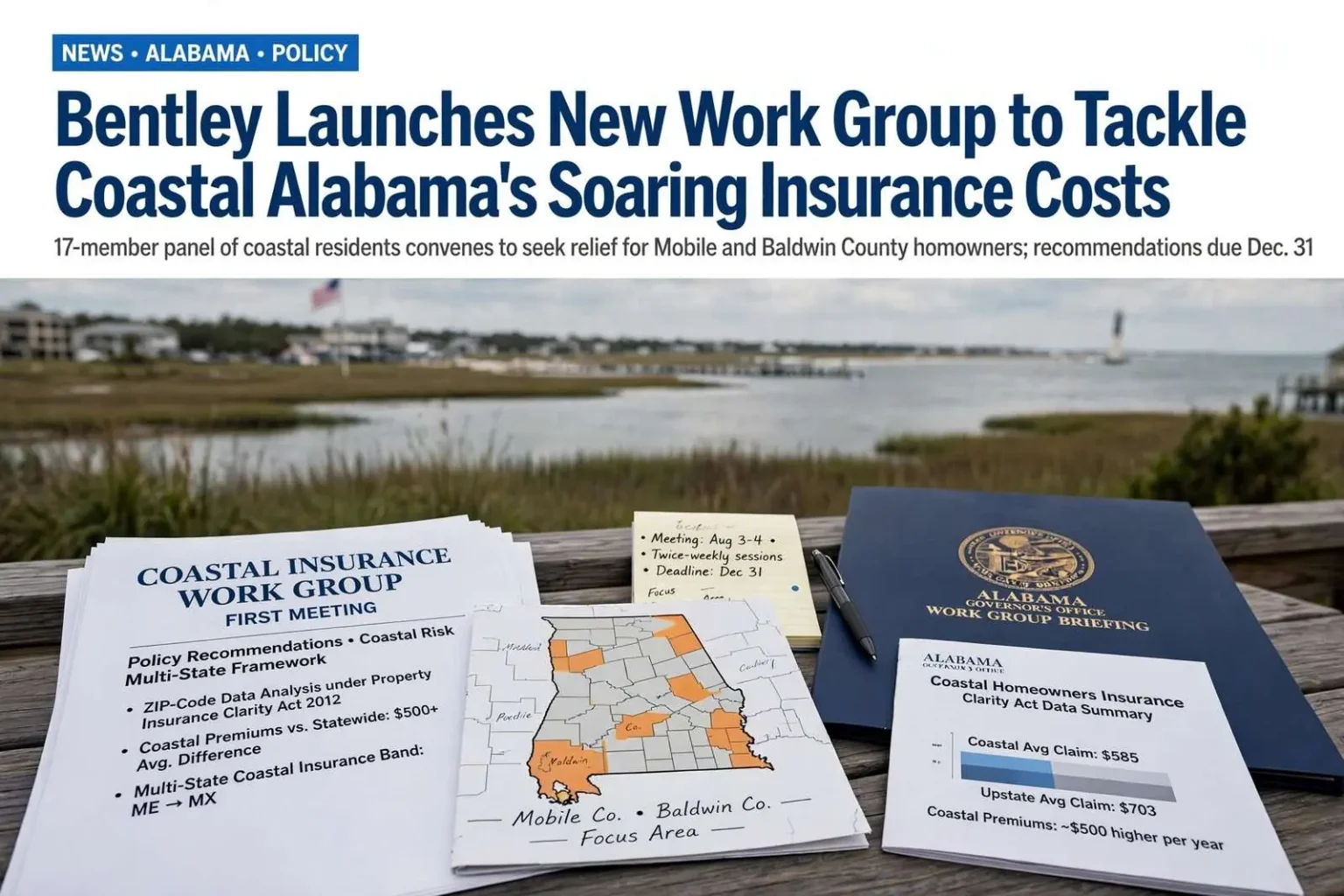
Gov. Robert Bentley has formed a new panel charged with finding relief for coastal Alabama homeowners who have spent years paying some of the highest wind and property insurance premiums in the country. In a letter dated June 19 to State Sen. Trip Pittman and State Rep. Joe Faust, Bentley announced the creation of the Coastal Insurance Work Group, directing its 17 members to develop concrete policy recommendations by Dec. 31. Unlike earlier state committees convened to study the same problem, the new group is stacked with representatives from the coast itself.
Thirteen of its 17 members live in Mobile or Baldwin counties, including Pittman, Faust, State Sen. Bill Hightower and Fairhope City Councilman Jack Burrell. Also seated on the panel are Alabama Center for Insurance Information and Research Director Dr. Lars Powell, insurance industry representative Steve Simpkins, Bentley spokesperson Suzanna Willis, Alabama Department of Insurance Deputy Commissioner Charles Angell, attorney Beth Lyons and Rev. Jerry Bergman.
Rounding out the group are several members of the Hurricane Homeowners Insurance Initiative, a grassroots advocacy organization that has pushed for insurance reform on the coast for years: Michelle Kurtz, Dan Hanson, Earl Janssen, Jerry Doughty, A.C. Leggett, Cathy Odom and Charles Kettell.
Bentley's letter instructs the work group to focus on policy options, regulatory guidelines and the possibility of a multi-state framework for spreading coastal insurance risk, while steering clear of hazard mitigation and public education campaigns — approaches that dominated the recommendations of previous state panels but that advocates say never addressed the underlying cost disparity.
The new group traces its roots to a March 18 meeting in which Hurricane Homeowners Insurance Initiative members, Mobile and Baldwin county legislators, Baldwin County Commission representatives and city officials met with the governor's staff and the Department of Insurance to press for what they described as fair property insurance premiums, deductibles and availability statewide.
Much of that argument rests on data collected under the Property Insurance Clarity Act of 2012, which the Hurricane Homeowners Insurance Initiative helped write.
The law requires insurance companies licensed in Alabama to report, by ZIP code, how many policies they write, how much they collect in premiums and how much they pay out in losses. The first year of data, analyzed by the group's Earl Janssen, found that coastal homeowners filed an average of $585 in damage claims annually, compared with $703 upstate — even though coastal residents paid, on average, roughly $500 more per policy each year over the preceding decade.
Charles Kettell, a Spanish Fort resident and longtime Hurricane Homeowners Insurance Initiative volunteer, said the makeup of the new work group sets it apart from past efforts. "This is the first time a coastal homeowners insurance work group has comprised a majority of coastal residents," he said, describing the panel as "intellectually honest and capable."
Michelle Kurtz, who lobbied for the creation of a new work group after previous state committees stalled out on recommendations limited to home mitigation grants and catastrophic savings accounts, said those earlier fixes never touched the core inequity the Clarity Act data revealed.
"Mitigation is wonderful and needs to be done, but if your budget is already tight you don't have money for it," she said.
Kurtz also said past panels, including the Affordable Homeowners Insurance Commission, met only once a month, a pace advocates felt slowed progress.
Under Bentley's letter, Pittman has been tasked with scheduling the group's first meeting, and organizers hope the panel will convene for the first time Aug. 3 and 4, followed by twice-weekly, six-hour sessions running through the end of the year.
Ahead of those meetings, Hurricane Homeowners Insurance Initiative members and others on the panel plan to hash out shared definitions of risk and insurance to build consensus before substantive negotiations begin.
Dan Hanson, another Hurricane Homeowners Insurance Initiative representative on the work group, said members will likely weigh two broad paths toward relief. The first is a proposed multi-state coastal insurance band stretching from Maine to Mexico and reaching as far as 70 miles inland, an approach meant to spread hurricane risk — and its costs — across a much larger pool of policyholders.
The second option would use the Clarity Act's ZIP-code-level data to push for a law requiring insurers to charge the same premium for comparably valued homes anywhere in the state, and requiring any company that sells homeowners coverage in one part of Alabama to offer the same policies in coastal counties. "If our losses are no higher than the rest of the state, then our premiums shouldn't be higher," Hanson said. "The two big ideas are multi-state and 'equality' laws, then each one has multiple ideas within. I hope we work on multi-state first, because we believe it has potential. Conversations about 'equality' regulations will likely be more contentious."
Kettell said the multi-state coastal band would not require every Gulf and Atlantic coastal state to sign on to get off the ground — buy-in from just three or four additional states, he said, could be enough to make the model work.
He also pointed to a lesser-known wrinkle in the insurance market that he said complicates any fix: the state's insurers fall into three categories. Some are based in Alabama, while national carriers such as Allstate and State Farm are licensed and regulated directly by the Alabama Department of Insurance.
A third category — non-admitted companies — operate largely outside that regulatory oversight. Non-admitted insurers pay higher state sales taxes but can leave policyholders more exposed if the company becomes insolvent, Kettell said, and their business isn't captured in the Clarity Act's reporting requirements because the Department of Insurance doesn't regulate them. The Hurricane Homeowners Insurance Initiative estimates that 20 percent to 30 percent of Mobile and Baldwin county homeowners now rely on non-admitted carriers for coverage.
"A lot of the mainline companies have dropped or limited coverages in Mobile and Baldwin counties and the non-admitted companies came in to fill that void," Kettell said.
For Kurtz, the stakes go well beyond a line item on a monthly mortgage statement. She said her family's deductible runs $7,000, and that she has paid roughly $16,000 more than the state average in premiums over the past several years. "That's my son's college money," she said. "Everybody has their story about where they have to sacrifice to pay these premiums, but for some people it can mean bankruptcy or their house note. It is unjust. We need the governor and the Department of Insurance to stand in the gap and raise Cain."
Hanson said he is cautiously optimistic about the panel's prospects given who is now at the table. "I think we have a very good balance of people who want to fix the problem," he said. "The insurance people who are on it, I have total respect for. I think the group is made up of intellectually honest and capable people."
Coastal Insurance Terms
Non-admitted carriers, also called surplus lines insurers, are not licensed by the state the way admitted companies are. Claims against them are not covered by the Alabama Insurance Guaranty Association, the state fund that pays policyholders’ claims when a licensed insurer goes insolvent. That is why advocates say their customers are more exposed.
Coastal homeowners who cannot find wind coverage elsewhere can turn to the Alabama Insurance Underwriting Association, often called the “beach pool.” It was created by the Legislature in 1970 as the insurer of last resort for wind and hail coverage in Mobile and Baldwin counties.