
USA economist Donald Epley says ‘buy local’ could keep $21 billion in Mobile region
USA economist Donald Epley says about $21 billion a year leaves the Mobile region on outside imports, and argues local purchasing could reverse the flow.
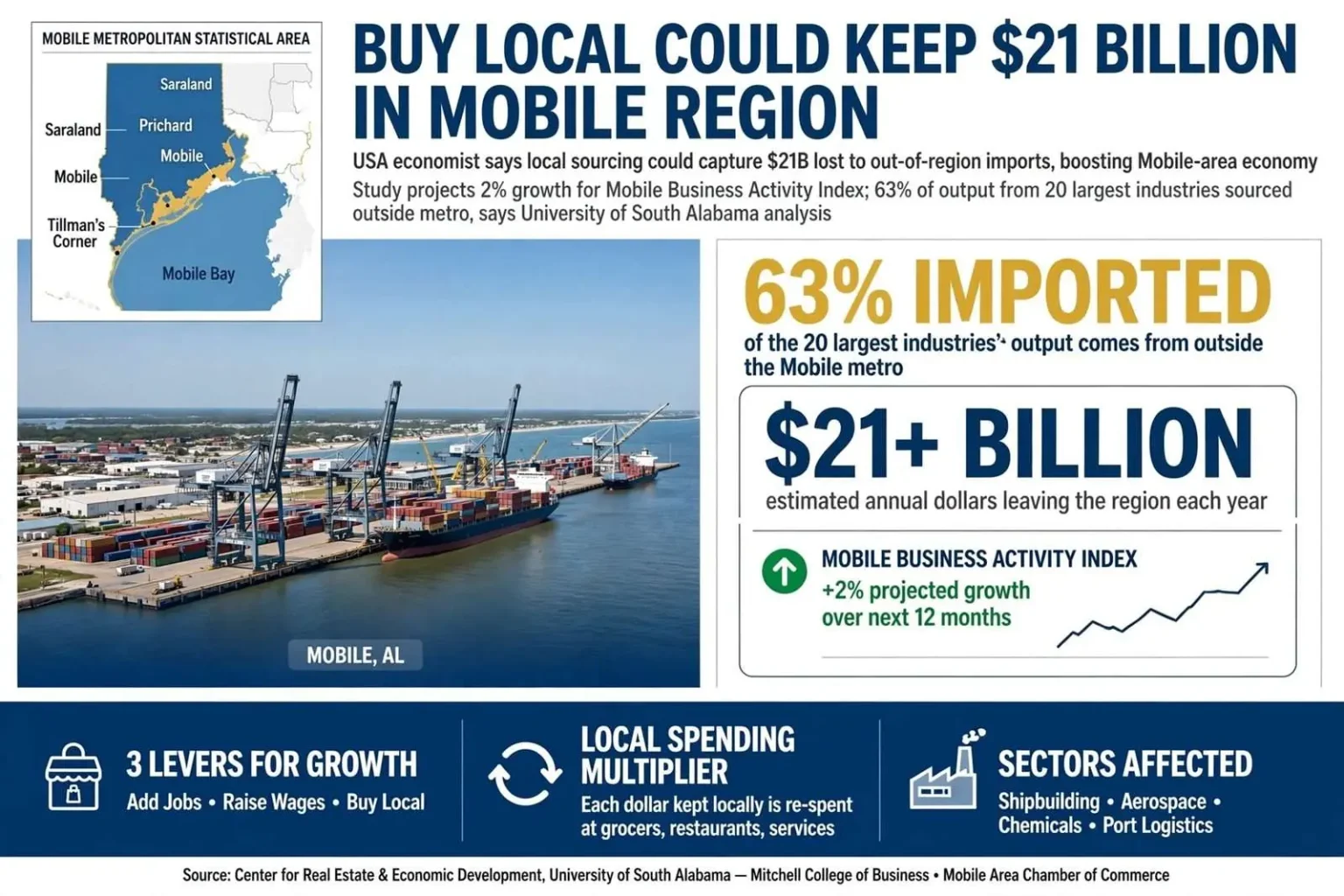
Buying local could be worth more than $21 billion a year to the Mobile-area economy, according to a University of South Alabama economist who recently laid out the region’s “importing” problem to the Mobile Area Chamber of Commerce.
Dr. Donald Epley, director of USA’s Center for Real Estate and Economic Development, presented data-driven projections built from the Mobile Business Activity Index, local employment and payroll figures, and consumer spending on home purchases. His analysis showed the index was projected to rise about 2 percent over the following 12 months, pointing to a more productive year than 2014.
But the most striking figure concerned how much of what the region produces depends on supplies brought in from elsewhere. Epley said roughly 63 percent of the output of the area’s 20 largest industries came from imports sourced outside the Mobile Metropolitan Statistical Area, the equivalent of more than $21 billion leaving the region each year.
In a follow-up conversation, Epley said the key to closing that gap is getting the region’s largest job-generating industries to understand the scale of the leakage. Because buying local depends only on local decisions, he argued, the area does not need to wait on help from Washington or Montgomery to stimulate its economy.
A region that ships its spending away
The Mobile Metropolitan Statistical Area encompasses Mobile County, home to the port city at the head of Mobile Bay and a string of suburban communities that ring it, from Saraland and Prichard in the north to Tillman’s Corner to the south. The region’s economy has long been anchored by heavy industry along the Mobile River and the Causeway — shipbuilding and repair, aerospace work at Brookley’s aeroplex, chemical and paper production, and the Port of Mobile, one of the busiest deepwater ports on the Gulf of Mexico. Those employers draw workers from across the county and beyond, and their supply chains stretch far past the state line.
That reach is precisely what Epley’s import figure measures. When a manufacturer buys steel, packaging, parts or services from vendors outside the region, the wages paid to local workers flow back out to communities elsewhere. The same is true, in smaller amounts, every time a household spends its paycheck at a retailer whose goods and corporate headquarters sit outside the metro area. A 63 percent import share among the 20 largest industries means nearly two-thirds of the value those industries produce is matched by money moving out rather than circulating among Mobile-area businesses.
Epley’s Center for Real Estate and Economic Development, based at the University of South Alabama’s Mitchell College of Business, tracks the local economy through tools like the Mobile Business Activity Index, a composite measure designed to signal whether commercial conditions are improving or deteriorating. A projected rise of about 2 percent over the following 12 months is modest growth — enough to suggest the region would outperform 2014, but not the kind of surge that would transform the area’s fortunes on its own.
Three levers for local growth
Epley outlined three levers for increasing economic activity: add jobs, raise wages, or do both. When existing firms see profits improve, they gain the ability to hire or pay more, he said, and reducing imports asks local companies to supply more of what their neighbors already buy.
The logic is straightforward. Every dollar of payroll that stays in the region is spent again at local grocers, hardware stores, restaurants and service providers, and each of those businesses in turn buys from suppliers and pays employees of its own. Economists call this the multiplier effect, and it is why a dollar retained locally can generate more than a dollar of total economic activity. Imports interrupt that chain at the first step.
Epley proposed that the Chamber convene the 20 major industries to review their own purchasing and identify what could be sourced closer to home. The exercise, in effect, would turn each company’s vendor list into a map of opportunities — categories where a Mobile-area firm already exists and could win the business, and categories where a gap in local supply might itself represent a business opportunity for an entrepreneur willing to fill it.
He also noted that many of those purchases are subject to local sales tax, a major source of government revenue, meaning a shift toward local sourcing could ripple through public budgets as well as private balance sheets. Mobile County and its municipalities fund roads, police, fire protection and schools substantially through sales tax collections, so purchases that shift from out-of-state vendors to local ones generate revenue for city halls and the county commission that would otherwise never materialize.
Why the timing matters
The presentation came as the Mobile area worked to build on a period of major industrial investment. Airbus had established its first U.S. assembly line at the Brookley Aeroplex, creating a cluster of aerospace suppliers around the airport, and the port continued to invest in container capacity on the Mobile River. Economists in the region have repeatedly emphasized that the challenge for such anchor projects is capturing more of the supply chain locally — a theme that runs directly through Epley’s import analysis.
Epley’s argument that the area does not need to wait on Washington or Montgomery carries particular weight in Alabama, where economic development incentives have historically been negotiated at the state level in pursuit of large manufacturing announcements. Those deals matter, but they are episodic. Import substitution, by contrast, is a continuous process that local firms and institutions control themselves, business by business and purchase by purchase.
The Chamber’s role, as Epley framed it, would be convening power: bringing the 20 largest industries into the same room to examine their own purchasing in a structured way. Individual companies rarely audit their vendor lists with local sourcing in mind, and the cumulative effect of many such audits has the potential to move the region’s import share meaningfully.
What residents can do
While the largest gains would come from industrial purchasing, Epley’s message extended to households as well. Consumer spending on home purchases figured in his projections, and the same arithmetic applies at the kitchen-table level: a dollar spent at a locally owned business is more likely to be re-spent locally than a dollar spent at a national chain or an online retailer whose distribution center sits in another state.
Mobile’s locally owned retail and restaurant sectors — from the businesses of downtown and Midtown to the commercial corridors along Government Street, Dauphin Street and Airport Boulevard — depend on that recirculation. Community groups and business organizations in the area have periodically promoted buy-local campaigns, and Epley’s figures give such efforts a concrete dollar value: the difference between $21 billion staying in the region and leaving it.
None of this happens automatically. Epley’s point was that the information has to reach the people making purchasing decisions — procurement managers at the big industries, and everyday consumers deciding where to shop. His presentation to the Chamber was a first step in making the scale of the leakage visible.
The follow-up conversation in which Epley elaborated on the numbers underscored how unusual the buy-local framing is among economists, who more often focus on attracting new employers rather than deepening ties among existing ones. His argument flips the usual economic development pitch: instead of courting a single large employer with incentives, a region can generate comparable gains by systematically redirecting existing spending toward businesses already operating within its borders. That approach requires no tax abatements, no land deals and no competition with other cities — only coordination and information.
For the region’s smaller suppliers, the potential is significant. Machine shops, trucking companies, print shops, catering firms, janitorial services and professional offices around Mobile depend heavily on contracts with the area’s large employers. A deliberate effort by those employers to review purchasing with local sourcing in mind could translate directly into new contracts for such firms, and the jobs that follow tend to be spread across the community rather than concentrated in a single plant.
The bottom line
The economist’s projections suggest a region with steady but unspectacular growth ahead — a business activity index rising about 2 percent, outpacing 2014 — and an enormous pool of untapped local demand in the form of $21 billion in annual imports. Closing even a fraction of that gap, through the three levers he identified, would compound through local payrolls, sales tax collections and the multiplier effect.
Whether the region acts on the recommendation is now a question for the Chamber and the 20 industries it would convene. The data, Epley argued, show the opportunity is entirely local — and so is the decision. If even a modest share of the $21 billion in annual imports shifts to Mobile-area vendors, the region’s economy would grow without a single new employer being recruited from outside.