Spoon’s Rob Pope on ‘Hot Thoughts’ and the band’s closest-ever Mobile show
Indie-rock veterans Spoon brought the Hot Thoughts tour to Mobile's Soul Kitchen in April 2017. Bassist Rob Pope talks new music and intimate venues.
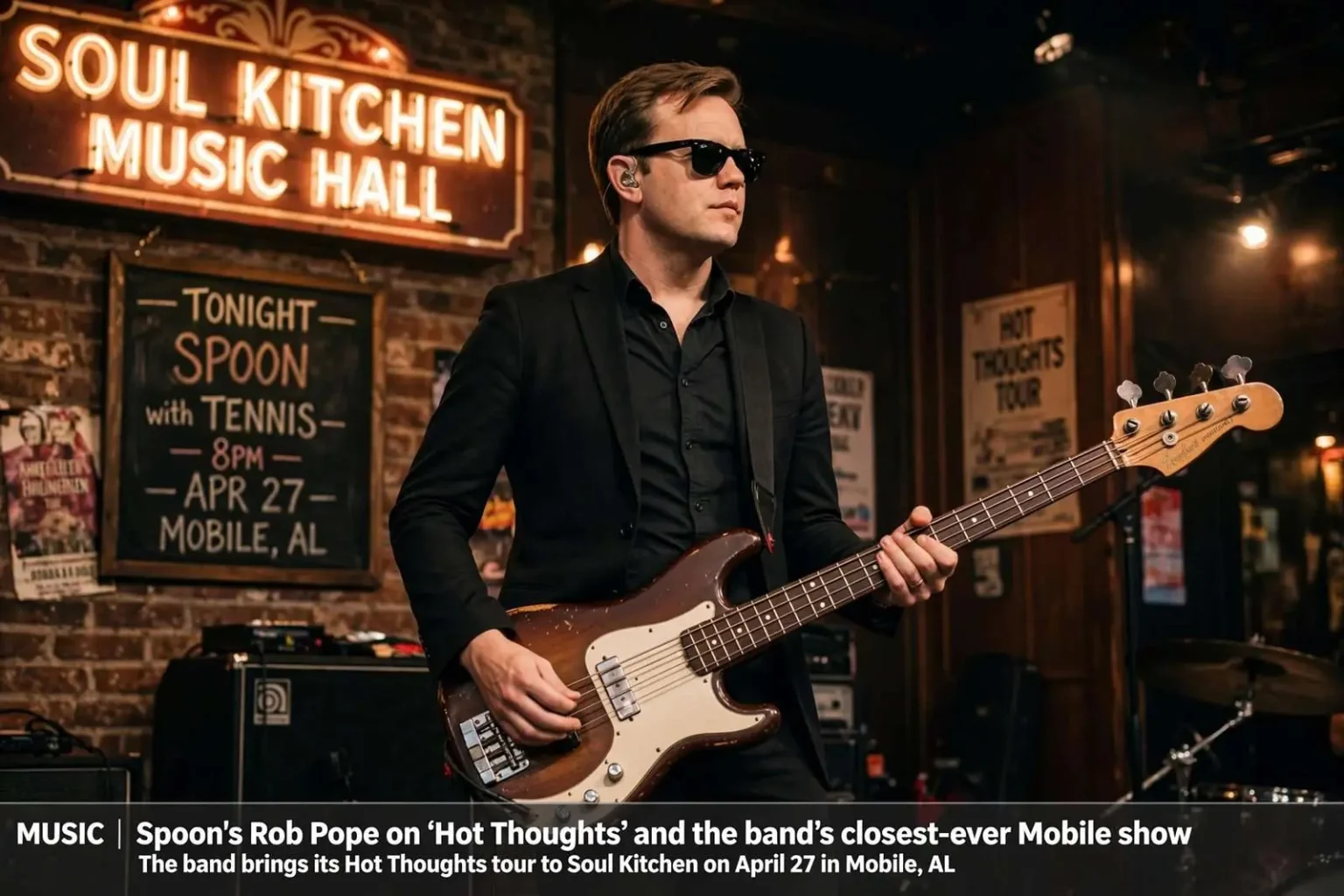
Legendary indie-rock band Spoon, from Austin, Texas, has spent more than two decades bubbling just under the mainstream while constantly reinventing its sound. The group brought its Hot Thoughts tour to Mobile’s Soul Kitchen Music Hall on April 27, with support from Tennis and an 8 p.m. start — and for local fans, the date was the closest the band has come to their city in years.
The show was possibly Spoon’s closest approach to Mobile outside its New Orleans dates, part of a Southeastern run that also hit Oxford, Miss., Baton Rouge, Athens, and Knoxville, plus Sloss Music & Arts Festival in Birmingham, Ala. For a band of Spoon’s stature, appearing in a room the size of Soul Kitchen was a rare treat, and Mobile listeners took notice.
Before the show, the band spoke about the new record, the tour, and why small rooms still matter to a group that has filled much larger ones. The conversation ranged across the band’s philosophy of record-making, the differences between amphitheaters and clubs, and what Mobile audiences could expect from a setlist drawn from one of the deepest catalogs in modern indie rock.
The Band and the New Record
Spoon has built its reputation on evolution rather than repetition. Across more than two decades, the band has moved through rock, soul-inflected grooves, electronic textures and stripped-back songcraft while keeping a signature sound — crisp rhythms, spare arrangements, and frontman Britt Daniel’s voice at the center of it all. Critics have routinely placed the band’s records among the best of their release years, and the group’s longevity in a volatile industry speaks to the durability of that approach.
We spoke with bassist, keyboardist, and backing vocalist Rob Pope, who joined before the band’s album Ga Ga Ga Ga Ga. He described the run as the band’s first proper tour behind Hot Thoughts after months of promo, SXSW, and television appearances. The difference between promotional appearances and a real tour, he suggested, is the relationship with the room — night after night in front of audiences who came specifically to hear the band play.
Hot Thoughts marked another left turn for the band, leaning into danceable rhythms and synthetic textures while keeping the taut musicianship that has always defined Spoon’s live shows. A first proper tour behind the album meant the new material would finally be tested in front of crowds, night after night, in rooms of every size.
“We didn’t really talk about a big global goal other than the band always sets out to make consistently good records… and also to make sure we are not repeating ourselves,” Pope said. That ethos — consistency without self-imitation — has been the throughline of the band’s catalog, and it was the framing the band carried into the Hot Thoughts tour.
The Southeastern Run
The routing of the tour put Mobile in the company of classic Southeastern indie stops. Oxford, Miss., Baton Rouge, Athens, and Knoxville each have long histories as college-town music markets, and the inclusion of Sloss Music & Arts Festival in Birmingham placed the band on one of Alabama’s largest festival stages. The Mobile date sat at the other end of that spectrum — a small hall rather than a festival field.
That mix is deliberate for a band at Spoon’s level. Festival slots reach large audiences but compress a set into an hour or less, often with production constraints. Club shows allow deeper catalog cuts, longer improvisations and a direct line of sight between band and audience. The Soul Kitchen date gave Mobile something neither New Orleans nor Birmingham could: the band in an intimate room, up close.
Soul Kitchen Music Hall has made a name for itself by booking national acts into a room that feels closer to a large living room than a concert hall. For touring bands, the venue offers sound and sightlines that favor detail — the kind of room where a rhythm section’s precision, a hallmark of Spoon’s music, is fully audible.
Stage Sizes and Takeaways
Pope said the band prefers intimate rooms where “ceilings and walls contain our sound a little bit,” letting them control every element. In open-air festivals and large theaters, sound disperses and the band’s careful mix becomes harder to manage. In a club, the band can hear itself — and the audience — with the clarity that Spoon’s arrangements demand.
That preference for control is not aesthetic fussiness; it is central to how the band’s records translate live. Spoon’s songs are built on interlocking parts: a bass line, a hi-hat pattern, a guitar figure, each occupying its own space. Rooms like Soul Kitchen let every one of those parts land where it was designed to.
He looked forward to “pummel[ing] the audience” with the tough new songs and returning to the Alabama road. The Hot Thoughts material, with its insistent grooves and sharper edges, was built to be played loud and close, and the early dates of the tour gave the band a chance to sharpen the new songs against live audiences before the run carried them through the summer festival circuit.
Austin Roots, National Reach
The band’s Austin origins have shaped its profile in ways that matter on a Southern tour. Austin’s music economy — built on clubs, festivals and a culture that treats live performance as a daily practice — produced a generation of bands that learned their craft in small rooms before scaling up. Spoon’s comfort in venues like Soul Kitchen reflects that grounding, and the band’s endurance reflects the work ethic the scene demands.
Two decades of bubbling just under the mainstream is a distinctive kind of career. Spoon has never been a blockbuster act, and has never wanted to be one; instead, the band has cultivated a listener base that follows it from record to record, trusting that each will sound like Spoon while sounding like nothing the band has done before. That trust is earned in rooms exactly like the one the band played in Mobile.
What Mobile Audiences Heard
For Mobile listeners who may know Spoon from “The Underdog,” “I Turn My Camera On,” or “You Got Yr. Cherry Bomb,” the Soul Kitchen date was a rare chance to see a national act in a home-city room. Those songs — the band’s most familiar to casual listeners — anchor a catalog that runs deep into albums that critics have championed for two decades.
Shows like this one carry weight for the local scene beyond the night itself. When a band of national reputation plays a Mobile room, it signals that the city can support touring acts that might otherwise route only through New Orleans or Birmingham. Venues that land such bookings build a track record that makes the next one easier.
The bill also gave Mobile audiences a first look at Tennis, the support act, whose own following has grown steadily on the strength of its distinctive sound. Opening slots like this one have historically been where audiences discover bands years before headlining runs of their own — and where the headliner’s stamp of taste introduces listeners to music they might not otherwise seek out.
Why Small Rooms Still Matter
The Hot Thoughts tour’s club routing reflects a broader truth about bands that endure: the connection forged in a small room cannot be replicated at scale. Audiences who saw Spoon at Soul Kitchen experienced the band at the distance of a few feet rather than the length of a field — a difference that shapes how the music is heard and remembered. Every arrangement choice, from the opening number to the encore, played to the room rather than against it.
For the band, the Southeastern run was a chance to road-test Hot Thoughts in real time, in front of the devoted listeners who buy records and fill clubs. For Mobile, it was evidence that the city belongs on the routing maps of touring national acts — a stop worth playing, in a room worth playing, with a crowd worth coming back for.
The 8 p.m. start kept the evening in the classic show format: doors, openers, and a headlining set with room to stretch. By the time the band left the stage, the tour had added one more city to its record of rooms where Spoon’s sound contained itself just right — and Mobile had added another chapter to its growing list of national acts passing through.
For a band whose records reward close listening, the setting made all the difference. Every hi-hat, every bass line, every vocal harmony arrived with the detail the studio versions promise — the kind of fidelity that only a room with walls and a ceiling can deliver, and the reason fans across the Southeast marked the Mobile date as one not to miss.