Scientists and Advocates Gather in Gulf Shores to Talk Sea Turtles, Manatees and a Whale With Nowhere Else to Go
Conservation advocates and marine scientists met in Gulf Shores to discuss Alabama’s sea turtles, manatees and the Gulf’s resident Rice’s whales, and the threats each faces in coastal waters.
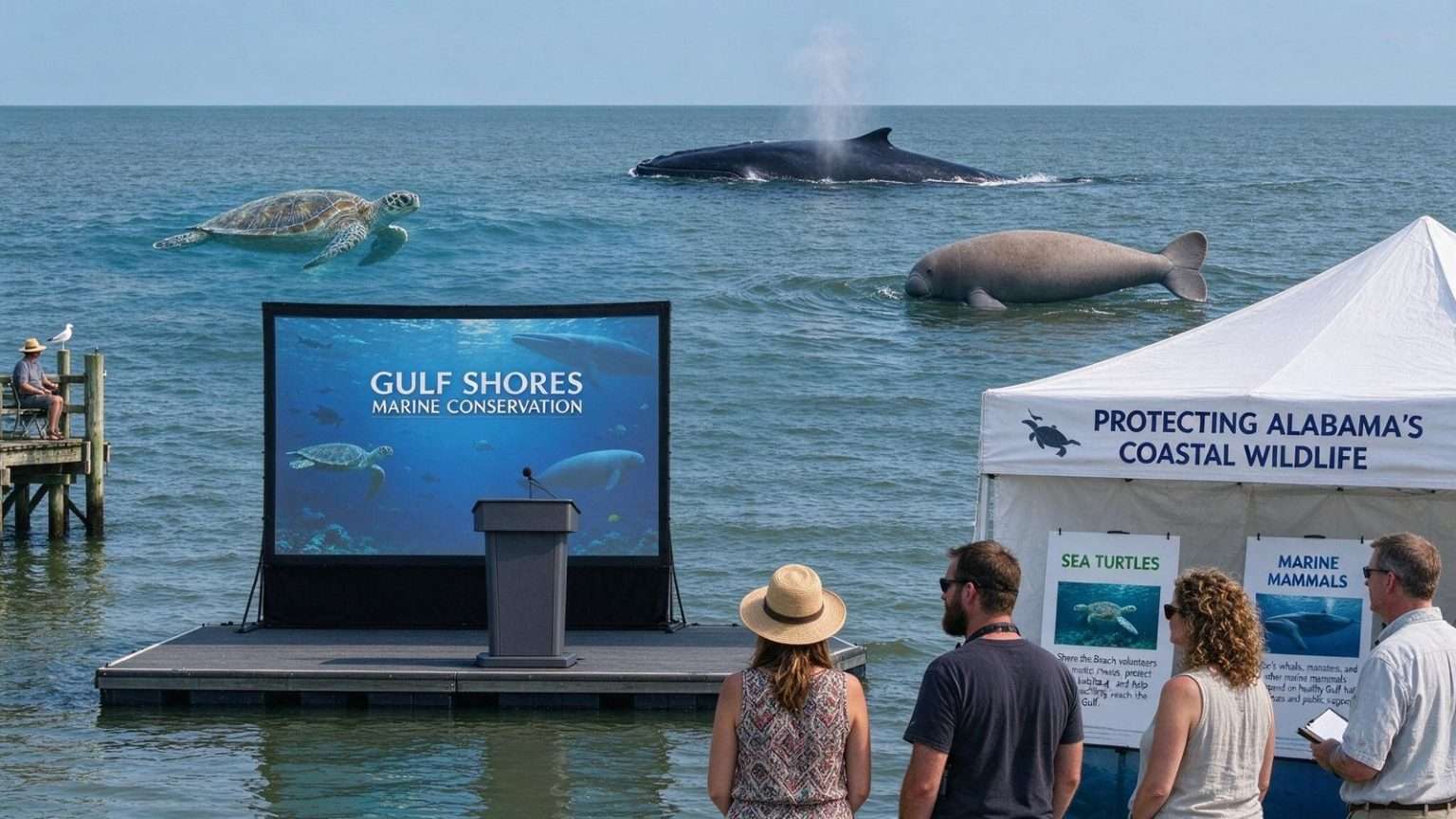
GULF SHORES — Conservation advocates and marine scientists gathered here last Thursday to take stock of the animals living in Alabama’s coastal waters — and of the pressures closing in on several of them.
Hosted by the Alabama Coastal Foundation and Healthy Gulf, the event combined presentations, short films and educational displays focused on sea turtles, whales, manatees and other marine species. Speakers discussed ongoing conservation efforts, recent research and specific things residents can do.
The recurring theme across all three presentations was less about crisis than about attention: that Alabamians frequently do not know what lives off their own coast, and that protection tends to follow recognition.
“This Is a Really Incredibly Important Time”
Christian Wagley, Florida and Alabama coastal organizer for Healthy Gulf, opened by pressing exactly that point.
“This is a really incredibly important time for our whole wildlife,” Wagley said.
He described the Gulf’s offshore waters as a biologically rich environment supporting a wide range of marine life — a characterization that surprises people who picture the northern Gulf primarily as a fishing and oil-production zone. The shelf break, the deep canyons and the influence of the Mississippi River system produce a set of habitats that support everything from plankton blooms to deep-diving whales.
Among the species Wagley discussed was one that exists nowhere else on Earth: the Gulf’s resident population of Rice’s whales.
The Rarest Whale in the Gulf
Rice’s whale is a baleen whale that was formally described as its own species only in 2021, after genetic and skull analysis distinguished it from the Bryde’s whales it had long been grouped with. It is found in the Gulf and, as far as scientists know, only in the Gulf. Federal scientists have estimated the population at fewer than 100 animals, which places it among the most endangered whales in the world.
Wagley said the whales face threats from ship traffic, underwater noise, oil and gas activity, and the potential for a major oil spill.
Each of those threats has a specific mechanism. Vessel strikes are a leading cause of death for large whales generally; a ship that never sees the animal can kill it outright or leave injuries that prove fatal later. Underwater noise — from vessel traffic, from seismic surveying, from industrial activity — interferes with the acoustic channel that baleen whales depend on to communicate across distance and to navigate, and chronic noise can displace animals from habitat that is otherwise suitable.
The oil spill risk is a particular concern for a population this small and this geographically concentrated. When an entire species occupies one body of water, a single catastrophic event can affect a substantial share of every individual alive.
Wagley also emphasized the role of conservation laws and public involvement in protecting endangered species. In U.S. waters, two statutes do most of that work: the Endangered Species Act, which prohibits the taking of listed species and requires federal agencies to consult before authorizing actions that could jeopardize them, and the Marine Mammal Protection Act, which protects all marine mammals regardless of listing status.
“Your voice absolutely matters,” Wagley said, encouraging attendees to contact elected officials, sign up for conservation updates and take part in local advocacy.
Sea Turtle Nesting Season Continues
Mark Berte, executive director of the Alabama Coastal Foundation, described the organization’s work and its partnership with Share the Beach, Alabama’s sea turtle conservation program.
Berte said the foundation focuses on protecting Alabama’s coastal environment through cooperation, education and public participation.
“The more we do that, the more people will want to protect it,” Berte said.
He gave an update on the nesting season. At the time of the presentation, 95 nests had been recorded, matching the previous year’s total, and more than 1,200 hatchlings had reached the Gulf, with the season still under way.
Share the Beach has 546 volunteers participating this year. Volunteers walk the beaches, document nests and help protect nesting turtles and hatchlings — work that begins before dawn, because that is when a fresh crawl in the sand is still visible and before beachgoers arrive.
Alabama’s roughly 60 miles of Gulf-front beach represent a small share of sea turtle nesting in the southeastern United States, which is precisely why each nest counts for so much here. All sea turtle species found in U.S. waters are protected under the Endangered Species Act. Nesting on Alabama beaches is dominated by loggerheads, with occasional nests from other species.
Why Holes and Lights Matter
Berte reminded beachgoers that simple actions help: fill in holes before leaving the beach, and remove items from the sand at night.
Neither request is cosmetic. A hole dug for fun during the day is a trap after dark. An adult female hauling herself up the beach to nest can fall in and become stuck, and a hatchling that drops into one has essentially no chance of climbing back out before the sun or a predator finds it. Chairs, tents, coolers and umbrellas left overnight form a physical obstacle course between the dune and the water for animals moving on flippers.
Artificial light is the other well-documented hazard. Hatchlings orient toward the brightest horizon, which on an undeveloped beach is the sky reflecting off the water. Lighting from buildings, parking lots and walkways can reverse that cue and draw hatchlings inland, toward roads and away from the Gulf. Coastal communities along the Alabama and Florida panhandle coasts have adopted lighting standards for that reason, and beachfront residents are encouraged to shield fixtures and use long-wavelength amber lighting during nesting season.
Education is another major part of the foundation’s effort. The Alabama Coastal Foundation provides programming for fifth-grade students across the state, covering sea turtles and other coastal species and habitats.
Manatees Are Showing Up More Often — and Staying Longer
Ruth Carmichael, senior marine scientist and professor at the Dauphin Island Sea Lab, addressed a change that Alabama boaters have noticed on their own: manatees.
Carmichael described the Sea Lab’s marine mammal research and stranding-response programs, which include documenting animals, responding to animals in distress, conducting health assessments and studying how marine mammals use Gulf Coast waters. Researchers have also built long-term datasets that can track changes in animal populations and their environment.
“Things are changing,” Carmichael said.
Manatee sightings have increased across several Gulf and Atlantic states, including Alabama. Researchers are also seeing manatees in Alabama during colder months, when the animals historically would have been expected to have moved farther south.
Carmichael said researchers are working to understand what is driving the increase. The change may not simply reflect a shift in the species’ range. A growing manatee population combined with limited habitat could also push more animals into areas outside their traditional concentrations.
That distinction is not academic. If animals are expanding into new territory because the population has recovered and existing habitat is crowded, the management response differs from a scenario in which animals are following changing water temperatures. Telling those apart requires the kind of sustained observation that produces a long record rather than a snapshot.
“These long-term data sets are really critical for that,” Carmichael said.
Cold Stress and Boat Strikes
Carmichael identified cold stress as a major cause of manatee mortality, with vessel strikes another significant threat. She described a recent incident near Gulf Shores in which a manatee was struck by a vessel and died.
Manatees are unusually vulnerable to cold for a large marine mammal. They lack the thick blubber layer that insulates whales and seals, and their metabolic rate is low. Prolonged exposure to cool water produces cold stress syndrome, a debilitating condition that can kill an animal over days or weeks. That physiology is the reason manatees have historically concentrated in warm-water refuges during winter — and the reason animals lingering north of their usual winter range is something researchers watch closely.
Vessel strikes are the more familiar threat. Manatees are slow, they feed in shallow water and they surface to breathe, which puts them in the same few feet of water column that boat hulls and propellers occupy. Injuries range from propeller lacerations to blunt-force trauma from the hull itself.
Despite those threats, Carmichael said researchers have documented manatees spending more time in Alabama waters, including animals that appear to be feeding, reproducing and using the area as habitat — not merely passing through. She also noted that the broader manatee population has grown substantially over the past several decades, suggesting that conservation efforts have contributed to the species’ recovery.
What Residents Can Actually Do
While the event ranged across species, speakers returned repeatedly to public involvement.
For sea turtles, that means volunteering with beach-monitoring programs, filling in holes, managing lights and reducing disturbance on nesting beaches. For marine mammals, it means reporting sightings, supporting research and learning about the threats facing animals in local waters. Sightings reports have genuine scientific value: a documented observation with a date, a location and a photograph is a data point that no research budget can otherwise buy, and stranding networks depend on the public to know an animal is in trouble at all.
Wagley also encouraged people to contact elected officials and speak out when protections for endangered species are at risk.
Taken together, the presentations pointed at both the pressures on Alabama’s marine wildlife and the progress that research, conservation programs and public participation have produced. The evening’s closing argument was the one it opened with: protecting Alabama’s marine life starts with knowing what is here.